BIZCHINA> Editor Choice

|
BIZCHINA> Editor Choice
|
|
Related
Changing times
By Liu Weiling (China Daily)
Updated: 2008-07-14 16:27
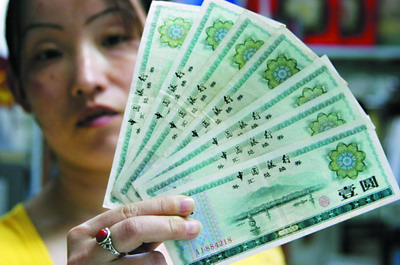
In the morning of December 30, 1993, dozens of foreign ambassadors, their wives and anxious foreign businesspeople stormed into a duty-free store in the east of Beijing, packing their bags with anything they found on the shelves. But the unusual shopping spree was not ignited by the New Year Eve rush, but instead by an unexpected overnight announcement from the central bank saying it would stop issuing foreign exchange certificates (FECs), a convertible version of renminbi used by foreigners in the mainland, from the beginning of 1994. Although the People's Bank of China made it very clear that existing FECs could still be used temporarily, FEC holders believed the sooner they spent them the better. The duty-free store in Jianguomen, located close to many embassies and office buildings, sold 9 times more goods than on a usual day. "Business was even hotter than at Christmas," Dong Jixiang, manager of the store, told China Daily. "We may even have to cancel New Year's holiday tomorrow," he said at the time. International companies in Beijing were also facing chaos in their offices. Many of the Chinese employees working for foreign companies were paid in FECs, which were supposedly equal in the value of yuan but were actually worth 30 percent more than renminbi yuan on black market. They were keen to find out whether their bosses would compensate them if they were to be paid in renminbi in the future. "We are getting burned," a clerk at the Beijing Office of Hong Kong Trade Development Council told the China Daily. Privilege money China started to issue FECs on April 1, 1980. Before they were finally withdrawn from the market on January 1, 1995, China had a 15-year history of a dual-track currency system under which two kinds of currencies - renminbi yuan and FECs - were in circulation in the market simultaneously. FECs were originally designed to serve visitors from overseas who came to China after the country moved out of isolation in 1978. The country very quickly embraced a growing number of foreign visitors, as well as Chinese returning from Hong Kong, Macao and Taiwan. At a time when the market supply was tight, Chinese people had only a fixed supply of daily necessities such as grain, pork, cloth and bicycles. The government built up hotels, restaurants and stores to serve people from overseas. As foreigners were not allowed to hold and use renminbi then, the State Council authorized the Bank of China, which had the strongest foreign currency business among China's four State banks at the time, to issue FECs in 1980 to enable overseas visitors to purchase goods in China. When foreigners and Chinese from Hong Kong, Macao and Taiwan arrived, they were told to go to Bank of China outlets or other designated places to change their foreign currencies into FECs. When they left the Chinese mainland, they could choose to covert FECs back into hard currencies or just hold on to them for use in their next trip. Many foreigners just called the FECs "tourist money". The FECs had seven denominations - 100 yuan, 50 yuan, 10 yuan, 5 yuan, 1 yuan, 5 jiao and 1 jiao, all with pictures of China's scenic spots like the Great Wall, Three Gorges, and the Temple of Heaven at the back. FECs were privileged money. As Kenneth Starck, a journalism professor from the University of Iowa in the US who came to China in 1986, described in his book, The Dragon's Pupils: "If money talks, FEC speaks louder than renminbi by 50 per cent or more." With FEC, a person can buy goods imported to China, purchase at special shops and change it back to US dollars - these were all things that could not be done with renminbi at the time. FECs could only be used in certain approved designated outlets - such as hotels, Friendship Stores, and duty-free shops, where people could find luxury imported goods - ranging from Remy Martin Xos to Marlboro cigarettes and from color TV sets to Swiss watches - items which were popular with foreigners. Popular Chinese artifacts and silks were also available in the Friendship Stores. (For more biz stories, please visit Industries)
|
主站蜘蛛池模板: 东宁县| 昭通市| 武强县| 屏南县| 襄垣县| 清涧县| 阜城县| 临沂市| 南雄市| 常宁市| 乌拉特后旗| 东明县| 班玛县| 平谷区| 开阳县| 元朗区| 灵台县| 青海省| 伊金霍洛旗| 方城县| 宜兰市| 铁力市| 敖汉旗| 白银市| 南靖县| 罗源县| 新郑市| 淮滨县| 体育| 泊头市| 泸水县| 微博| 清水河县| 原阳县| 南城县| 无极县| 同仁县| 林芝县| 石屏县| 塔河县| 革吉县| 岫岩| 双辽市| 偃师市| 建昌县| 腾冲县| 山西省| 大港区| 思南县| 太康县| 宁阳县| 芦山县| 台北县| 镇康县| 鹤庆县| 庆云县| 嘉义县| 望江县| 二连浩特市| 无棣县| 井研县| 阜南县| 永寿县| 沙雅县| 巫溪县| 石河子市| 辛集市| 扶余县| 太白县| 海晏县| 青川县| 三穗县| 蒙城县| 宝坻区| 凌云县| 河西区| 武宁县| 虞城县| 淮阳县| 罗田县| 长海县| 芒康县|