BIZCHINA> Editor Choice

|
BIZCHINA> Editor Choice
|
|
Related
Smart mart
By Liu Jie (China Daily)
Updated: 2008-07-21 10:38
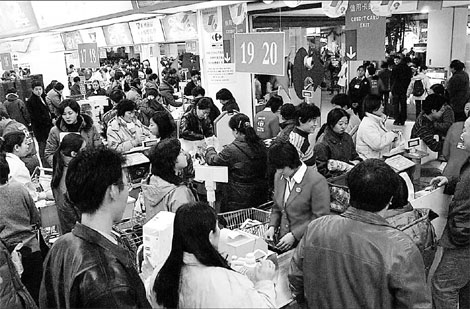 Chinese consumers commonly regard France-based Carrefour's launch of its first China hypermarket in Beijing in 1995 as the debut of foreign retail chain enterprises in the nation. When the store opened, it was the first time many Chinese consumers could select goods from shelves by themselves, see snacks being cooked, and, most important, buy fresh, high-quality goods in a clean, comfortable environment at prices even lower than open markets. The chain supermarket concept was common for people in developed countries, but was still a novelty for Chinese in the mid-1990s. The world's largest consuming group could not imagine that over the following decades China would become a most white-hot competition arena for domestic and foreign chain retailers.
Market liberalization "It (Carrefour) was so amazing - a spacious and bright store, light music, numerous commodities, colorful tags and magical cash machines," recalls Beijinger Liu Bingyan, 50, adding that the crowds of shoppers at Carrefour during weekends often caused traffic jams around the store at the time. However, the first batch of Carrefour stores in Beijing, Shanghai, and Wuhan did not abide by Chinese law; they were not registered with the Ministry of Commerce and simply received nods from the local governments. Furthermore they were all wholly owned by Carrefour. China issued a provision in July 1992 that one to two trial joint venture retailing enterprises would be allowed in six key cities, including Beijing, and five special economic regions. It stated that all the joint ventures must get approvals from the central government and the stake share cap of foreigners was 49 percent. But the bold French retailer could not wait, eyeing the untapped market which was still dominated by State-owned retailers that had grown up under a planned economy. In this case, the early bird truly caught the worm. Carrefour - the world's second largest retailing group - is also the most successful foreign retailer in China by number of outlets and sales. Now, it has 114 hypermarkets across China with 30 billion yuan in annual revenues. Since 1996, a group of foreign operators, including world's No 1 retailer Wal-Mart, Japan's Ito Yokado, Tesco of the UK and Thailand's Chia Tai also set up shops in China via joint ventures. The joint venture model has provided shortcuts for both sides in terms of operation experiences, management mechanisms, purchase and sales networks, as well as local and global marketing know-how. "The foreigners' booming entry was accompanied by China's step-by-step liberalization of its retail sector," says Huang Guoxiong, a professor of economics with Renmin University of China. In June of 1999, the State Council issued Regulations on Trial Foreign-funded Commercial Enterprises, which stipulated that foreign commercial funds were allowed to flow into municipalities, provincial capitals and cities with independent budgetary status, with maximum stock share set at 65 percent. China officially joined the WTO on December 11, 2001 and promised to gradually open its retailing sector over the next three years. By the end of 2002, there were more than 300 Sino-foreign retailing joint ventures on the Chinese mainland. The country lifted the restrictions on shareholding, locations and store numbers for all foreign-funded companies in the commercial sector on December 11, 2004 in line with its commitments to the WTO, which sets domestic and foreign retailers at the equal competition platform. (For more biz stories, please visit Industries)
|
主站蜘蛛池模板: 东城区| 清徐县| 黄陵县| 邛崃市| 嘉鱼县| 岱山县| 苍山县| 钟山县| 环江| 河曲县| 峨眉山市| 金阳县| 南皮县| 南漳县| 安塞县| 重庆市| 札达县| 息烽县| 吉安县| 多伦县| 梨树县| 白朗县| 普宁市| 南漳县| 绥芬河市| 通道| 达拉特旗| 民县| 名山县| 迭部县| 抚顺县| 望城县| 许昌市| 铜陵市| 胶州市| 寿宁县| 松原市| 从化市| 佛山市| 沧源| 阿克苏市| 景泰县| 齐齐哈尔市| 原平市| 普宁市| 揭西县| 垫江县| 甘谷县| 海原县| 革吉县| 威宁| 马关县| 永顺县| 泸溪县| 扎兰屯市| 阳原县| 武宁县| 荥经县| 徐州市| 泽库县| 甘肃省| 象山县| 商城县| 江陵县| 那坡县| 湖州市| 宿松县| 怀柔区| 仁怀市| 临沂市| 宁德市| 凌海市| 汤原县| 五指山市| 沭阳县| 台南县| 博客| 阿坝| 伊宁市| 三穗县| 房山区| 互助|