BIZCHINA> Newsmakers

|
BIZCHINA> Newsmakers
|
|
Related
China growth offers optimism amid downturn
(China Daily)
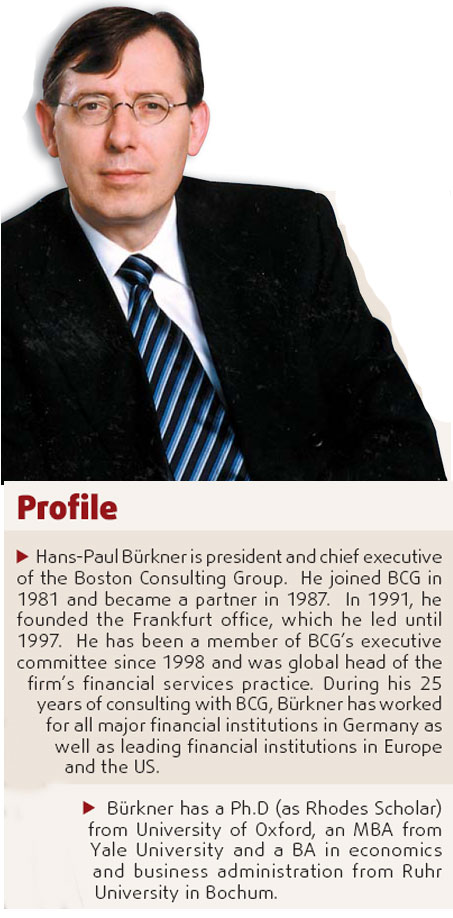
Updated: 2008-08-05 10:00 The consumer price index in China has been high since the beginning of the year, despite a moderate drop to 7.1 percent registered in June. Hans-Paul Brkner, Global CEO of The Boston Consulting Group (BCG), one of the world's leading consultancy firms, talked to China Daily reporter Ma Zhenhuan in an exclusive interview where he shared his views on high inflation and corporate management in Chinese enterprises, during his most recent visit to Shanghai. Q: The US sub-prime crisis has come as a huge blow to the global economy, how do CEOs view the current global economic situation? What's on the minds of global CEOs these days? A: I think for many companies they are still very optimistic about the future and the future growth opportunities. There are some industries, of course, that are very badly affected. Obviously quite a number of banks have to really clean their balance sheets, and in the real estate sector, especially in America, there will be significantly lower prices with lower business volume, so CEOs really have to reduce capacity to adjust. And then there're some special situations for the airliners who are suffering from higher fuel costs. When we talk about recession, the sub-prime mortgage crisis doesn't have to lead to a very big crisis in the global economy. I think it's really important that the banks clean up their balance sheets, and recapitalize when there is not enough capital, both from private and sovereign funds. Yes, some people will suffer from certain industries, but overall, the world economy will continue to grow. Q: China's CPI has been going up since the beginning of this year, leading to a widespread fear of high-inflation. What, in your view, should management do during a time of high inflation?
A: Management has to pay higher prices for natural resources. They need to make sure they can find ways of digesting the higher prices for resources, and make sure their own costs are not going up dramatically. This is the biggest job because if they have no way of cutting their own costs, they will either have to hand over the higher costs to their clients, or the profit margins will be squeezed. So as management executives, they need to look for opportunities for cutting costs. Q: Talking about business management, in "Create People Advantage", a report on human resources management compiled by BCG, it mentioned that talent and leadership are becoming even scarcer resources than even before. What do you think Chinese executives should do to develop and maintain their best employees? A: First of all, every company has to understand that every business is people's business. You are successful because you are able to attract, develop and promote good people. I think the key issue for the top management of every company in China and everywhere else, is to recognize that their key responsibility is on the people's side. Top management has to be involved with recruiting top people, developing and retaining them. Besides, more efforts should be given to not only training, but also to provide opportunity so that people feel this is the place where they can learn and make progress, providing them with challenges. I remember that when I was working in a bank prior to consulting, I had a lot of ideas of what we could do to improve. But the head of my department then told me he would only take my idea seriously if I have ten years' experience. If you provide that kind of "encouragement" to people, why should they stay? So I think if you want to develop leadership capabilities, you have to give them leadership opportunities earlier on, besides coaching and training. Maybe even give them responsibilities that are a bit ahead of them, maybe it's larger than what they can digest, but they will grow with the opportunities that you give them. This is the key task for all top management, rather than the human resources department. It is important for people to realize this is the place they can be rewarded, not just financially, but also rewarded by having ample opportunities for personal development and personal goals. Q: Shanghai is the economic center of the Yangtze River Delta as well as the economic center for the whole of China. Shanghai and neighboring areas have a huge presence of private companies and SMEs. What can BCG do to help improve the management of these private firms and SMEs? A: About half of our Chinese clients are private entrepreneurs. Private entrepreneurs or top executives are strong-willed, either well-educated or with great ideas and entrepreneurship. But the best entrepreneurs also understand they have limitations, and the further they go out, the more it is important to understand the challenges. That's why consultants like us play important roles and help them address these challenges. As consultants have the knowledge, experiences in other parts of the world, in new businesses, or in different functions, which the entrepreneurs are not so experienced in. For example, if you have a specific business model that has worked very well, and now you are expanding but your business model can not help you over the next five years, to develop with growth. Then implementation of a new business model, to approach new client segments, going to different distribution channels, coming up with new ideas, is vital. Q: What has the BCG China achieved in 2007? A: In 2007 we grew by 28 percent worldwide, while in China, the growth was 40 percent. China of course means a lot to our growth worldwide.
(For more biz stories, please visit Industries)
|
主站蜘蛛池模板: 中超| 呼图壁县| 凤台县| 海南省| 安义县| 扎囊县| 桦川县| 仙居县| 梅河口市| 喀喇沁旗| 东乡| 资溪县| 页游| 紫金县| 永嘉县| 乐平市| 虞城县| 宜章县| 普陀区| 定日县| 武穴市| 五莲县| 新绛县| 花莲市| 河南省| 屯留县| 白山市| 揭东县| 红安县| 通化市| 黔东| 阳泉市| 漳州市| 惠州市| 汉源县| 毕节市| 宜宾县| 台中县| 镇雄县| 安西县| 崇文区| 岗巴县| 宝清县| 湖南省| 米易县| 梁平县| 嵩明县| 泽州县| 洪泽县| 冷水江市| 河东区| 城固县| 杭锦后旗| 正定县| 白河县| 仲巴县| 肇庆市| 萍乡市| 体育| 临清市| 新竹县| 尉氏县| 云安县| 桃园县| 北京市| 广昌县| 马龙县| 重庆市| 姜堰市| 报价| 金阳县| 扬中市| 安溪县| 台江县| 东安县| 瓦房店市| 灌南县| 达州市| 红桥区| 高唐县| 政和县| 乐业县|
