BIZCHINA> Center

|
BIZCHINA> Center
|
|
Related
New restrictions placed on public sector vehicles
By Wang Qian (China Daily)
Updated: 2008-09-16 09:51
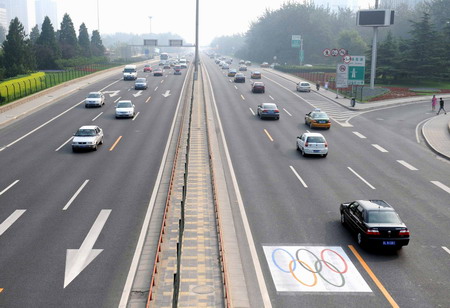 With the odd-even plate license ban to be lifted on Saturday, the Beijing municipal government is trying to set an example on curbing pollution and energy consumption by imposing a traffic restriction on State-financed vehicles, the Beijing News reported on Sunday. Vehicles operated by government agencies, social organizations financed by government budgets and State-owned enterprises will be included in the ban, according to the gazette of Beijing municipal government, which was released on Wednesday. The driving ban, divided into five groups, will apply to all government-financed cars from Monday to Friday, depending on the last digit of the license plates. Government cars with license plates ending in a 1 or a 6 will be banned from the roads on Mondays. Those with plates ending in a 2 or a 7 will be banned on Tuesdays, and so on. The rule was based on a circular from the State Council released on August 13, which requires local governments and State-owned organizations to save energy, such as driving cars less and turning down air conditioning. Shanghai and Shandong already implemented the rule on State-owned vehicles in the middle of last month. Li Jun, who has driven cars from the Chinese Academy of Arts, a government-funded institution, for 10 years, said the restriction would not affect him much.
"We'll just arrange another car to drive our chief. Or we can just buy a new car," Li said in a telephone interview. "What's important about the restriction is that the government is showing its attitude and giving a signal to citizens," he said. Song Zhi, a driver for the government-financed China Conservatory, agreed by saying that the State-owned vehicles took a small part of the total vehicles in Beijing, so the actual impact is quite limited. Zhou Zhengyu, deputy director of the Beijing municipal committee of communications, said last month there are about 300,000 government-financed vehicles among 3.29 million vehicles in Beijing by the end of June. "But the government has to do something first before asking the residents to follow," Song said. Ou Guoli, a professor of economics at Beijing Jiaotong University, who does research on traffic regulations with economic measures, agreed with Song. "This is the first step taken by the government to save energy and reduce emissions. It will benefit both the traffic and environment," Ou said. "In the future, further restrictions will be carried out in order to ease congestion and improve the air quality. Economic means should be used more such as charging the license tax and rising the parking fee," Ou said. Mao Baohua, a professor of traffic systems at Beijing Jiaotong University, said the restriction on state-owned vehicles was good, but it would bring just a little help to the environment. "The odd-even plate license ban cut air pollution and traffic jams. Can the new restriction do the same? Never," Mao said. Beijing started the odd-even rule on July 20, which kept about 40 percent of vehicles off the roads every day. Average vehicle speed rose by 10 percent to 43 kph, Zhou said.
(For more biz stories, please visit Industries)
|
主站蜘蛛池模板: 海淀区| 台东县| 涡阳县| 台中县| 昔阳县| 梓潼县| 泰宁县| 正镶白旗| 日土县| 太仆寺旗| 高安市| 泰和县| 绿春县| 若羌县| 苏尼特左旗| 仁寿县| 城固县| 龙口市| 凤阳县| 威宁| 郧西县| 合阳县| 泸水县| 北辰区| 高唐县| 娄烦县| 古交市| 罗田县| 渝中区| 响水县| 乐清市| 龙泉市| 台南市| 宜君县| 广元市| 武宁县| 阿勒泰市| 遂平县| 志丹县| 阿克| 上饶县| 兰西县| 海盐县| 高要市| 德保县| 彭山县| 类乌齐县| 黔西| 惠来县| 连平县| 文成县| 浙江省| 蒲城县| 平远县| 辽源市| 乃东县| 阜宁县| 雅安市| 香河县| 胶州市| 尖扎县| 乌拉特中旗| 玉屏| 玉屏| 毕节市| 铜川市| 平乐县| 海宁市| 宿迁市| 彩票| 三穗县| 宜丰县| 台安县| 汉寿县| 阳泉市| 沐川县| 科技| 荣成市| 祁门县| 衡山县| 清涧县| 红河县|