BIZCHINA> Regional

|
BIZCHINA> Regional
|
|
Related
Mining for tourism in Hubei
By Li Jing (China Daily)
Updated: 2008-09-22 09:15
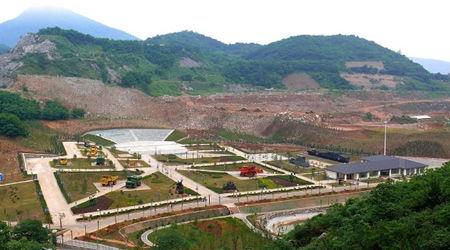
Located in Huangshi, northeast of Hubei province, the Daye iron mine has a history of more than 1,780 years. Perennial exploiting left a huge pit in the open air, covering an area of 1.8 sq km. Several years ago, the pit was almost turned into a landfill. Luckily, city planners found a way to preserve history: the area became the country's first national mining park. Age-old mining site About 65 km from Wuhan, capital city of Hubei province, Huangshi used to be one of ancient China's bronze centers, where copper mining can be traced back to the Yin Dynasty (about 1,500 BC). Historical documents show that iron ore mining started in 226 AD. In 1889, during the reign of Emperor Guangxu in the Qing Dynasty (1644-1911), Zhang Zhidong was appointed the governor-general of Hunan and Hubei. Promoting modern heavy industries, he founded the Hanyang steel plant, Daye iron mine, Pingxiang coal mine and Hubei arsenal in 1890. Since then, the Daye iron mine has been an important base for China's iron and steel industry. More than 130 million tons of iron ore and 320,000 tons of copper have been excavated from the pit, while 360 million tons of rocks were also mined. However, after years of constant mining, the geological structure and the environment at the site were severely damaged. Frequent landslides and other geological disasters have posed dangers. Thus when mining activities stopped in the eastern pit in 2000, dealing with the gaping pit became a big headache for the local government. Landfill 'crisis' In recent years, with the progress of urbanization, Wuhan's population was also increasing rapidly; as a result the household garbage continued to accumulate. Some experts proposed to turn the Huangshi mining site into a landfill, as the train sending iron ore from Daye iron mine to Wuhan could carry all the solid waste produced in the provincial capital when it headed back to the mine. The plan is considered to be killing two birds with one stone: If the pit received 2 million tons of solid waste per year, it would take 100 years to fill the mining site. In this way, Wuhan could find a solution for its mounting garbage disposal problem, and refilling the mining site will reduce the geological disasters in the area. However, the proposal aroused strong opposition from the local miners. For them, the mining site was not only the place where they had worked; the huge pit was also the result of a man-made miracle accomplished by thousands of miners over hundreds of years. The concept of industrial heritage inspired the workers from the Daye iron mine. If the old centers during the industrial revolution can be transformed into museums and parks in Western countries, then why should Daye iron mine end up as a landfill site? The opportunity opened when in 2005, the Ministry of Land and Resources (MLR) called for the application of national-level mining heritage sites all over the country. On June 16, 2005, the application of Huangshi National Mining Park passed the provincial assessment. In the following month, it became the first national mining park in Hubei province, after nominations by the MLR, the Ministry of Finance, National Tourism Bureau, and State Environmental Protection Administration. After that, Daye iron mine started the park planning and construction immediately. Financing issues However, it was not easy for the Daye iron mine to support the planning with shrinking revenues. In the past, the mine made revenue through selling iron ore. But when the east site closed, the annual production capacity was reduced significantly from 5 million tons to about 1 million tons. Financing became a major problem for the national mining park. But the MLR and provincial tourism bureau in Hubei put up the money and the country's first iron mine museum was officially launched in February 2006. In the same year, an industrial exhibition garden was also set up. After two years' construction, an iron mine park with two sightseeing areas, one at the mining pit and the other at the eco-recovery site, opened on April 22, 2007. The park attracted a lot of tourists with its unique resources. By the end of 2007, the park received a total of 80,000 tourists, bringing a revenue of several million yuan. Environmental protection In the Huangshi National Mining Park, some "retired" equipment - such as excavation machines, transportation trains - are on exhibit. Some parts of the equipment were also collected and processed into huge statues. The huge mining pit is no longer as busy and boisterous as before. Only two or three trucks are still moving at the bottom of the pit. Seen from the above, they look like tiny beetles moving slowly on the earth. "To protect the pit, mining has almost been stopped here, except on a small-scale," says Zhang Zhihe, an official from the local tourism bureau. The eco-recovery site in the park covers an area of 4 sq km. It used to be the site where rocks excavated from the pit were piled up. The rocks, with diameters ranging from 0.2 m to 1.2 m, made it almost impossible for any plants to grow. After several years of experiments, drought resistant trees turned out to be an effective way to arrest the deterioration environment at the mining site. Now, 3.66 sq km of the rock-pile site has been covered with trees and foliage. (For more biz stories, please visit Industries)
|
主站蜘蛛池模板: 开原市| 杂多县| 平昌县| 台江县| 襄垣县| 肃北| 垫江县| 随州市| 文化| 榆树市| 来安县| 德江县| 印江| 浑源县| 额尔古纳市| 澳门| 黄冈市| 永胜县| 大关县| 新田县| 肥城市| 肇庆市| 乾安县| 佛学| 常山县| 蓝田县| 巴林右旗| 大渡口区| 乃东县| 建德市| 渑池县| 襄樊市| 柳江县| 美姑县| 邮箱| 阳东县| 恩平市| 新昌县| 藁城市| 霍城县| 车险| 石城县| 清水河县| 文登市| 玛曲县| 肥西县| 三亚市| 张掖市| 盐城市| 汝城县| 普定县| 临武县| 奉新县| 兴宁市| 永顺县| 新乡市| 浦城县| 开化县| 桐城市| 利辛县| 宣武区| 从化市| 永康市| 成武县| 闽侯县| 绥宁县| 富民县| 丰镇市| 舞钢市| 华宁县| 巴马| 宁晋县| 塘沽区| 达拉特旗| 汤阴县| 克东县| 酉阳| 望谟县| 合水县| 三明市| 介休市| 德昌县|