BIZCHINA> Wen's Lens

|
BIZCHINA> Wen's Lens
|
|
Related
Stitches in time
By You Nuo (China Daily)
Updated: 2008-10-13 15:44
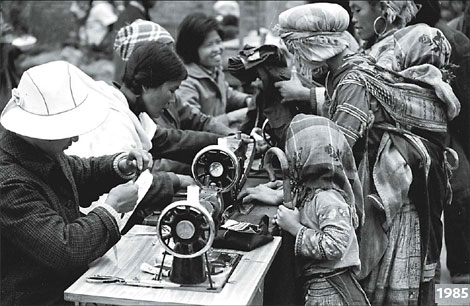 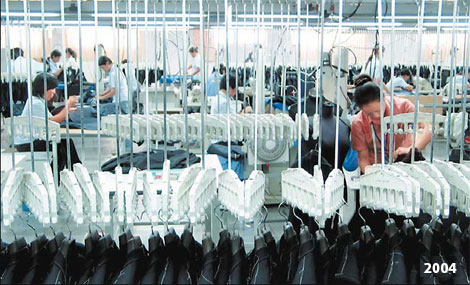 Buying new clothes was not easy in China through the 1960s and 70s. Clothes and fabrics to make them were generally unavailable, even if people had the money. In an economy bogged down by bureaucratic inefficiency many supplies were rationed, including clothes and basic. Understandably, a sewing machine was an important household asset - to help make and mend clothes. People who were fortunate to own a sewing machine (a manual one had to suffice, for China still couldn't make electrical ones) could practically make a business with it by running a community tailoring service. This was exactly the case in the black-and-white photo taken by China Daily photographer Wang Wenlan. A few women with a few sewing machines were enough to open a small marketplace. The photo was taken in 1985 in China's southwestern frontier province of Yunnan, a land on the upper reaches of the Mekong. Although the locale was far from Beijing and Shanghai, and the time was long before China grew into one of the world's leading textile and garment makers, the beginning of a change was beyond doubt. You already had some market economy and private initiatives there. Indeed, those women making or mending clothes for their customers (some of minority nationalities, as one can tell from their dress) should be regarded as pioneers of the nation's market-oriented reform. When they moved their iron sewing machines to the village fair most of China's industry was still under monolithic State ownership, and very few services were available - from large cities to small townships. Without personal efforts from millions of people, successful or otherwise, there could not have been enough driving force for China to experience the sweeping change which economists call development. By the same token, without those seamstresses and many others like them in other cities and towns, probably China would not have had as many modern garment-making factories as shown in our color photo. It was taken in a garment factory in coastal Zhejiang Province in 2004, during the golden time for China's textile merchants. When people come to talk about China's economic success, they tend to define it as a success of development. But as our photos tell, the true history is that China already began to change when development was still to come along. It's the market economy that leads all the change in China.
(For more biz stories, please visit Industries)
|
主站蜘蛛池模板: 新沂市| 拜泉县| 曲沃县| 吐鲁番市| 隆回县| 大宁县| 尼勒克县| 即墨市| 城口县| 茌平县| 泸州市| 广宁县| 清河县| 女性| 富锦市| 文登市| 湘潭市| 泰和县| 沙雅县| 松滋市| 吉隆县| 大埔区| 合作市| 会同县| 汉沽区| 新丰县| 高尔夫| 和龙市| 射阳县| 芒康县| 通化县| 龙川县| 迁西县| 友谊县| 庆云县| 丹巴县| 扎囊县| 岳阳县| 丘北县| 荣昌县| 青田县| 四子王旗| 陵水| 阿瓦提县| 郴州市| 南汇区| 易门县| 政和县| 全州县| 仙桃市| 巴塘县| 建平县| 荆州市| 平阴县| 南部县| 绵竹市| 沈丘县| 永顺县| 平定县| 边坝县| 顺昌县| 永和县| 浠水县| 汾西县| 南城县| 广安市| 怀来县| 临安市| 沭阳县| 常熟市| 京山县| 大埔县| 清河县| 沂水县| 喀喇沁旗| 剑川县| 湄潭县| 怀仁县| 和龙市| 卫辉市| 嘉鱼县| 莫力|
