BIZCHINA> Review & Analysis

|
BIZCHINA> Review & Analysis
|
|
China must be cautious in raising consumption
By Colin Speakman (China Daily)
Updated: 2008-11-21 11:26 The author is an economist and director of China Programs at the American Institute for Foreign Study Perhaps few would have imagined that no sooner had the eyes of the world moved from being firmly fixed on China during the August/September Olympics and Paralympics, those eyes would be right back in November - this time focused on Chinese leaders and the Chinese consumer as the world looks to China to keep high growth rates going and mitigate the effects of a global economic recession.
Chinese President Hu Jintao has said that China recognizes the importance of a strong Chinese economy for the global economy and the leadership recognizes its responsibilities to the world economy. After all, China now represents 6 percent of that output. Chinese Premier Wen Jiabao has also said that encouraging the Chinese consumers to spend is no easy task. Indeed one of the remarkable things about China's 30 years of economic progress and many years of double digit growth is that it has been achieved without the stimulus usually found in Western economies of a high marginal propensity to consume (MPC) out of extra income, which multiplies further the initial demand increases from extra economic activity.
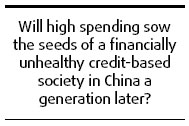
Certainly the authorities have planned infrastructure projects (a wide range from high speed trains and energy conservation to rebuilding in Sichuan province) and have said that they will, but it is difficult to see how the export declines will not hit consumption as jobs are lost through structural problems. A few years ago my students were fascinated by statistics such as the Chinese economy producing over 500 million cellphones a year of which only 50 million stayed in China. Now if the global downturn produces a 20 percent decline in export demand for cellphones, and Chinese demand for cellphones could be encouraged to rise 100 percent (a remarkable jump) that would still leave around 50 million units annual shortfall in demand and rising unemployment in that industry. Picking up the slack will be even harder in industries where production was uniquely to meet the needs of export demand such as for Mattel and Disney in the toy industry. Then we have the impact on support industries already in evidence - the shipping fleets that carried this export-determined production across the oceans aren't going to be needed in such numbers to "ship" production across China, even if the output can find domestic buyers. So it seems inescapable that consumer expenditure growth will initially be handicapped by domestic job losses and reduced incomes in those industries. There is another drag on the potential for rising consumer spending. An important segment of Chinese wage earners that might be most likely respond to encouragement to spend more on domestic output is also the segment that would like to own their own home - indeed doing so usually creates some further spending needs. However it is widely reported that property prices have risen too far outside the reach of such would-be buyers in China and that this remains so despite a recent downturn in prices. In recognition of this, the authorities have introduced policies to reduce the property deposit from 30 percent to 20 percent and to consider subsidies to costs and lending rates at 70 percent of normal interest costs for a period. Of course this encourages consumers to stretch themselves to try to afford high property prices, limiting income for other spending. It essentially "validates" the high property prices whereas the "next housing generation" consumer would be better off with property at more affordable prices. There is an important lesson to be learned from the West here. It has been precisely the encouragement of Western consumers to stretch themselves to take on ever-larger mortgage commitments and higher housing costs relative to income, which necessitated the low (sometimes non-existent) savings ratios out of income and the reliance on credit for significant consumer spending decisions. Affordable housing, avoiding a excessive proportion of income committed to housing costs is the only sensible way to sustain rising general consumer spending without a credit explosion to finance it. Add the drag from the reality that property owners in the last year or so have seen their assets fall in value and that the Chinese stock markets have fallen even further from their 2007 peaks (now a fall of over 80 percent) than Western stock markets, and there is an important section of Chinese consumers whose confidence to respond to the world's need for higher spending has been severely dented. There is a certain irony in looking to historically cautious Chinese consumers to increase spending at precisely the time that the horrific results of Western consumers not saving for a rainy day are all too clear. The Western consumers, particularly in the United States, believed they could live with spending nearly all their disposable income because of ready access to credit for emergencies - a belief honed from their early college days when banks competed on campuses to place credit cards in pockets of students yet to earn any significant income, through to the assumption in last 20 years that property prices (give or take a blip) will rise annually and always provide equity against which affordable loans could be secured. The home was an ATM. Given the culture of the Chinese consumer, is a significant reduction in savings out of income something they will feel comfortable with unless access to credit is part of the process as a "safety net"? And will this sow the seeds of a financially unhealthy credit-based society in China a generation later? China should not ignore the lessons from the West's financial crisis. The authorities are clearly seeking to learn from the experiences of the Western financial institutions and avoid those mistakes, but the greater lessons are likely to come from the impact of the Western consumer's personal credit crisis and this is an experience that will be more fully revealed in 2009. So the Chinese government's attempts to raise consumption in China should proceed, but "proceed with caution". (For more biz stories, please visit Industries)
|
||||
主站蜘蛛池模板: 武鸣县| 罗定市| 交城县| 大关县| 丰原市| 甘洛县| 广元市| 三台县| 孟州市| 锡林浩特市| 平谷区| 虞城县| 仪征市| 自贡市| 昆山市| 柞水县| 佛山市| 铜鼓县| 卓尼县| 常宁市| 宣化县| 多伦县| 蒙城县| 西平县| 齐河县| 桂平市| 上杭县| 绥宁县| 舟山市| 桃园市| 咸阳市| 雅江县| 偏关县| 乡城县| 海伦市| 洛川县| 永春县| 禄丰县| 平湖市| 商水县| 井陉县| 二连浩特市| 永丰县| 上饶县| 武鸣县| 瑞丽市| 扶沟县| 新平| 青海省| 江门市| 沂源县| 松原市| 新津县| 武清区| 横峰县| 皋兰县| 新郑市| 漯河市| 大理市| 余干县| 遂平县| 石泉县| 博客| 鹿泉市| 阳泉市| 灌南县| 盘山县| 瑞金市| 虎林市| 汽车| 会理县| 繁峙县| 屯昌县| 淮北市| 洛隆县| 平泉县| 防城港市| 武强县| 利川市| 且末县| 共和县| 屏东县|