BIZCHINA> Wen's Lens

|
BIZCHINA> Wen's Lens
|
|
Growing pains
By You Nuo (China Daily)
Updated: 2008-12-15 08:07
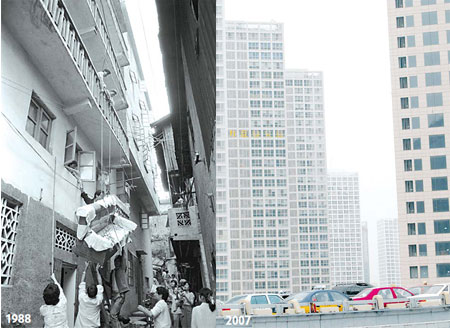 If there is growth, there will always be growing pains. Trying to fit a large piece of furniture in a residential flat was one such pain. There could be so much trouble, as vividly recorded by our 1988 black-and-white photo, if the gate and stairway were so narrow that you had to haul in your newly acquired asset from the window. Large pieces of furniture were important for a worker's family back then. The National Bureau of Statistics (NBS) counted them along with bicycles and sewing machines as indicators of an urban family's level of consumer power. While another kind of growth pain, albeit equally painful, is to wait humbly no matter what expensive vehicle you are in, for your turn to crawl your way out of a dense traffic jam like the one in the 2007 color photo on the fly-over near Guo Mao, one of Beijing's main business areas and the area with the largest number of modern buildings. Public services are inadequate here and there, even in the largest cities in China. In fact, people often have to wait, with a much greater patience than they need to ride out a traffic jam, for their first telephone, first neighborhood medical clinic and automatic telling machine, first subway or expressway to connect their homes to workplaces, and many other conveniences and services. Just from these two photos, people can all tell how the skylines of Chinese cities have changed. This year, to mark the 30th anniversary of the economic reform, many stories of great changes can be told of cities and of individuals' lives. But 30 years of change, however major and profound, is still part of a larger and longer process in which the nation learns to build and manage a modern society.
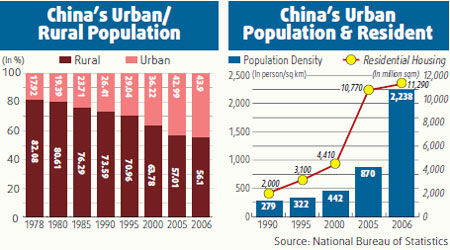
One major factor driving so much change and also giving rise to so much growth pain is the migration into the cities. When China was at the beginning of its economic reform, it was, except for a few cities, an agrarian society. More than 80 percent of its population was in the countryside. Now, according to the NBS data, the size of urban population has grown nearly 150 percent and it will probably see as much growth in the next two or three decades. Although fewer now need to hire a hoist to move furniture into an apartment, people will continue to press for, and at times also wait patiently, for the changes they want.

 (For more biz stories, please visit Industries)
|
主站蜘蛛池模板: 图们市| 老河口市| 兴国县| 尼玛县| 阿克苏市| 板桥市| 额敏县| 英山县| 阜城县| 都兰县| 汤原县| 当阳市| 广元市| 巴楚县| 浪卡子县| 佛山市| 合水县| 庄浪县| 德清县| 麦盖提县| 岑巩县| 宁乡县| 水城县| 磴口县| 临澧县| 广灵县| 锡林郭勒盟| 新竹县| 承德县| 阳高县| 白河县| 布拖县| 孟州市| 连江县| 庆安县| 绿春县| 黄冈市| 凉城县| 商洛市| 浙江省| 武清区| 延吉市| 阳新县| 通渭县| 佛冈县| 阿巴嘎旗| 霞浦县| 遂昌县| 平遥县| 商南县| 西昌市| 吉安县| 于田县| 名山县| 锡林浩特市| 郸城县| 营口市| 临猗县| 杭州市| 临颍县| 远安县| 乐东| 忻州市| 马尔康县| 称多县| 拉萨市| 横峰县| 肇州县| 南溪县| 宜昌市| 育儿| 北票市| 安远县| 林州市| 镇巴县| 南乐县| 新干县| 荣成市| 冀州市| 哈密市| 海南省| 肥城市|
