BIZCHINA> Top Biz News

|
BIZCHINA> Top Biz News
|
|
Related
Cement plant should play role as purifier
By Yu Tianyu (China Daily)
Updated: 2008-12-22 07:54
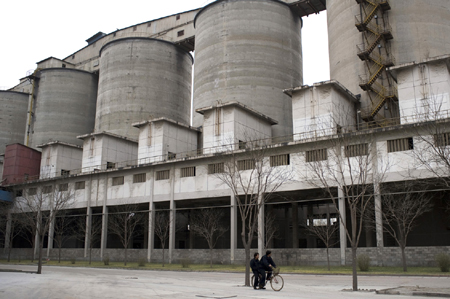
A good cement plant shouldn't be a polluter; it should play a role as a purifier. Since 1985 China's cement production has been the highest in the world for 21 consecutive years and accounts for 48 percent of the global annual output. However, the cement industry also consumes 15 percent of all the coal burned in China, while the cbountry is the a major carbon dioxide producer in the world. According to the 11th Five-Year Plan for the Chinese cement industry from 2006 to 2010, the energy consumption of each ton of cement is predicted to be reduced by 25 percent compared with the previous five years. Different from traditional cement plants that are associated with high-energy consumption and high emissions, the Beijing Cement Plant, located in Machikou of Beijing's Changping district, is one of the pioneers in the energy saving and emissions reduction campaign of China's cement industry. Established in 1992, the State-owned Beijing Cement Plant has been striving to clean up its production process and help the capital to safely digest its industrial wastes, household garbage and hazardous wastes. "Through technology innovation and industrial structure reform, we have tried our best to reduce our impact on the local environment and contribute to the national goal of energy efficiency and emissions reduction," says Fu Qiutao, general manager of Beijing Cement Plant. Beijing is facing serious environmental challenges. In 2004, the city generated about 140,000 tons of industrial wastes and 60,000 tons of hazardous wastes including medical waste and lead-acid batteries. In 2005, the Beijing Cement Plant launched a demonstration project using the cement kiln for processing industrial wastes.
In the central area of the plant, a cement kiln works not only for cement production but also as a facility for treating industrial wastes. Through a huge pump, industrial liquid waste, soot and waste slag are transporting into the kiln. The French-made kiln uses low nitrogen combustion technology to make soot, industrial liquid waste, ashes and secondary fuel combust at the same time. At high temperatures of 1,450 to 1,700, 99.999 percent of the noxious elements can be burnt, Fu says. Turning wastes to new materials Heavy metal wastes are also processed into a raw material to produce cement without discharging waste residues. And organic wastes with thermal value can be burnt as secondary fuel for the kiln, Fu adds. In 2007, Beijing Cement Plant helped the Beijing public security bureau combust about 135.3 kg drugs, worth 200 million yuan. In the same year, Beijing Cement Plant again helped Beijing Drug Administration burn about 17 tons of illegal drugs. So far, the Beijing Cement Plant has an annual capacity of treating 100,000 tons of industrial wastes in 28 categories. The plant is hoping to process about 150,000 tons of industrial wastes by 2010 and produce more "green cement" for the country. At Beijing Cement Plant, a waste heat recovery (WHR) technology has also been adopted. Through the technology, waste heat has been collected for power generation, which can produce roughly 50 million kWh of electricity each year. It can satisfy about 20 percent of the total energy demand at the plant. Yu Fei, an official with the Ministry of Environmental Protection, says the central government is requiring that by 2010, over 70 percent of the country's cement should be produced by the new suspension preheater (NSP) cement production lines. The National Development and Reform Commission hopes that 40 percent of the NSP cement production lines in China will use WHR equipment by 2010. At that time, the annual electricity produced by WHR projects will reach 8.93 billion kWh. Yu says that by 2010, current 5,000 cement plants will be reduced to 2,000, including 10 plants with an annual capacity of 30 million tons and 40 plants with an annual capacity of 5 million tons. She says government will intensify supervision of the cement industry and improve the overall management level, also keep cooperating with international environmental protection organizations and advanced cement enterprises. Impact on cement Industry Due to the deepening global financial crisis and slowdown of the Chinese economy, China's cement production saw a slower growth at 2.8 percent year-on-year to about 1.27 billion tons in the first 11 months of this year, according to latest figures released by the Ministry of Industry and Information Technology. It is arousing concerns over whether the Chinese cement enterprises will continue their efforts for cleaner production and environmental protection. Fu, of Beijing Cement Plant, says: "We will further eliminate our obsolete production capacity and shoulder more social responsibility of treating industrial wastes and promoting alternative energy." China has unveiled a massive 4 trillion yuan stimulus package to avert an economic slump, with the fund to be spent over the next two years to finance low-price housing, rural infrastructure, water, electricity, transportation, the environment, technological innovation and rebuilding from several disasters. About 80 percent of the package is relevant to the construction material industries. Industry insiders say that they are optimistic about the future of the cement industry in China. Zhai Qi, deputy director of the China Business Council for Sustainable Development, says if cement enterprises can carry out reforms of production and technology, the economic crisis could become an incentive for developing a more balanced industrial structure. (For more biz stories, please visit Industries)
|
主站蜘蛛池模板: 海林市| 贵港市| 东城区| 延川县| 辽宁省| 宁都县| 木兰县| 南投县| 都安| 云阳县| 龙里县| 达日县| 梅河口市| 宁远县| 宁南县| 洪泽县| 上栗县| 特克斯县| 岳阳县| 涿州市| 阜城县| 美姑县| 嵊泗县| 临泽县| 佛冈县| 崇州市| 景德镇市| 武安市| 金昌市| 邢台市| 苍山县| 永昌县| 民乐县| 定边县| 麻栗坡县| 会东县| 仪征市| 陇川县| 华池县| 含山县| 合作市| 巴马| 肃宁县| 浙江省| 大姚县| 容城县| 灵川县| 西平县| 桦南县| 方山县| 蓝田县| 田东县| 莒南县| 广饶县| 济阳县| 密云县| 五指山市| 右玉县| 西华县| 天门市| 汝州市| 临沂市| 务川| 中牟县| 桃江县| 巍山| 揭西县| 柳林县| 姚安县| 雷州市| 嘉义县| 珠海市| 巩义市| 隆尧县| 林周县| 淮安市| 星子县| 平果县| 龙泉市| 甘南县| 沂源县| 道真|