BIZCHINA> Top Biz News

|
BIZCHINA> Top Biz News
|
|
Output cuts 'no solution' for steelmakers plagued by losses
By Wang Ying (China Daily)
Updated: 2008-12-24 08:05
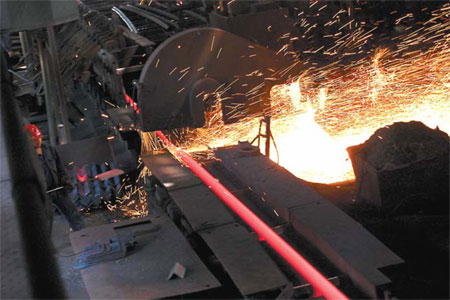
With sluggish downstream demand and falling price of steel products, many Chinese steel mills are cutting back on their output in recent months. However, industry experts warn that slashing output is only a sticking plaster solution for steelmakers plagued by losses, with the solution lying in buoying market sentiment, securing a bigger say in ore price negotiations and upgrading the industrial structure.
Major steel products are cutting their ex-works prices. For example, the price of cold-rolled steel plummeted 42.7 percent from the highest 7,309 yuan per ton since June through November, according to statistics from Beijing Lange Steel Information Research Center. Chinese steel mills started to build up a large inventory of raw materials in the months prior to the Beijing Olympics to guard against any possible supply disruption. However, this iron ore, which was purchased at a high price, has now become a heavy economic burden for steel producers as the global financial crisis has evolved into market panic and seriously dented consumer confidence. According to Zhou Tao, an analyst with Sinolink Securities, about 10 to 15 percent of Chinese steel products are exported overseas, while the rest are consumed domestically. As the credit crunch affects the world's real economy, neither the overseas nor domestic markets can be immune. "Major steel consumers, such as real estate, infrastructure construction, machinery, shipbuilding, automobiles, and home appliances are all suffering due to the global financial turmoil, while the car and home appliance industries have witnessed negative growth over the past three months," said Zhou. In downstream sectors, real estate and infrastructure construction account for almost half of total steel product demand, or 34 percent and 14 percent, respectively. Meanwhile, the property market is experiencing a downward spiral, according to an analyst with TX Investment Consulting. According to the National Bureau of Statistics, house price growth in 70 major cities across the nation slowed from 11.3 percent year-on-year in January to 3.5 percent year-on-year in September. Apart from sagging demand, price rises introduced by iron ore giants Vale, Rio Tinto and BHP Billiton are proving to be a headache for Chinese steelmakers. "The iron ore price has deviated greatly from their intrinsic value in recent years. It is time to bring the price back onto a rational track," said Shan Shanghua, secretary-general of China Iron & Steel Association (CISA), who recently urged domestic steel companies to forge a united front in negotiations with giant iron ore suppliers. "In China, not only spot and contract prices are different, but contract prices are not always the same. We should secure a uniform price for imported ore, no matter if it comes from Australia, Brazil or India," Shan said. In addition, China steel companies should rely more on domestic miners to cushion themselves from the volatile overseas market, advised Wu Xichun, a former CISA chief. Statistics show that China's iron ore output increased 23 percent in the first seven months of this year, with newly emerging iron ore miners filling the supply gap. Meanwhile, a growing number of domestic steel mills are resorting to production cuts, but an unidentified expert pointed out that this is a piecemeal solution. "The best option for firms is to work on improving their productivity, and come up with more high value-added and energy-saving products. This is survival of the fittest," the expert stressed. The expert predicted a shake-up in the steel industry, with giants such as Baosteel and Hebei Iron & Steel Group taking the opportunity to realize industrial upgrading and move up the value chain. An Jianghong, an analyst with logistics information provider Anbound Group, said that the ongoing credit crunch offered Chinese steelmakers an opportunity to grab control of more iron ore resources as assets are downgraded due to the global financial storm. Through overseas mergers and acquisitions, Chinese steelmakers will get a footing in Western markets and gain a greater say in iron ore price negotiations dominated by Brazilian and Australian firms, he noted. (For more biz stories, please visit Industries)
|
|||||
主站蜘蛛池模板: 松阳县| 东丰县| 手游| 礼泉县| 青州市| 晋城| 惠来县| 三穗县| 北安市| 含山县| 金堂县| 巴南区| 广德县| 锡林郭勒盟| 清涧县| 故城县| 临西县| 罗甸县| 台山市| 克东县| 彰化县| 吕梁市| 上林县| 泽库县| 句容市| 唐海县| 扬州市| 重庆市| 堆龙德庆县| 读书| 库伦旗| 融水| 德阳市| 白水县| 海林市| 平果县| 东乌| 舟山市| 鹿邑县| 乐东| 酒泉市| 屏边| 黄陵县| 望谟县| 磐安县| 通州区| 汉源县| 平陆县| 宜州市| 保亭| 闸北区| 平塘县| 建昌县| 福鼎市| 湛江市| 慈利县| 即墨市| 农安县| 丹巴县| 凤冈县| 南澳县| 汶上县| 建水县| 五河县| 上蔡县| 灵武市| 永丰县| 夏河县| 奈曼旗| 涿鹿县| 东台市| 丹江口市| 晋宁县| 湘潭市| 肥城市| 神池县| 乌鲁木齐县| 疏附县| 监利县| 承德县| 额尔古纳市| 鹿邑县|