BIZCHINA> Wen's Lens

|
BIZCHINA> Wen's Lens
|
|
Tracks of change
By You Nuo (China Daily)
Updated: 2008-12-29 07:48
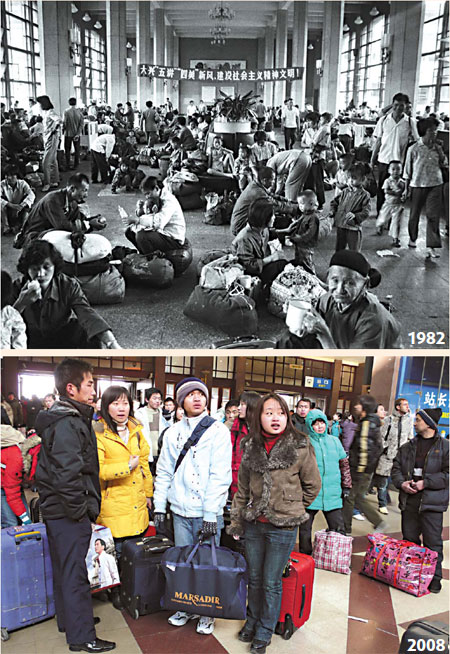 For the railway industry, some words and phrases essentially mean the same thing - be it development, modernization, reform or change. They all mean the job of carrying rural people into the cities - hundreds of thousands, time after time - to find new jobs, lives and homes.
Travel was costly and tiring. An average scene of the Beijing Railway Station, then the largest and most modern of the country (and still one of the largest), as in our 1982 black-and-white photo, shows no trace of the future trend. People from villagers and small cities just sat in ramshackle clusters on the lobby floor with simple luggage and home-made snacks. Despite the hanging propaganda banner to promote the so-called socialist spiritual civilization, some were sitting on the dirty floor littered with waste paper. Everybody was in a transient mood. They knew they were soon to go when the boarding whistle blew and this was not a place where they belonged. In fact, in 1982, the redistribution of collective farms to private management had yet to become a sweeping change. People were only beginning to make a little more income than the 1970s and could afford a few more colorful clothes. The phrase "market economy" was still taboo. Having millions of villagers leaving their farm jobs was something hardly anyone could have imagined. But as a result of the successful rural reform projects, first in Sichuan and Anhui provinces, then nationwide, the rise in farm productivity was able to raise a tremendous pool of labor for the industrial development in the cities. Nowadays, in many villages, farming is only reserved for the older people and providers of specialized services. All the young people (who would have been called "able-bodied farm workers") have gone to work in the cities, on fulltime or temporary contracts. In 2007, in an official survey, rural families reported at least 130 million of their members working on longer contracts in the cities - after some families had already entirely moved out of their old villages. The favorite destinations of many migrant workers are the large cities in the coastal and near-coast areas (such as Beijing). They want to stay in those cities. They want to be part of the modern China. Correspondingly, in the last 30 years, Beijing has built two more large railway stations - the Beijing West and Beijing South - with the one where our 1982 photo was taken still carrying the name Beijing Railway Station.
 (For more biz stories, please visit Industries)
|
主站蜘蛛池模板: 仁布县| 青田县| 安溪县| 平阴县| 宁海县| 威信县| 富顺县| 仙居县| 武陟县| 西丰县| 清水县| 海丰县| 册亨县| 板桥市| 康马县| 酒泉市| 昌平区| 青龙| 婺源县| 南开区| 高雄市| 鄂伦春自治旗| 穆棱市| 青河县| 泰顺县| 亚东县| 怀远县| 安图县| 澄江县| 缙云县| 克什克腾旗| 台南市| 揭西县| 辽宁省| 上饶县| 宁波市| 陆良县| 克什克腾旗| 斗六市| 涡阳县| 谢通门县| 进贤县| 天等县| 工布江达县| 曲麻莱县| 清丰县| 宜阳县| 周口市| 海口市| 九江市| 庆元县| 望都县| 舞钢市| 乐昌市| 十堰市| 裕民县| 东港市| 静海县| 衡南县| 手游| 鄂托克旗| 澄城县| 宣汉县| 新河县| 龙口市| 务川| 寿宁县| 绍兴县| 德兴市| 绥棱县| 黑龙江省| 聂拉木县| 鄄城县| 昆山市| 吉水县| 盐池县| 汉沽区| 乌什县| 宜州市| 泌阳县| 绍兴县| 石景山区|



