BIZCHINA> Top Biz News

|
BIZCHINA> Top Biz News
|
|
Unemployment deters rural consumption push
(Xinhua)
Updated: 2009-02-06 21:34 With the Chinese government pinning its hopes for economic resurgence on stronger rural demand, the swelling ranks of jobless migrant workers are making it a much tougher task.
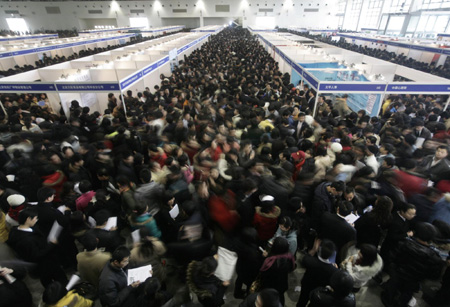
Growing joblessness will slow income rises for rural residents and compound the economic troubles China faces in its attempt to boost rural consumption, a key part of domestic demand. With less cash back for Chen's family in rural Manjing Township, Sichuan Province, this year's Spring Festival celebration will be subdued.
The government estimates about 20 million rural migrants, or 15.3 percent of all rural workers employed outside their hometowns, have returned home without jobs. The number reflects a worse-than-expected blow from the global financial crisis, says Tang Min, deputy secretary of the China Development Research Foundation. Slumping foreign demand has forced China's coastal industries to close or scale back production, claiming the jobs of millions of migrants. "Large scale layoffs of migrant workers will take a heavy toll on rural incomes and consumption," Tang says. Official figures show migrant wages account for about 40 percent of the average net income of rural Chinese. Moreover, income changes affect farmers' spending more obviously than they do for urbanites, said Wen Tiejun, head of the School of Agricultural Economics and Rural Development at the Renmin University of China. "Research shows if a farmer earns more, he will spend 70 percent of the increase, compared with 50 percent for an urbanite. When less money is made, rural people will cut spending more drastically than city dwellers." That's bad news for Chinese authorities, who are focusing on domestic demand as the bases for faltering economic growth. "The countryside holds the biggest potential for boosting domestic demand," said the State Council and the Central Committee of the Communist Party of China in the first document of the year issued Sunday. The document outlines policies to raise rural subsidies, improve infrastructure and better tap the vast rural market. China should "especially place priority on tapping the rural market and developing the countryside" to alleviate the effects of the global financial crisis, said Vice Premier Wang Qishan last month. Rural Setback? The spending potential of more than 700 million rural people, about 55 percent of China's population, should not be underestimated, says Tang. "Rural demand is still key to China's long term economic future." The average per capita net income of Chinese rural residents reached 4,761 yuan last year, a real annual growth of 8 percent. That was down from 9.5 percent in 2007, when farm produce prices ran high, but still higher than the annual rates of 2004, 2005 and 2006. Retail sales in towns and villages outpaced urban growth for the first time in November, rising 20.9 percent year-on-year to 210 billion yuan, according to the National Bureau of Statistics. That was 0.6 percentage points faster than the rate in cities. However, the growing trend would suffer a setback this year as more labor-intensive enterprises fell victim to the economic downturn, says Wen Tiejun. He says it's still too early to say if the economic slump will go so deep as to reduce the average net income of rural families. Chinese farmers have experienced two periods of continuous earning decreases since the market-oriented reforms were launched 30 years ago. The first came as a result of runaway inflation in late 1980s and the second was due to the Asian Financial Crisis in 1997. The first decline lasted three years and the second four years, and both were caused by sharply lower demand for farm produce, says Wen. "This time, the non-farming revenues are affected and the crisis is global," he says. "What we face now could be more serious." (For more biz stories, please visit Industries)
|
主站蜘蛛池模板: 黔东| 福贡县| 开江县| 大丰市| 新营市| 济南市| 海丰县| 科尔| 古交市| 福海县| 万州区| 康平县| 莱西市| 宁武县| 南木林县| 桃源县| 全州县| 乳山市| 晴隆县| 邵阳市| 阳朔县| 崇仁县| 安达市| 涿州市| 陇西县| 监利县| 军事| 通许县| 潮州市| 洪洞县| 乐安县| 金阳县| 新和县| 岱山县| 连平县| 河源市| 塔河县| 扬中市| 凉城县| 天峻县| 沅江市| 咸宁市| 台中县| 来宾市| 抚顺市| 克拉玛依市| 白山市| 平远县| 白水县| 朔州市| 天等县| 龙里县| 宾阳县| 石城县| 嘉义县| 塔城市| 博兴县| 葫芦岛市| 恭城| 仙居县| 东兴市| 五峰| 邵阳市| 体育| 博客| 华蓥市| 红原县| 隆子县| 津南区| 翁源县| 鄱阳县| 临海市| 丹东市| 广平县| 吉隆县| 台安县| 华坪县| 策勒县| 平潭县| 罗城| 穆棱市| 托里县|