BIZCHINA> Top Biz News

|
BIZCHINA> Top Biz News
|
|
Shipbuilders in consolidation mode
By Tong Hao (China Daily)
Updated: 2009-02-16 07:57
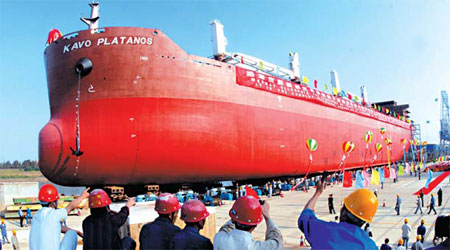
China's shipbuilding industry, which last year suffered its steepest annual decline since 2003, is likely to be squeezed further this year by shrinking order books and order cancellations as the global economy remains in recession. The industry, the world's second-largest by capacity, will see more small shipyards swallowed by big players as mergers and acquisitions are expected to pick up pace this year, analysts said.
Shipyards worldwide will see orders further plunge to 40 to 60 million dwt in 2009, while the new orders Chinese shipyards receive is likely to drop to 20 million to 30 million dwt, a 48.4 percent to 65.6 percent fall form a year earlier, the China Association of the National Shipbuilding Industry said in its latest report. Besides, an analyst Ye Zhigang with Haitong Securities said in a report that 15 to 25 percent of Chinese yards' orders, or 300 million to 500 million dwt, are likely to be canceled over the next three years, five percentage points higher than the global average. The industry will remain in depression during the next three years and another period of growth will come after 2013, Ye estimated. The State Council, or the Cabinet, on Feb 11 approved a stimulus package for the country's shipbuilding industry, after similar plans for the auto, steel and textile industries. The stimulus package includes support in financial credit and technology upgrades, new capacity control as well as encouragement of mergers and acquisitions within the industry. "The package comes as a boost to a sector that has been struggling for new orders and in retaining old ones," said Guo Yalin, an analyst with CITIC Securities. Large shipyards are more likely to survive over the next three years, but life for small ones will be hard, analysts said. "Large State-owned shipyards in China have better capacity to tackle the difficulties," said a PingAn Securities analyst who declined to be named. "Compared to small private shipyards, they have higher skills and their clients are of better quality." China State Shipbuilding Co Ltd (CSSC), one of the country's largest shipbuilders, is now considering offering discounts to its clients to avoid order cancellation, said Shi Weidong, board secretary of CSSC. The company has given top priority to vessel delivery and winning new orders this year. The company, which forecast a profit of 10 billion yuan for 2008, has 52.77 million dwt in shipbuilding orders, accounting for 8.8 percent of the world's total, enough to see it through the next few years. But "for small- and medium-sized private shipbuilders in China, the situation is serious," said the Pingan Securities analyst. "Building ships requires a huge amount of money. Compared to State-owned yards, they are less likely to get money from banks and their orders are more likely to be canceled due to lack of experience." According to statistics from the Commission of Science, Technology and Industry for National Defense in 2006, there were 3,050 shipyards in China, with most being privately owned. The fragmented industrial pattern will see changes as the world's economic climate worsens, analysts said. "The number of shipyards in China is sure to decrease over the next few years," said Zhang Jincan, an analyst at Guotai Jun'an Securities. "Some small private yards will go bankrupt, while more mergers and acquisitions will take place, but is hard to predict the scale of this." Such a trend echoes China's long-term plan for the shipbuilding industry from 2006 to 2015, which advocates efficiency improvements through mergers and acquisitions and aims to build three consolidated shipbuilding bases in the Bohai Bay region, the Yangtze River Delta and the Pearl River Delta. "The traditional advantage of China's shipyards is building bulk freighters. However, I think they should aim to build more oil tankers, container vessels and ships with higher added value in the long term," said analyst Zhang. Clarkson said China received 50.5 percent of the total bulk freighter orders worldwide by September 18, 2008. And among the new orders Chinese shipyards received in 2008, 66 percent were bulk freighters while oil tankers and container vessels accounted for 18 percent and 9 percent respectively, according to Changjiang Securities Co Ltd. Therefore, "Chinese shipyards should try to invest more in research and development. At present, China still cannot build some type of ships or lags behind developed techniques such as those of South Korea and Japan," said Zhang. (For more biz stories, please visit Industries)
|
||||||
主站蜘蛛池模板: 甘南县| 铜陵市| 寿阳县| 晋江市| 汾阳市| 筠连县| 龙里县| 九龙县| 鱼台县| 准格尔旗| 维西| 延津县| 益阳市| 香格里拉县| 长乐市| 桂阳县| 治县。| 邵东县| 疏附县| 扶风县| 岑巩县| 营山县| 武宁县| 屏东县| 镇安县| 永德县| 延寿县| 横峰县| 海城市| 清远市| 秭归县| 曲水县| 涡阳县| 玉山县| 安陆市| 鹤庆县| 嘉禾县| 抚远县| 板桥市| 虎林市| 宁武县| 澜沧| 聊城市| 肃宁县| 临潭县| 凤台县| 那曲县| 中超| 共和县| 沙田区| 吉水县| 彰武县| 古交市| 普安县| 崇左市| 湖口县| 庆阳市| 兰考县| 黄龙县| 昌乐县| 木里| 全州县| 千阳县| 海安县| 许昌市| 永宁县| 高邮市| 肥城市| 兰考县| 东阿县| 永州市| 花垣县| 凤台县| 银川市| 陵川县| 教育| 南充市| 越西县| 平谷区| 连南| 红桥区| 高青县|