BIZCHINA> Top Biz News

|
BIZCHINA> Top Biz News
|
|
China's foreign exchange assets safe
(China Daily/Agencies)
Updated: 2009-02-23 08:01 China's foreign exchange assets were safe and some were even profitable last year despite the global financial crisis, but Chinese regulators and economists are already concerned about the "grave challenges" ahead and will actively manage the country's huge forex reserves. Fang Shangpu, a deputy administrator of the State Administration of Foreign Exchange, told reporters last Wednesday that China's forex reserve assets were safe as of the end of 2008. "We provided abundant liquidity (for the country) to cope with the crisis and at the same time we also made some profits," he said, without elaborating.
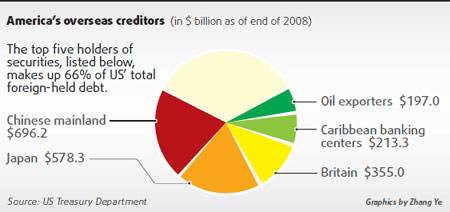
Asked whether China will continue to buy US treasury bonds after President Barack Obama signed a $787-billion bill to rescue the US economy, Fang did not say yes or no, but called for measures to protect such investments. "We hope major reserve currency economies will take active steps to effectively tackle the financial crisis and economic recession ... and protect investors' rights and interests and boost their confidence," he said. China overtook Japan as Washington's biggest foreign creditor in September and as of October held $652.9 billion in US treasury bonds. Its forex reserves reached $1.95 trillion by the end of 2008. Analysts say Beijing is likely to shift its strategy from passive to active reserve management and that such a change is especially urgent and an obvious response to the financial crisis. "The government has sent clear signals it will manage the reserve more actively," said Yin Jianfeng, a senior finance researcher of the Chinese Academy of Social Sciences. Chinese Premier Wen Jiabao said earlier this month China was exploring more efficient ways to use its reserves to boost domestic development. "We hope to use the money to buy equipment and technology, which are urgently needed for the country's development," Wen told the Financial Times. He said the forex reserves must be spent on foreign trade and overseas investment. China's massive reserves have put it in a good position to increase imports to meet domestic demand, which will likely be one of the main ways to use the money, said Yin. The United States and China signed an agreement in January that allows US exporters to sell certain dual-use items to China without acquiring permission from the government. Dual-use products are those that have either civilian or military uses. "China should find new ways to use these funds more efficiently, get a higher return and support domestic development," said Yin. Zhao Xijun, deputy director of the Institute of Finance and Securities at Beijing's Renmin University, said China could also use its forex reserves to make direct investments through commercial banks or support State companies' overseas acquisitions. "Buying more strategic assets, energy and resources is also an important way to efficiently use the reserves. It would help preserve and enhance the value of the reserves," said Zhao.
 (For more biz stories, please visit Industries)
|
主站蜘蛛池模板: 白朗县| 左权县| 故城县| 蕲春县| 新疆| 天气| 合阳县| 新邵县| 马公市| 弥勒县| 松原市| 东方市| 承德市| 津市市| 古丈县| 德令哈市| 若尔盖县| 奉节县| 惠东县| 衡东县| 开原市| 大连市| 英山县| 岳普湖县| 华池县| 樟树市| 芦山县| 龙江县| 大埔区| 墨玉县| 静宁县| 杭锦旗| 边坝县| 曲靖市| 固始县| 临清市| 武汉市| 丹东市| 和田市| 淮阳县| 楚雄市| 桂东县| 泾阳县| 兴化市| 霞浦县| 西乡县| 伊金霍洛旗| 砚山县| 上思县| 惠来县| 台南市| 安多县| 措勤县| 成都市| 武川县| 新竹市| 永康市| 高台县| 通河县| 砀山县| 灵台县| 吕梁市| 邯郸市| 泗水县| 神木县| 洱源县| 彰化市| 古浪县| 成武县| 福海县| 恩施市| 沈丘县| 吴江市| 五指山市| 体育| 满城县| 蒙阴县| 平乐县| 平凉市| 陕西省| 孟州市| 延津县|



