BIZCHINA> Bizchina

|
BIZCHINA> Bizchina
|
|
Spring comes to art market
By Li Xiang (China Daily)
Updated: 2009-04-13 07:45
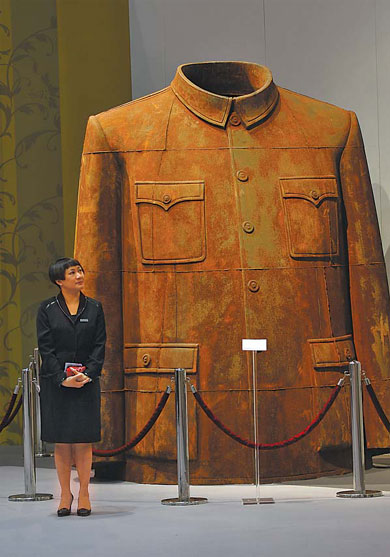
Spring is here, and none too soon for China's beleaguered art market. Artists and galleries alike have suffered a long, cold winter, brought on largely by the global economic crisis. More than one-third of the Asian contemporary art went unsold at auctions in Hong Kong last fall. In Beijing's once-bustling 798 art district, more than 60 of the nearly 200 galleries have closed their doors. But on Monday, a warm breeze began to blow. A handful of Chinese artists broke world auction records during Sotheby's spring sales in Hong Kong, proving that demand for certain categories of Chinese art remains robust. Chinese artist Lin Fengmian's "Fishing Harvest", on the market for the first time, sold for $2.1 million, a record for the artist at auction, according to Sotheby's. A quartet of Lin's paintings of Chinese opera figures, sold separately, fetched $3.1 million, far more than expected. Zhu Yuanzhi's "The Last Supper" sold for a record $770,000.
Demand for lesser works was patchy, and 21 percent of the art at Monday's auction remained unsold. But several Chinese artists, including Huang Yongping and Sui Jianguo, broke world records for their work at auction, according to Sotheby's. In the more established fine Chinese paintings category, 89 percent of the lots sold on Sunday. Fu Baoshi's "Drunken Monk" ink brush painting fetched $801,000, about twice the pre-sale estimate. Total sales were $16.6 million, well above expectations. "It is a very encouraging sign for the market that quality works are highly sought after, with almost three-quarters of the lots sold going for more than the pre-sale estimate," said C.K. Cheung, head of Chinese paintings for Sotheby's. Most active collectors appear to be from Chinese mainland and Europe, analysts say. But Americans are starting to express interest again. "Collectors are regaining their confidence," said Carrie Clyne, director of China Square Gallery in New York City. As examples, she cited the first-ever solo exhibition by a Chinese artist at the Museum of Modern Art in New York, scheduled for June and featuring Song Dong. The Hong Kong auctions were good news for the art world, which like many other sectors has had a year it would rather forget. The Mei Moses index, which mostly reflects New York prices, fell 35 percent in the first quarter of 2009. Until then, the Chinese contemporary art market had enjoyed an unprecedented boom. Eight years ago, only Cai Guoqiang was listed among the world's 100 best-selling artists. But by 2007, five of the 10 best-selling, living artists in the world were Chinese, among them Zhang Xiaogang, Yue Minjun, Zeng Fanzhi, Zao Wou-ki, and Wu Guanzhong. Zhang rose to second in the world list in 2006, ahead of Jeff Koons and behind Damien Hurst. Best known for his Bloodline series, Zhang's work fetched a total of $56 million at auction in 2007, according to Artprice.com, which tracks auction sales around the world. In the same year, China surpassed France to become the world's third-biggest auction market, trailing only the United States and UK. The Chinese market generated 75 sales of more than $1 million, with a top price of $8.5 million for a series of gunpowder paintings by Cai Guoqiang. The soaring market not only turned Chinese artists into multimillionaires, but also brought huge profits to international auction houses. Sales at Christie's in Hong Kong grew from $1.8 million in 1986 to $473 million in 2007. Sotheby's, another heavyweight in the auction market, sold nearly $200 million worth of Asian contemporary art in 2007, the bulk of it by Chinese artists. International galleries were also tapping into the Chinese market by opening branches in Beijing and Shanghai. Galleria Continua, a well-known Italian gallery, opened its exhibition space in Beijing in 2005. Pace Wildenstein, a major Manhattan art gallery, followed suit last summer, right before the opening of the Beijing Olympics. While many people wondered if the Chinese contemporary art scene would ever slow down, others saw signs that the bubble was about to burst. The first sign was Howard Farber's selling of his collection of Chinese contemporary art, amid the frenzy for Chinese art in 2007. Farber, an American collector, spent $2 million on Chinese art starting in 1995 and sold part of his collection for $20.4 million twelve years later. Another sign was the controversial sale of the Estella Collection at Sotheby's in Hong Kong last April, which reaped a total of $18 million for 108 works. According to The New York Times, many of the Chinese artists felt cheated by the American dealer Michael Goedhuis, who staged the auction for a group of investors. The artists said they sold some of their best works to Goedhuis at discount prices because they were promised that the collection would be donated to museums for permanent public display. Last year was the turning point. Not long after Zeng Fanzhi's Mask Series No. 6 sold for $9.6 million, an all-time record for a work of contemporary Chinese art, the global financial crisis began rippling around the world, sending the contemporary art market into a deep slide. Galleries in Beijing's 798 art district closed one after another. Sales were sluggish, and artists moved out because they were unable to pay the inflated rents. "The rent was so high at 798, we decided we couldn't afford it," said Brian Wallace, director of the Red Gate Gallery, who closed a secondary gallery at 798 last December. There were also complaints that trendy clothing stores, bars, and cafes were changing the nature of the 798 district, turning it into a commercial tourist attraction rather than a serious art base. "This kind of development cycle happens everywhere. It's just that here, it happened so fast! That's typical of what happens in China," Wallace said. The slowdown in the Chinese contemporary art market is not surprising, according to Fang Zhenning, an independent art critic in Beijing. "Art works are commodities, just like sugar or copper. The art market, like any other market, is speculative in nature and has its ups and downs," he said. Fang said the challenge for China's prominent artists, such as Zhang Xiaogang and Yue Minjun, is to see whether they can keep innovating. "To change or to repeat themselves. That's the question," he said. The overheated Chinese art market also raised issues for rising young artists. "What people are concerned about is all these young artists coming to the art world as a job rather than as a creative thing," said Wallace. "They've got the skills and they know the market is here. So you see a lot of repetitiveness in their subject matter, particularly in place like 798," he said. But many believe the downturn will help China's art market in the long run by helping artists get back to the basics. "The market will come back and it will be more mature," Wallace said. "And that will mean more reasonable prices, fewer poor quality works in the good galleries, and fewer poor quality galleries." Reuters and Tatiana Prophet contributed reporting.
(For more biz stories, please visit Industries)
|
||||||
主站蜘蛛池模板: 沛县| 南漳县| 宜州市| 穆棱市| 璧山县| 鄂托克前旗| 满洲里市| 休宁县| 游戏| 湖南省| 永顺县| 华宁县| 吕梁市| 梅河口市| 株洲县| 英德市| 宜黄县| 泰顺县| 鄂尔多斯市| 连云港市| 恩平市| 海宁市| 通辽市| 如东县| 新营市| 清水县| 靖西县| 大同市| 壤塘县| 易门县| 山丹县| 台山市| 陆川县| 洛阳市| 沈阳市| 云和县| 湘西| 织金县| 新宾| 东海县| 泰州市| 洪江市| 寻甸| 绥中县| 温宿县| 保德县| 呈贡县| 富裕县| 兴化市| 平利县| 枣强县| 新余市| 兖州市| 阿图什市| 通河县| 海南省| 诏安县| 黄平县| 灌云县| 亚东县| 察隅县| 安阳市| 韩城市| 靖江市| 南乐县| 深圳市| 栾城县| 赣州市| 鄂托克旗| 乐陵市| 晋江市| 铜陵市| 遵义市| 金坛市| 屯留县| 讷河市| 仲巴县| 彭泽县| 清镇市| 游戏| 武安市| 靖安县|