BIZCHINA> Top Biz News

|
BIZCHINA> Top Biz News
|
|
Acquisitions shore up crude supplies
(China Daily)
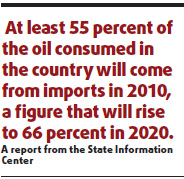
Updated: 2009-07-06 07:57 On June 30, China National Petroleum Corp (CNPC) and BP won a contract to develop the Rumaila oilfield in Iraq, which boasts the third-largest oil reserves in the world. Just a week before that, Sinopec Group, the country's second-largest oil company, said it agreed to acquire the Geneva-based oil and gas producer Addax Petroleum Corp for $7.3 billion. The deal will enable Sinopec to achieve its objective of building a stronger presence in West Africa and Iraq, accelerating its internationalization strategy and widening its portfolio of offshore oil and gas assets, Beijing-based Sinopec said in a statement. Analysts said that both moves are in line with China's need to diversify its energy supplies to enhance energy security. After becoming a net oil importer 16 years ago, China's import pace quickened rapidly. In 2004 the figure first surpassed 100 million tons, a 35 percent increase from a year earlier. By last year the nation was importing a whole lot more than that, some 179 million tons, an increase of 9.6 percent from 2007, as imports met 48 percent of total crude oil demand. Analysts said China's oil imports will continue to increase rapidly. A report from the State Information Center predicts that 55 percent of the oil consumed in the country will come from imports in 2010, a figure that will rise to 66 percent in 2020.
China's oil consumption grew around 5 percent annually in recent years, but domestic production increased by only 2 percent yearly. Analysts note that China is further diversifying sources to ensure sustainable supplies. The Middle East, Africa and Asia-Pacific are presently its three main suppliers of crude. The nation's three major oil companies - PetroChina, Sinopec and China National Offshore Oil Corp (CNOOC) - have all accelerated overseas development. PetroChina, the country's largest oil producer, said last month it completed purchase of a 45.51 percent share in Singapore Petroleum and would make a buyout offer for the rest of the shares. The deal is expected to cost S$1.47 billion. PetroChina's parent, China National Petroleum Corp, has already taken over PetroKazakhstan (PK) at a cost of $4.18 billion. PK's annual crude oil production now exceeds 10 million tons, about 16 percent of Kazakhstan's total oil output. With today's trading at about 50 percent of what it was last July when the global oil price spiked to a record high of $147 a barrel, the timing is "good" for Chinese companies to do overseas deals, PetroChina President Zhou Jiping said at the company's annual shareholders' meeting in May. According to Zhou, overseas mergers and acquisitions will become part of PetroChina's strategy in the next few years as it "will actively but cautiously select more overseas projects". Yet Fu Chengyu, chairman and CEO of CNOOC, noted that "Chinese companies must remain calm and clear-headed about overseas mergers and acquisitions, as the risks of such deals are on the rise". CNOOC is now taking a "patient approach", he said. Lower prices Executives from China's three main oil companies have all publicly stated that they expected this year's crude price to average about $70 a barrel. But that level will have varying impacts on the three companies.
To Sinopec, Asia's largest refiner, lower oil prices means much less pressure. Because of the yawning gap between high global crude prices last year and State-controlled low prices at the pump, Sinopec's refining business lost 114.4 billion yuan ($16.74 billion). But the company could see around 50 billion yuan in profit from its refining business this year, said industry insiders. And its entire group could see around 100 percent growth in profit. But for CNOOC, which is mostly dedicated to the upstream business, lower oil prices definitely mean lower profits. Lin Boqiang, a professor with Xiamen University in Xiamen, East China's Fujian province, said international crude oil prices will have the biggest effect on the three companies' business performance, but other factors such as windfall taxes might also play a role. China's stimulus package for the petrochemical industry will also give the three companies a boost, he added. China approved a stimulus package for the country's petrochemical industry on Feb 19. The country will speed up construction of some large-scale oil refining and ethylene projects as part of the package. The stimulus package has already impacted the industry by improving the investment environment, said Liu Gu, a Guotai Junan Securities analyst. (For more biz stories, please visit Industries)
|
|||||
主站蜘蛛池模板: 赤壁市| 桓台县| 乐清市| 霞浦县| 当雄县| 清苑县| 奉新县| 松阳县| 泰和县| 平阳县| 综艺| 南川市| 青河县| 诸暨市| 南漳县| 合山市| 馆陶县| 恩施市| 卢氏县| 崇义县| 上高县| 临安市| 基隆市| 合川市| 忻城县| 晋中市| 龙州县| 呼图壁县| 双辽市| 赤峰市| 邯郸县| 丹巴县| 河池市| 墨玉县| 本溪| 曲水县| 阜宁县| 鄢陵县| 芜湖市| 宽城| 敖汉旗| 仁布县| 斗六市| 南投市| 巴彦淖尔市| 五寨县| 琼结县| 锡林郭勒盟| 玛纳斯县| 浮山县| 嘉鱼县| 潍坊市| 平邑县| 宁武县| 自治县| 鲁山县| 吐鲁番市| 竹溪县| 广河县| 山东| 塘沽区| 乐清市| 华容县| 师宗县| 肥城市| 浦县| 宣化县| 明星| 牡丹江市| 博客| 莱西市| 文安县| 嵩明县| 茶陵县| 资溪县| 安庆市| 璧山县| 尼木县| 织金县| 仁布县| 许昌市| 灵石县|