BIZCHINA> Editor Choice

|
BIZCHINA> Editor Choice
|
|
Digital dreams
By Chen Nan (China Daily)
Updated: 2009-07-28 08:13
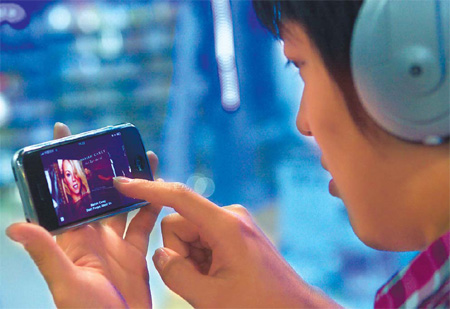
It is rush hour and Beijing's subway crush reflects this. Han Song, a frequent traveler between Dongzhimen and Guomao, fights his way to a corner. Sandwiched by the crowds, he reaches for the bag held high above his head and takes out his iPod. He slides the wheel on the slim gadget, no larger than his palm, and picks one of the more than 1,000 tracks on it. It is enough to distract him on yet another trip. The mainland's young music fans are increasingly downloading music to cell phones and other music players, thanks to new technology. "I can download any kind of music from around the world on the Web and enjoy the tracks anywhere," Han says. "It has become a habit." His latest downloads are songs by Hong Kong pop singer Karen Mok and pop group S.H.E. All of this comes at a time when fans are faced with a wealth of new choices on how to buy and listen to music. Before MP3, the Internet and unbridled music piracy, music distribution was dominated by the big record labels. Fans would congregate at midnight at local music stores to get the latest album of their favorite singers. "Buying CDs is a little old-fashioned. I don't buy CDs as regularly as I used to four or five years ago. CDs have become more of a collection or gift item," says Han.
"Back in those days, singers promoted by the music labels were the ones everyone paid attention to," Song recalls. "But changing habits have led music fans to the virtual world. With CD sales down and the digital side growing, you have a different business model. The major labels are looking for new revenue streams, including ringtones." When Taihe Rye released mainland singer Dao Lang's five singles on the Internet in 2003, it saw more than 5 million downloads and raked in more than 2 million yuan ($292,000) in profits.
The company also put Super Girl champion Li Yuchun's debut album Happy Winter online in 2006 and made more than 1 million yuan ($146,000). The total revenues from digital music sales, especially cell phone downloading, account for up to 80 percent of the company's income, according to Song. The market potential in this segment is drawing others. Shenzhen-based A8 Digital Music Holdings owns more than 60,000 original works of music on the mainland. It has designed the A8 Box software to enable mobile users to easily access and buy content from its large online database and various digital music service providers. China Mobile, Beijing-based top100.cn, Shanghai-based Shanda's digital home entertainment company and Aigo Music have teamed up with well-known music companies from both China and overseas. All of them are trying to build their own legitimate music library. Turning music into digital format allows each song of an album to be sold individually, giving fans the freedom to choose just the hits they want. This April, mainland music producer Zhang Yadong, who is known for producing pop diva Faye Wong's hit albums, released his personal album Underflow online by cooperating with China Mobile music club, which guarantees copyright protection. Popular songs, such as Faye Wong's I Love You and Zhang's own songs have become hot hits. The number of downloads hit 15 million in one month. "The number is far more than CD sales," Zhang says. In today's market, if an album reaches the 50,000 sales figure, it is cause for a music company to celebrate. "Music downloading brings profits which cannot be compared with CDs," he says.
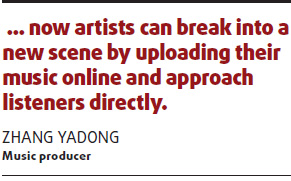
But as a professional music producer, Zhang says that selling individual tracks breaks up the continuity of a full album. "I like a complete concept behind an album. One single is not enough to express an artist's feeling or story," he says. "But singers have to feed themselves first to create more music. The compromise is inevitable." Putting music online also benefits the artists. Zhang points out that nowadays, thanks to the Internet and the changing habits of music fans, non-mainstream musical genres and artists have better prospects. "In the past, big record labels invested vast sums of money to market their musicians' albums to radio, to MTV and to CD shops. Anyone not represented by any of these labels, independent musicians, struggled for the spotlight," he says. "But now, artists can break into a new scene by uploading their music online and approach listeners directly." Zhang's own music company, Dong Music International, targets new talents. "The current music scene is unhealthy. If we have 1,000 new songs within a year, 800 are bound to sound similar. Chasing after one successful genre, such as R&B and Hip Hop, hinders diversity," says Zhang. "New musicians are throwing out convention. They are trying different styles by moving away from mass tastes. "Music downloading offers them a chance to get their efforts across to the listeners. There are lots of newbies out there, people who don't know any of these bands, and they could easily buy one song." The biggest challenge to the development of China's Internet music market is consumers' reluctance to pay for legitimate copies of music, according to Song. The industry needs to come together to change this mindset. The introduction of relevant laws will also aid the industry's growth. "The business model for China's digital music industry is not yet fully developed," says Song. "There will be many forms of digital music that play music with high original sound quality rivaling that found in traditional records." (For more biz stories, please visit Industries)
|
|||||||
主站蜘蛛池模板: 方城县| 巴南区| 灵石县| 彭阳县| 郓城县| 临洮县| 清水县| 鄂伦春自治旗| 自治县| 郸城县| 霍林郭勒市| 平舆县| 潞城市| 长宁区| 凤冈县| 鹤山市| 灌阳县| 浑源县| 河东区| 凉城县| 泰来县| 台南市| 涟源市| 手游| 平顶山市| 长治县| 亚东县| 珲春市| 昌江| 盐边县| 色达县| 轮台县| 射阳县| 梁山县| 梁山县| 霞浦县| 淮北市| 顺昌县| 霞浦县| 淮北市| 阜康市| 东乌| 阿巴嘎旗| 景洪市| 五寨县| 合作市| 左权县| 青川县| 太白县| 渝中区| 三明市| 邻水| 峨眉山市| 临城县| 克东县| 宁海县| 南汇区| 涞源县| 楚雄市| 雷州市| 同仁县| 抚州市| 东乌珠穆沁旗| 谷城县| 宝坻区| 麦盖提县| 苏尼特右旗| 曲周县| 久治县| 夏河县| 黔南| 乌兰县| 仪征市| 北辰区| 抚顺市| 阿拉尔市| 宁晋县| 宽城| 连城县| 民乐县| 日照市| 吉隆县|