BIZCHINA> Review & Analysis

|
BIZCHINA> Review & Analysis
|
|
An economist rises to the green challenge
By Fu Jing (China Daily)
Updated: 2009-09-16 14:24
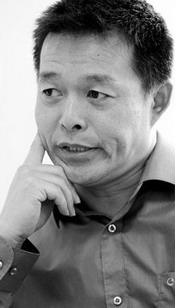
Hu Angang, one of China's leading policy advisers, has long been seen by critics as being too ready to speak for the central government. Perhaps his association with an elite research group on "state of the nation" (or guoqing) of the Chinese Academy of Sciences has a lot to do with that. Hu joined the research team in 1985 before Tsinghua University co-sponsored the program in 2000. That group has prepared about 500 policy research papers. But these days, he is leading a one-man campaign for such an ambitious plan that even his most ardent critics will admire him for his boldness. In fact, it is the most radical proposal from a member of a Beijing think tank. And Hu knows exactly what he is saying. "Mine is going to be the most radical program," says the 56-year-old scientist turned researcher in public and environment policies in an interview with China Daily. "This is what I wanted I want to represent the most radical climate line in China." Most people calculate, but not Hu. This is not the time to play with figures, he says. Nor is it a time for only diplomacy with no country taking the lead in sacrificing some of its immediate interest for a good cause. "It is just like China's reform and opening up." When an old development model stops working, the main task is to change it. "You don't just do your own calculation. You don't just look at other people. Deng Xiaoping never did that," Hu says, referring to the man who began the reform and opening-up process in the late 1970s. "He (Deng) set the goal. He made people work to achieve it, irrespective of what other countries were doing."
What 2030 should see, instead, is the falling of China's GHG emission to its 1990 level, Hu says, adding that the fall in GHG emission, or the pace of progress toward a green economy should be so drastic that by 2050 China's emission should be down by another 50 percent. These targets, he admits, may earn him the wrath of some of his colleagues and may never be wholly accepted by the government. Hu did his post-doctoral research in economics at Yale University after earning his PhD from the Chinese Academy of Sciences in 1985. That research resulted in his first book and brought him global recognition. Co-authored by Wang Shaoguang, the book, State Capacity of China, was translated into English and published by Oxford University Press in 1994. It deals primarily with the relationship between the central and regional governments during economic reform. Hu has been engaged in research and development ever since, using his interdisciplinary approach. Of late, his publications and speeches show his key areas of interest are the discrepancy between China's developed and underdeveloped regions, and the environment and natural resources. (For more biz stories, please visit Industries)
|
主站蜘蛛池模板: 青河县| 大方县| 项城市| 天门市| 噶尔县| 隆子县| 鹤峰县| 屏南县| 临西县| 哈巴河县| 康定县| 赣州市| 收藏| 越西县| 兴安盟| 壶关县| 桦甸市| 洮南市| 鄂温| 高雄市| 海原县| 隆昌县| 江门市| 三都| 孟州市| 黄浦区| 中江县| 新巴尔虎右旗| 兴和县| 永宁县| 临沧市| 同德县| 双城市| 襄垣县| 右玉县| 剑阁县| 宜春市| 河东区| 宜阳县| 黑山县| 长春市| 将乐县| 崇信县| 游戏| 达拉特旗| 郧西县| 德昌县| 蓬安县| 永宁县| 和田市| 寿宁县| 安吉县| 东城区| 无锡市| 潞西市| 杭州市| 得荣县| 安阳市| 彰化市| 天台县| 南康市| 新丰县| 乌兰察布市| 璧山县| 商南县| 手机| 博客| 荣昌县| 红河县| 绵竹市| 扎兰屯市| 易门县| 海门市| 沅陵县| 资兴市| 红原县| 康马县| 禄劝| 肥乡县| 河北省| 南投县| 昆明市|