BIZCHINA> Review & Analysis

|
BIZCHINA> Review & Analysis
|
|
Chinese tourists and the reality of faux pas
(China Daily)
Updated: 2009-09-17 08:04
Chinese in America have a long history of struggle. Over the past 30 years, hundreds of thousands of people from China have traveled to the US to study and/or to work. Many of them have returned, and some have stayed back to become contributing members of American society. But unlike in the past, the overall image of Chinese in the US today is more or less positive. One can readily list laudable examples, big and small, of how naturalized Chinese Americans have excelled in their fields and made positive contributions to the government, science and technology, industry, the financial and educational systems, and the arts in the US. The recent appointments of Washington Governor Gary Locke as US secretary of commerce and Nobel Prize-winning physicist Steven Chu as secretary of energy come easily to mind. The increased presence of Chinese working as financial professionals in New York has given rise to a joke about Wall Street being turned into a workaday "Chinatown". In New York's real Chinatown, public schools near the Confucius Plaza have become the embodiment of educational excellence due, in part, to the diligence of their students. This fact has induced many non-Chinese parents to relocate to Chinatown, so that their children can receive quality education alongside their Chinese peers. Here, one is reminded of how Mencius' mother shifted house thrice 2,300 years ago to ensure her son got the best education and helped him become one of China's pivotal cultural icons.
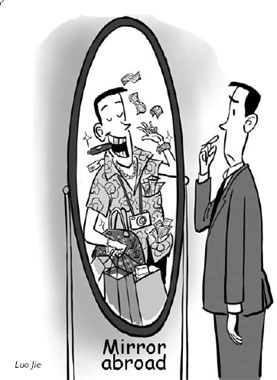
This brings the image of Chinese tourists sauntering across the world. Chinese people traveling abroad are a surprising phenomenon today. In 2007, about 37 million of them traveled overseas, which was a six-fold increase from 1995 and 50-fold from 1985. The World Travel Organization estimates that 100 million Chinese tourists would travel abroad every year by 2020. This key social and economic fact is hard to ignore. Overseas travel is a new experience for Chinese. It reflects their newfound wealth, higher standard of living and increasing personal freedom. But these positive traits are overshadowed by a problem: the "uncouth behavior" of Chinese tourists, especially when they travel abroad. Actions like jumping queues and talking loudly in public imply cross-cultural insensitivity, a lack of appreciation for local customs and ignorance of the subtle difference between private and public space. In 2006, the Chinese government launched a three-year campaign to "enhance the civil quality of tourist behavior", as part of which an intensive tourist educational campaign was implemented in cooperation with tour operators and transport providers. Though much progress has been made, the work is not yet finished.
Why Chinese tourists behave the way they do? There are many explanations. Closer in time, observers have mentioned the effects of the "cultural revolution" (1966-76). Further back in time, an academic even traced the behavior to the emergence of the jianghu culture (the Robin Hood-and-his-band-of-merry-men kind of society-outside-society) during the middle reign of Ming Dynasty (1368-1644). Whatever the real reasons, two general circumstantial conditions must be recognized. First, people will commit cross-cultural faux pas whenever they encounter unfamiliar cultures. Cultural shock has its behavioral ripples. Every Western tourist in China would have at least one faux pas story to tell. Despite precautions, business travelers keep committing gaffes in China, sometimes with costly consequences. But Chinese tourists tend to commit faux pas en masse. When people are isolated culturally in a foreign land, their behavior tends to wobble. But then Chinese tourists also display similar behavior at home, which brings us to the second circumstantial condition. When people acquire wealth suddenly, more likely than not their behavior shows nouveau riche traits, which include ostentation and haughty arrogance. This is reality, and has been rampant across the globe throughout human history. Currently, a Chinese traveling overseas spends an average of $1,000 on luxury goods. Conspicuous consumption connotes power, the false sense of which often leads to haughty arrogance, which, when crudely expressed, could end up as tasteless, philistine kind of behavior. But with the passage of time, the average Chinese tourist will become comfortable with his/her wealth and with other cultures. Once that happens, Chinese travelers will gradually shed the traits they are associated with today. And to achieve that, we should continue our educational efforts. The author teaches philosophy in the United States. (For more biz stories, please visit Industries)
|
主站蜘蛛池模板: 兴山县| 克什克腾旗| 阜阳市| 乌兰县| 集安市| 黑山县| 伊川县| 新绛县| 延安市| 锡林郭勒盟| 即墨市| 剑川县| 普兰店市| 延川县| 建宁县| 寿宁县| 南城县| 福鼎市| 神农架林区| 海丰县| 丰县| 北海市| 永清县| 延川县| 祁东县| 灌阳县| 孙吴县| 苍溪县| 锦屏县| 临城县| 称多县| 泾阳县| 金沙县| 樟树市| 吉水县| 甘谷县| 岗巴县| 安岳县| 铁力市| 吉木萨尔县| 无棣县| 皋兰县| 体育| 呼伦贝尔市| 清苑县| 大同县| 周宁县| 黑山县| 泸溪县| 溧水县| 晋中市| 青阳县| 皮山县| 枣阳市| 石柱| 普宁市| 嘉峪关市| 宁乡县| 中西区| 同江市| 宁津县| 宜宾市| 循化| 怀仁县| 平原县| 肥城市| 巴林右旗| 兴安盟| 肃宁县| 会泽县| 方城县| 抚宁县| 县级市| 田林县| 高尔夫| 英德市| 莎车县| 黄骅市| 长治县| 民和| 广灵县| 连江县|