BIZCHINA> Review & Analysis

|
BIZCHINA> Review & Analysis
|
|
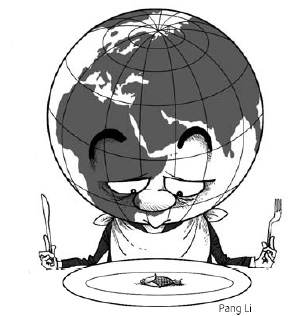
Financial crisis has deepened food crisis
(China Daily)
Updated: 2009-10-16 16:14 Q: How has climate change affected the world food situation? A: Communities should play the key role in fighting climate change. We can debate on the issue of emissions, but the fact is that the poor have been hurt the most.
If they are not helped, they will suffer a greater impact of climate change. For example, climate change can cause the loss of (arable) land. In many places, the topsoil has been washed away by floods. If people don't have land to grow food, they will migrate. And there will be mass migration between countries, which may lead to lots of conflicts. Q: Which countries or regions will be threatened the most by the food crisis caused by climate change? A: Island states are under the greatest threat because climate change is raising the sea level. Some countries in Latin America have experienced landslides caused by unusually heavy rain. It is estimated that Africa will lose 50 percent of its capacity to grow food. If we see it globally, the impact of climate change can be more serious. Q: The world has about 1.02 billion hungry people. How many of them will die of hunger? A: We know that hunger kills one child every six seconds. That number hasn't changed. But we are watching Africa very closely because we believe the crisis is regional. We don't have any numbers on people who may die of hunger. We hope the international community will step up its efforts before starvation becomes a threat. Q: What action has WFP taken to help the people facing hunger? A: In Liberia, we have introduced school meals in urban areas, and extended it to the weekends. We help to keep the schools open on the weekends, too, because the school meal is the only one the children can get. If the schools are closed, they will have to go hungry. In many places, people are hungry not because there is no food, but because they cannot afford the high food prices. So we have launched a program, Purchase for Progress, to make food available at affordable price. We try to cover the gap between affordability and income of the people we support. We also have a program to buy more food from small farmers. WFP uses its purchasing power to increase production and quality of crops that small farmers grow. Q: How do you manage to buy food from the small farmers, who are scattered across the world? A: The method varies from country to country, but infrastructure is most important. Buying is more difficult in places that have weak infrastructure. That is why we encourage other countries to learn from China. In many places, farmers are encouraged to organize cooperatives. If farmers can be reached, it will be easier to buy from them. Through such cooperatives we help the farmers grow crops better and to make them meet the standard we require. We help them participate in the market, too. It's a huge pilot project. Q: Have you already started this in many countries? A: Yes, in 14 countries, most of them in Africa. A couple of them are in Latin America. This program can help the demand side grow. The supply side will grow, too. We don't work on the supply side but we work with partners who help the supply side. We are trying to get the farmers organized at the same time as we are trying to persuade the governments to develop their infrastructure. We hope small farmers can have access to the facilities, although it's not easy. Q: It may not be enough for the world's hungry people to rely only on aid. Can you suggest how developing countries with hungry people can improve their agriculture? A: In WFP, we have a program for mothers and children to break the poverty cycle. If girls stay in school longer, they are more likely to raise healthy families. If girls stay longer in schools, they won't be married at a very young age. And if they get some education, they may raise their children in a healthier way and thus break the cycle of poverty. We are not just helping people, but also showing them how they can help themselves get out of poverty and hunger. Through the Purchase for Progress program, we help them grow more food, which they don't necessarily have to sell to us. We not only provide aid, but also create market dynamics.
Q: Do you mean that besides buying food from small farmers, WFP also introduces new technology to farmers? Have you ever introduced new seeds to them? A: WFP doesn't provide seeds we work on the demand side. But we explain our buying standards to the farmers and how they can achieve them. And then associations like cooperatives and other partners that work with the farmers on the supply side help them meet the standards.
(For more biz stories, please visit Industries)
|
||||||