BIZCHINA> Review & Analysis

|
BIZCHINA> Review & Analysis
|
|
High rate must give way to quality growth
By Yao Shujie (China Daily)
Updated: 2009-11-11 08:38 At last weekend's G20 financial ministers' meeting, the world's leading economies agreed on the need to shift their focus from crisis response to a stronger, more sustainable and balanced growth. China's growth figures show it has little to worry about in that area. The Chinese economy is strong, having grown 8.9 percent in the third quarter, up from 7.9 percent in the previous quarter. And the country's budgetary deficit remains low, allowing the government to maintain aggressive lending programs and a vast stimulus package. Yet the overriding question for international economists at the Globalization and Economic Policy Centre forum at the University of Nottingham's Ningbo campus in Zhejiang province this week is how to avoid a second financial crisis - a crisis triggered by China. The obstacles that lie ahead are by no means hidden. With liberal lending - the World Bank puts Chinese government loans at a record $1.27 trillion this year - comes excess liquidity that sloshes around the system, inflating serious asset bubbles. In China, these bubbles are forming in stocks and, especially, the property market. House prices are out of control in metropolises like Beijing, Shanghai and Guangzhou, making property more expensive than in most UK cities outside London. This, when China's per capita GDP is 10 times less than the UK's. Common sense says this is grossly unsustainable. House prices cannot keep rising given the relative income levels. If prolonged bouts of quantitative easing drive up inflation and interest rates, ordinary people will struggle to meet their mortgage repayments. The bubble will eventually burst, creating the fundamental conditions for a second financial crisis. Industrial overcapacity in sectors such as steel and coal, too, remains a source of anxiety as the government struggles to rein it in despite the regular issuance of new policy announcements aimed at curbing investment. Then there is the ever-present dispute over the valuation of the yuan, which was drowned out in the panicky aftermath of the global financial crisis but which is now bubbling back to the surface amid signs of recovery and calls for a new era of global collaboration. The value of the yuan has been pegged at 6.8 to the US dollar for more than a year now. Western fingers have started pointing again, and the issue will be high on Barack Obama's agenda when he visits Beijing at the end of this week. This is understandable. China still enjoys a mammoth trade surplus and by allowing the yuan to appreciate, it would help balance global trade. But the Chinese leadership is worried, and rightly so, that the country's export sector, on which its economy relies, would take a beating and that hot money would flow over China's borders spurring on the asset bubbles it is desperately trying to avoid.
 In averting potential asset bubbles China needs to act with foresight and be wary of allowing the market to dictate policy. It should work with leading economies to draft coordinated and transparent policies to decide when interest rates should rise, rather than delaying decisions until market forces compel them to do so. When it comes to the housing dilemma, local governments cannot be allowed to continue to use the property market to boost their revenues while ordinary urban residents struggle to get on the property ladder. Local authorities must look at society as a whole and pay more attention to increasing the supply of low-cost housing. Taxes should be raised for higher-income people living in apartments of 100 sq m or above. The revenues can then be used to subsidize smaller apartments of 40 to 50 sq m for low-income groups. Similarly, the government has to be more aggressive in its tax policies toward car owners. Rates should be raised for those who own gas-guzzlers and benefits should be afforded to those who purchase cars with engine sizes smaller than 1 liter. The central government would also benefit from being more selective in the areas of the economy it bombards with credit. Investment in infrastructure, education, healthcare, the environmental sector and technology is vital for long-term growth.
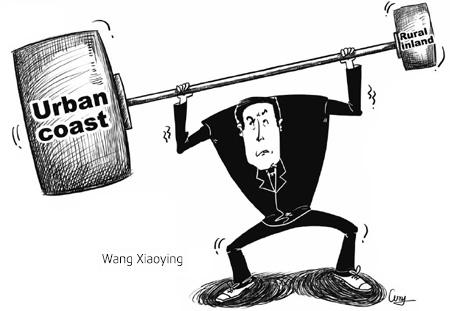
Double-digit growth should no longer be the aim for China. It is the quality of that growth that should count and much will depend on establishing greater equality between coastal and inland - notably western - areas. Efforts should be made to set up strong growth centers in cities such as Xi'an, Chengdu and Kunming to drive the growth of medium and small cities in those regions. This would create productive employment for local people and reduce the number of rural migrants moving to the already overcrowded coastal cities or to Beijing, where water is scarce. The Chinese economy is expected to overtake that of the US around 2030. But of greater long-term importance is how the government can create a sustainable living environment for 1.3 billion people. Social equality is crucial for China's next 20 to 30 years of development. For this, the leadership will have to approach development much more cleverly than before. The author is head of the School of Contemporary Chinese Studies at the University of Nottingham. (For more biz stories, please visit Industries)
|



