Opinion
Who said Chinese have to spend more?
By Jonathan Anderson (China Daily)
Updated: 2010-02-02 07:49
 |
Large Medium Small |

One of the most common tenets of the pundit class is that emerging countries consume less than developed nations do - and that global rebalancing involves getting emerging consumers to spend more and advanced consumers to spend less.
Is this actually true? Our answer is "a bit, perhaps - but not nearly to the same degree as most investors would imagine".
As it turns out, there is no structural difference whatsoever in private consumption/GDP shares between emerging and developed markets. Moreover, the more recent drop in the emerging consumption/GDP ratio has less to do with consumption and more to do with the (temporary) inflation of other parts of GDP - that is, even on a cyclical basis it's unlikely that higher consumption spending in emerging economies will play any significant role in global rebalancing.
Who consumes more?
Well, to begin with, historically there is no real difference at all between developed and emerging household consumption ratios: the 1960-2000 average is 60 percent of GDP in the emerging universe as a whole, and 60 percent of GDP in advanced countries as well.
So where do we get the common idea that consumption ratios are higher in the developed world? As it turns out, this has nothing to do with households. Rather, the culprits are governments. According to national accounts data, the average historical government consumption ratio is about 13 percent of GDP for emerging countries and closer to 20 percent for advanced markets. So when you add the household and government ratios together it does turn out to be true that overall developed consumption shares are higher. But again, this has nothing to do with private consumption spending.
The above points are true for the past 50 years as a whole, but if you just look at the last decade, there has been a clear upward trend in the developed household consumption ratio - and an even more visible and sharp decline in the emerging ratio. Isn't this clear evidence of "global imbalances" in action? And doesn't this mean that emerging countries need to boost domestic consumption in order to rebalance the world?
Again, the answer is "probably not in the way that most investors imagine".
The first point is that although nearly every financial commentator tends to point a finger at China (where headline consumption ratios have indeed fallen significantly since 2002), its economy is actually a minor part of the overall emerging consumption decline, accounting for less than one-third of the total net adjustment in recent years.
Who accounts for the rest? As it turns out, the entire remaining decline came from emerging oil and fuel exporters. To give a sense of numbers, Russian household consumption was about 54 percent of GDP coming into the current decade but had fallen to 45 percent by 2008. The numbers are fairly similar for countries such as Iran and Venezuela. Private consumption in Nigeria was 80 percent of GDP in 2002, but only 55 percent six years later. And in Saudi Arabia and other Gulf oil exporting economies private consumption shares fell from 45-50 percent to a paltry 25 percent of GDP over the same period.
Why did consumption/GDP ratios fall so heavily in the emerging oil and fuel bloc?
It certainly wasn't because of weak consumption; real consumer spending growth in commodity exporters reached record levels in the past five years. So the problem is not that consumption fell, rather it's simply that the nominal GDP base shot up as oil prices skyrocketed through 2008. And to a large extent this is business as usual. We had exactly the same phenomenon from 1973 to 1980 during the last global price shock.
When we talk about "rebalancing" in these cases, we're not really talking about the need to address a structural consumer problem. Instead, most of the subsequent action has come through falling oil prices, that is, reversing the temporary inflation of the denominator in the consumption/GDP ratio rather than increasing the numerator.
Lower oil prices directly slashed the estimated current account balance for emerging market (EM) oil and fuel exporters from 14 percent of GDP in 2008 to only 4 percent of GDP in 2009. This, in turn, implies a sharp rise in the consumption/GDP ratio for these economies of perhaps 8 or 9 percentage points in the last year alone - all without any acceleration whatsoever in actual consumer spending.
And then there's China. Virtually alone among emerging non-fuel exporters, the official mainland household consumption share of GDP also fell precipitously in the past seven years, from 45 percent at the beginning of the decade to only 36 percent in 2008. Surely this, at least, points to a structural consumption problem that needs to be urgently addressed?
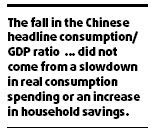
Perhaps not. As UBS has discussed in the Future of EM Surpluses report, the fall in the Chinese headline consumption/GDP ratio is very similar to that in the oil exporters, in that it did not come from a slowdown in real consumption spending or an increase in household savings.
Rather, just as in Saudi Arabia and Nigeria, the culprit was a sizeable increase in the GDP denominator - only this time, instead of oil, it came from a sharp rise in heavy industrial capacity, a good bit of which went into pushing up mainland net exports.
But the final impact was the same: In China as well as in emerging commodity exporting countries, the current account surplus shot up as national savings rates rose, but in all cases those savings came from the corporate or official sectors, not from households. (For a simple exposition of the above points please refer to The Myth of Chinese Savings, Far Eastern Economic Review, November 2009).
| ||||


As she stresses, China's real rebalancing lies elsewhere: first and foremost, in measures to control excessive industrial capacity creation by adjusting relative costs, promoting lending discipline and sending a higher share of corporate profits to state and private shareholders.
All of which, incidentally, involve slower trend growth compared to the overheated trend of the past five years - that is, once again, reducing the denominator in the consumption/GDP ratio rather than raising the numerator.
The author is an economist with UBS