Opinion
Succeeding in the family business can be a hazardous affair
By Jean Lee (China Daily)
Updated: 2010-03-01 13:07
 |
Large Medium Small |
Over the past two centuries, family enterprises have made great contributions to the growth of wealth and creation of job opportunities in many countries, becoming the dominant economic elements of developing and developed economies.
According to the China Private Economy Development Report released by the All-China Federation of Industry & Commerce in 2006, private economy accounted for around 65 percent of China's gross domestic product (GDP) in 2005 and provided 84.1 percent of job opportunities in second and third-tier industries. Furthermore, the tax revenue of private companies has been more than 70 percent of the fiscal revenue of many places where 70 percent of the private economy is made up of family enterprises.
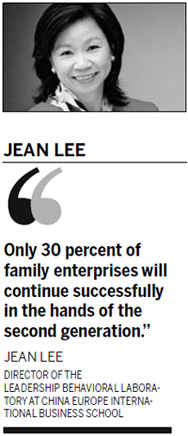
However, it's estimated that only 30 percent of family enterprises will continue successfully in the hands of the second generation and only 14 percent survive into the third generation.
An EU research paper quoted by Herbert Neubauer in the book The Dynamics of Succession in Family Businesses in Western European Countries said there would be obstructions, including organizational and individual barriers, when family enterprises are handed down to the next generation. If that is true, the feasibility of business transfer should be fully considered in order to avoid the potentially fatal risks brought by such obstacles to family enterprises.
The barriers
Organizational barriers include outdated products and services, the inappropriate scale of the enterprise and obsolete management and organizational structures. Indeed, the barrier created by a specific individual is the key area to be addressed in the succession process. The main complaint or problem caused by this is that the successors are inexperienced in business and management.
The journalist Sharon Nelton, who has written extensively about nepotism, pointed out that experience working beyond one's own family enterprise is vital in helping successors strengthen their self-awareness and prepare to deal with problems and difficulties in the business.
According to Robert H. Brockhaus, in his book Family Business Succession: Suggestions for Future Research, training within one's own family enterprise, including the gradual increase of management responsibilities, expands the range of a person's work. Also establishing relations with major clients is valuable for the cultivation of successors. Another good approach is to send successors on relevant courses and training programs.
An excellent education background, relevant external work experience as well as internal induction programs are key elements in the succession planning of family enterprises.
Another important dimension in succession planning is to examine the family relationship.
It is said, "Family business is the business of relationships" and "Relationships are at the heart of family business". The key element of a family system, which usually has the strongest influence on the operation of business, is the social ties among family members. Family relationships may not appear to be too important to the success of a family business until we witness the unraveling of a great organization due to family bickering, backbiting or outright conflict.
Family relationships do have a substantial influence on the attitude and behavior of the second generation working in family businesses.
Research has found that family cohesion has an impact on the attitude and commitment of the second generation who stay in a family business.
In highly cohesive families parents spend considerable time discussing their future expectations and plans with their children. This particular kind of communication encourages the children's desire to fulfill their parents' dreams of continuing the business.
This desire, coupled with a high degree of loyalty found in highly cohesive families, increases the children's commitment to the organization. However, research has shown that family cohesion is not as significant as family adaptability in impacting on the work satisfaction and commitment of the second generation.
Family adaptability refers to how the family functioned as a unit, their flexibility in meeting difficulties, a readiness to adjust to changes, and the manner of making decisions. In highly adaptable families, parents encourage the sharing of leadership responsibilities. This characteristic is believed to make family members more involved with and concerned about the well-being of the business. In addition, highly adaptable families improve the skills of members in understanding the differences between each individual's expectations and needs. This helps family members to negotiate their individual expectations better and formulate a shared vision of the business in which some form of commitment is created.
More specifically, adaptability is a valuable asset to have in family businesses because it affects the second generation's work satisfaction and organizational commitment significantly. And work satisfaction and organizational commitment are significant predictors of a propensity to leave. As such, family business owners need to exercise a certain degree of flexibility with the second generation in order to make the latter stay and willing to succeed in the business.
|
||||


A balanced family system is characterized by a more open leadership style, more open communication and sharing of roles which are more clearly defined. Decision-making is conducted in an open and participative manner.
Such a system will nurture commitment and satisfaction. In contrast, an unbalanced family system. in which individuals wield control and power and where roles are not well defined and decision-making is unpredictable, will strongly affect the commitment and satisfaction of the second generation.