Top Biz News
China must learn from Toyota's mistakes
By Li Fangfang (China Daily)
Updated: 2010-03-15 09:49
 |
Large Medium Small |
Legislation on recalling defective vehicles is needed, say experts
Japanese automakers' recent product recalls were not only a warning to Chinese homegrown brands not to expand too fast and ignore management and quality control, but also sounded an alarm to China's automobile recall system.
"Although we seldom witness Chinese automakers' recall initiatives, it does not mean that their products are high quality," said Tan Kunyuan, an auto industry analyst with Changjiang Securities.
 |
|
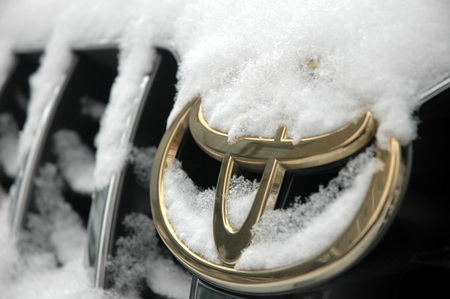
The Toyota logo on a car covered in snow in Beijing. This winter is really cold for the Japanese automaker who saw one disaster after another in its product quality and after-sales services. [CFP] |
"Quality defects often emerge a long time after the vehicle has been in use, but Chinese-branded vehicles have only been in the market for a short time. Moreover, as recalls have a serious impact on brands, the still-young domestic automakers deal with quality problems through their after-sales service, rather than recalling them," said Tan.
However, Luo Lei, vice-secretary of China Automobile Dealers Association, attributed the rare occasions of recall from domestic automakers to an imperfect automobile quality supervision system in China.
"Whether it's the US, European countries or Japan, faulty vehicles are under strict supervision and restrictions from the governments by related laws but, in China, we only have a recall regulation, rather than a law, with which to deal with auto manufacturers," said Luo. "Without authoritative legislation, no enterprises are willing to initiate recalls."
In 1966, the US government legislated for the recall of defective vehicles. Japan began to implement a vehicle recall system in 1969 and included it in its auto industry laws in 1994.
However, China only started to pay attention to vehicle quality issues in October, 2004, by launching a vehicle recall regulation.
According to statistics from the national quality watchdog - the General Administration of Quality Supervision, Inspection and Quarantine - over the past five years it received 212 active recall applications from almost 60 automakers, involving 3.21 million defective vehicles in total. Only seven among the 212 recalls were from Chinese automakers. This compares with the recall of 3.29 million vehicles in Japan in 2001 alone.
The US has recalled more than 200 million vehicles since 1966.
"Without a complete law to regulate vehicle quality, the domestic automakers will have no awareness to voluntarily recall their defective cars," said Luo.
China overtook the US to become the world's largest auto market last year, with 13.6 million vehicles sold within 12 months. China now has more than 180 million vehicles on the road, including 26.1 million cars owned by individuals. The number increased 33.8 percent from a year earlier.
In 2009, China experienced 238,351 traffic accidents, with 67,759 people being killed, 275,125 injured. This is said to have cost 910 million yuan ($133 million). Analysts said that although vehicles are not the major killer in accidents, some of the tragedies are caused by vehicle defects.


Another deficiency of China's recall system is that the government's punishment for faulty vehicle producers is considered to be too light.
According to the regulation, maximum penalties for automakers that try to hide product defects are a fine of 30,000 yuan, without compulsory compensation to purchasers. That compares with Toyota's possible penalty of $16.4 million required by the US government for the current recalls, and more expensive compensation to consumers.
"Japan also added compulsory compensation to consumers to its recall system in 1995," said Jia Xinguang, an independent auto analyst based in Beijing.
He also suggested that China should establish an information collection and management system with a database to support the recall system.
"Moreover, China should extend the range of recall in the automobile industry to some automobile parts and accessories," said Jia. "By the end of 2007, Japan had conducted seven recalls on 130,000 automobile accessories after it included automobile parts and accessories such as tires and children's car seats into its recall range in 2004."