Opinion
Debate: Urbanization
(China Daily)
Updated: 2010-03-29 07:52
 |
Large Medium Small |
Zhao Zhihao: Urbanize west to rebalance development
The rise of Chongqing as a megacity and economic center has brought the issue of developing cities in the vast expanse of China's central and western regions to the forefront.
A large number of cities in northern and eastern China, such as Beijing and Shanghai, have developed into world-class metropolises because of the past three decades of reform and opening up. The rapid development of these megacities have been in line with China's rapid economic growth, but they have also created problems like skyrocketing housing prices, shortage of resources and intense competition.
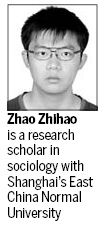
Developing more cities in central and western China is one way of correcting the imbalance between the developed eastern and southern regions and the backward western areas, says Zhao Zhihao, a research scholar in sociology with Shanghai's East China Normal University.
In other words, the government has to follow the Chongqing model to help western China's urbanization keep pace with the country's overall economic development.
The central and western regions together account for nearly 90 percent of the country's territory, but their urbanization, 40.4 percent and 35.7 percent, is well behind that of eastern China's 54.6 percent. Scattered population and large swathes of land with a low urbanization rate have impeded economic development in the central and western regions.
The low rate of urbanization in the two regions has made people there heavily dependent on agriculture. But the problem is that many places in central and western China don't have favorable farming conditions for lack of resources. As a result, it has become difficult to alleviate poverty there, Zhao says.
To tackle the problem, efforts must be made to transfer laborers from rural areas to cities, expedite urbanization and replace agriculture with industry as the main source of livelihood.
This certainly is not an easy task, he says. On one hand, there is considerable outflow of skilled personnel from the central and western regions to the developed east, which has created a dual problem: brain drain in the two regions and an excessively high density of population in eastern China.
On the other, capital still finds eastern China more lucrative and thus ignores the government's advice and favorable policies for industrial and commercial development in central and western China. This is not surprising considering the scaled economic effects in cities, which means better infrastructure, more business opportunities and bigger markets for enterprises, more and better jobs openings for candidates, and convenience for employers to get suitable recruits.
In comparison, many of the infrastructure facilities that are taken for granted in big cities may not be important for towns whose populations can be measured in thousands or tens of thousands, Zhao says. So how does the government go about the urbanization drive?
|
||||


Many of the areas that governments in other countries developed didn't have enough people around for sustained industrial growth. China doesn't face that problem, for its central and western regions hold hundreds of millions of people.
As the already developed areas of eastern China are expanding and modernizing their megalopolises further to carry development forward, the central and western regions should focus on cities for their development.
And they can use Chongqing, which headquarters multinationals like Chang'an Auto, Foxconn and HP, as a reference point.