Opinion
Business is not the same in China
By Wellington K. K. Chan (China Daily)
Updated: 2010-07-28 16:43
 |
Large Medium Small |
Why has China succeeded so spectacularly in the span of just three decades since the launch of Deng Xiaoping's economic reform? The reasons that are usually cited are China's compelling demographic, geographic and broad cultural factors. What is less understood is that China's success has also depended on its entrepreneurs - and their deeply rooted patterns of activity.
There are two key aspects of Chinese entrepreneurship. Traditionally, successful Chinese businessmen emphasized trust and reliability in fulfilling commitments (xinyong), the gradual development of sentiments (ganqing) with customers and suppliers, and the ability to build on networks of relationships (guanxi) that are often based on common origin or kinship. They also stressed the need to be bold, frugal and highly driven to succeed, as well as the ability to adapt to changing market conditions.
Some of these characteristics are more culturally specific than Joseph Schumpeter's description of entrepreneurship as a process of "creative destruction" might imply. But boldness and adaptability do accord with Schumpeter's emphasis on forming new combinations and doing things in new ways. For example, traditional businesses, from fabric wholesaling to banking and salt mining, evolved elaborate profit-sharing schemes among owners, partners and employees as their businesses expanded over time or into chain outlets across the country.
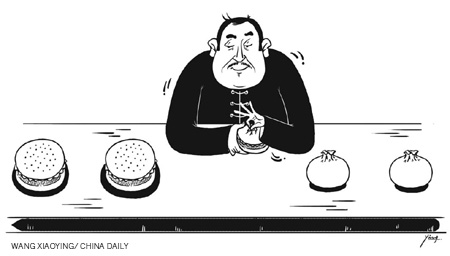
When new forms of business such as textile manufacturing and department stores came to China from the West in the late 19th century, Chinese businessmen quickly adopted them and adapted them to local conditions. More recently, local managers who took on McDonald's franchises transformed several aspects of the business to fit Chinese tastes and habits.
A second aspect of Chinese entrepreneurship is the kind of institutions and the management style that it embodies. I have studied many Chinese firms that flourished from the early 19th to the mid-20th century. They all seemed to have the following core features:
Small to medium size, with a relatively simple organizational structure;
Considerable overlap of ownership by individuals linked by family and kinship ties, or by partnerships among kin and family friends;
Centralized and disciplined decision-making;
Personal and family networking that encourages opportunistic diversification, transcending regional and national boundaries to expand;
Cooperation with affiliate firms to reduce transaction costs in sourcing, capital acquisition, and contracts; and


These structural features fit well with Chinese merchants, who did not want to see their companies grow so large that they attracted official attention. Successful businessmen could in fact build up extensive holdings by owning or sharing several businesses. Since China never established male primogeniture, this meant that when a successful businessman died, each of his sons could have his own business to start with.
Likewise, the functional features of Chinese entrepreneurship were heavily dependent on cultural values, particularly given a financial and legal system that was often unreliable. Thus a business was controlled and managed mostly by family members and relatives, with support through networking with those in an established relationship of trust.
This history and evolution matter in trying to understand today's Chinese entrepreneurs.
The great majority of the roughly 24 million private individuals estimated to have gone into business between 1980 and 2005 were ordinary folk with very small capital - usually obtained by pooling the savings of family members and perhaps friends.
Their businesses include small stores or a stand on a busy sidewalk selling specific goods or providing some service. Only some 3 million of these businesses gained sufficient size and organization to form limited-liability corporations that issued shares. And all firms with annual revenues of $1 million or more seem to have required some form of support from officials, who serve as gatekeepers for all forms of licensing, sourcing, and financing.
In recent years, some of these controls have been relaxed. Attending to the gate-keeping role of officials has become less of a necessity. But networking and connections continue to matter.
And, aside from a relatively small number of joint ventures with foreign partners and State-owned enterprises that are in fact hybrid public-private firms, most businesses today, including publicly listed companies, remain family owned or dominated.
Some may have grown large in size and scale, but only to the point where they could compete efficiently in the international market. Even the small number of national companies that have grown large are relatively small when compared to the Japanese kereitsu or the South Korean chaebol.
Chinese entrepreneurs nowadays are particularly well adapted to take advantage of new market trends brought about by rapidly changing fashion and similarly rapid technological progress. Their relatively small companies and their efficient decision-making processes allow them to remain nimble and to react quickly.
In addition, their often highly diversified structure and their loose network of affiliates and supply chains allow Chinese entrepreneurs to reconfigure business strategy and production facilities quickly, thereby bringing new products to the market with shorter lead time. For example, Chinese cell phone companies offered 3G phones much earlier than in America, and when they learned that each phone was being used by several individuals in rural China, they programmed their phones to allow multiple accounts for each phone, thereby adding tens of millions of new subscribers.
Despite continuing political restrictions, Deng Xiaoping succeeded beyond his wildest imagination.
The author is professor of Humanities and professor of History at Occidental College, Los Angeles. Project Syndicate.