Markets
Battle of the beans
By Lan Lan (China Daily)
Updated: 2010-08-23 13:21
 |
Large Medium Small |
|
 |
|
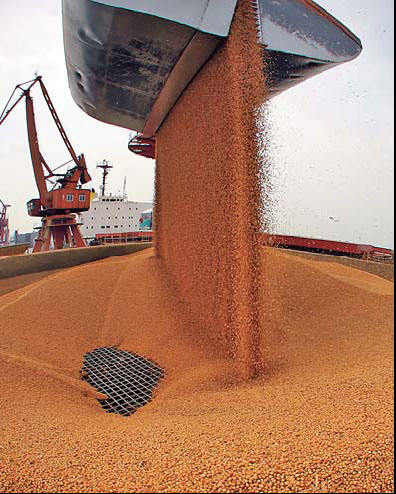
China's soybean imports increased 16.2 percent year-on-year to 30.76 million tons in the first seven months, according to recent statistics, threatening domestic soybean production. [Xu Congjun / For China Daily] |
HARBIN - Farmers in China's Heilongjiang province are losing faith in soybean production because of growing imports of genetically modified varieties of the foodstuff.
Some working the land in the nation's main soybean supply base have given up growing the produce entirely.
| ||||


More than a decade has passed since China became a net soybean importer in the mid-1990s and those cultivated abroad have nibbled away at the home-grown variety every year since.
China's soybean imports increased 16.2 percent year-on-year to 30.76 million tons in the first seven months, according to the latest China's customs statistics.
Farmers such as Li Guofu, 61, in rural Jixi, Heilongjiang province, have now decided to stop soybean cultivation.
"It's customary for local farmers to grow soybeans but we have to shift to other crops since you can't make money from them," Li said.
A mu of land, about 666 square meters, can generate about 300 yuan from corn but farmers would hardly break even if they planted soybeans instead, he said.
Farmers worry about selling the soybeans after harvesting them because most local oil refinery businesses have ceased production.
International players such as Archer Daniels and Midland have dominated nearly 80 percent of the soybean processing capacity in China.
They largely use imported GM soybeans, which are about 300 to 600 yuan cheaper per ton than non-GM soybeans, said industry insiders.
The price of GM and non-GM soybean oil and soybean meal in China are largely the same, so it makes economic sense for processing enterprises to buy imported GM soybeans.
China consumes about 10 million tons of soybean oil and about 40 million tons of soybean meal per year, more than 80 percent of which is imported or made from imported GM soybeans.
"The dual standards in trade policy failed to provide an equal competition platform for the domestic industry. It stimulated more imports instead of protecting the domestic industry," Fan said.
Generally, countries that don't allow production of GM crops, also prohibit the importing of GM crops.
So far, China has yet to approve GM crop production but the nation imports more than 40 million tons of soybeans per year from countries such as the United States, Brazil and Argentina that mainly grow GM soybeans.
Fan said China should either permit the domestic production of GM soybeans or forbid importing them to create a level playing field.
"Chinese soybeans are green and come with lots of nutritional value. They should be priced higher, but it's a big pity that we have yet to become a successful brand," said Zhang Honglei, an official of Heilongjiang Beidahuang Group, the biggest agriculture group in Heilongjiang.
"We are not willing to cultivate GM soybeans even if we could. There are still many uncertainties about GM food and it contradicts our vision of building a green and natural ecology."
Competition from outside is "cruel" and the industry needs more protection from the government, Zhang added.
To alleviate the pressure on farmers, the government has protectively purchased some soybean produce in northeast China since 2008.
Both American and European countries adopt various measures to protect their own soybean industries. These include subsidies or lifting tariffs on imports, as well as non-trade methods such as the prohibition of imported GM food, said analysts.
In comparison, China's protection for the domestic soybean industry is not enough, said Fan of the Food Policy Research Institute.
Another reason for today's problems is the lack of attention paid to soybean research and development over the past 10 to 20 years, said Fan.
Domestic soybeans have less oil and provide lower yields compared with soybeans from the United States and Brazil, but that can be changed by adopting higher level technologies, Fan said.
"It's still not too late to rescue the Chinese soybean industry," he said.