Economy
Learning from wolves to fight lions
(Xinhua)
Updated: 2010-09-01 15:17
 |
Large Medium Small |
Working for customers In 1988, with 20,000 yuan ($2,942) borrowed from his relatives and friends, 44-year-old ex-serviceman Ren Zhengfei founded Huawei as a distributor of imported exchange switches for a Hong Kong company.
The 2010 Fortune Global list published by the US magazine "Fortune" ranked Huawei at number 397 with annual sales of $21.8 billion and net profits of $2.67 billion in 2009.
Unlike many of its Chinese counterparts, Huawei has a strong commitment to creating long-term value for its customers by being responsive to their needs and requirements.
"We exist to serve customers, whose demand is the driving force behind our development, and we measure our work against how much value we bring to customers, because we can only succeed through our customers' success," Huawei's founder Ren once said.
Forty-six percent of Huawei's 95,000 staff works on R&D, on which the company persistently spends at least 10 percent of its revenues. Even during the economic downturn in 2009, the company increased R&D spending by 27.4 percent from 2008 to 13.34 billion yuan.
With 17 research institutes in the US, Germany, Sweden, Russia, India, and Italy and other countries, mainly employing local engineers, it has also set up more than 20 joint innovation centers with top operators such as Vodafone.
However, most Chinese enterprises are less enthusiastic about innovation.
Big industries, mainly state-owned enterprises (SOEs), have no reason to innovate, as they can achieve huge profits by virtue of their monopoly, says Professor Yao Shujie, head of the School of Contemporary Chinese Studies at the University of Nottingham.
"For SMEs and private businesses, the motivation is there, but most of them have funding shortages partly due to Chinese banks' selective lending approach, which favors SOEs," Yao says.
In 2008, China's large and medium-sized industrial firms (with an annual revenue of more than 30 million yuan) spent 0.84 percent of their revenues on R&D, a sharp contrast with the 5 percent to 10 percent allocated by companies in the West and Japan and the Republic of Korea, the National Bureau of Statistics (NBS) said on Dec 28, 2009.
The NBS's second national economic census in 2009 found only 6.5 percent of industrial enterprises (all SOEs and private firms with annual revenue of more than 5 million yuan) conducted any R&D activities at all.
 |
|
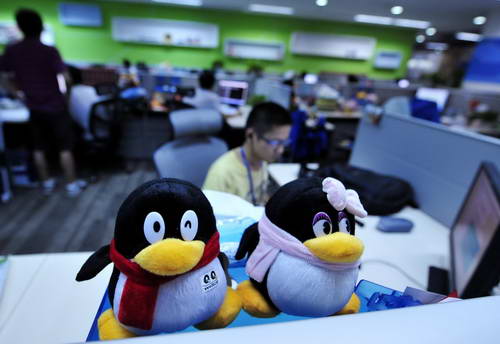
Staffers at work at Tencent's office in Shenzhen, south China's Guangdong province, Aug 20, 2010. [Photo/Xinhua] |
Leveling the Playing Field
While the "wolf culture" and the customer commitment can inject innovative spirit into enterprises, the government still has a role in encouraging innovation.
|
||||


It is no coincidence that these innovative champions are located in Shenzhen, says Ni Pengfei, director of the Research Center For City and Competitiveness at the CASS.
"The government of Shenzhen encourages enterprises to take center stage in innovation by being single-focused on creating a level playing field for all kinds of companies, big or small, private or state-owned," Ni says.
The fair and open market system of Shenzhen forces SOEs to innovate under real threat from competitors and ensures SMEs have the funds and the confidence to invest in R&D, he says.
"Each innovation of Huawei is a direct product of market," says Ni. "The government should focus on its role of ensuring all players do business on an equal footing and the winners are selected by the market and customers."