Opinion
Boost China's financial power
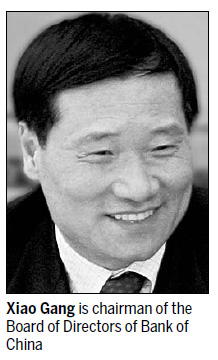
By Xiao Gang (China Daily)
Updated: 2010-12-03 16:44
 |
Large Medium Small |
China's stake in the International Monetary Fund (IMF) has become the third largest. Malaysia's central bank has bought yuan-denominated bonds for its reserves, representing a significant step toward the internationalization of China's currency. And a pilot plan, "mini-QFII" (Qualified Foreign Institutional Investor) in Hong Kong, could create channels for overseas institutional investors to participate in the Chinese mainland's capital market.
These developments have come about because of the reform of the global financial system, and have boosted China's financial power.
Yet there is no reason to be overjoyed or complacent. China is in the early stages of increasing its influence in the global financial market, and despite being the world's second-largest economy and one of the biggest manufacturing centers, it has limited influence in the international banking system and capital markets.
For example, though four Chinese banks are among the world's top 10 in terms of market capitalization, none is eligible to be on the list of 20 "systemically important" global banks that the recent G20 summit in Seoul asked regulators to draw up so that higher capital requirements and more supervision can be imposed on them.
China has $2.7 trillion worth of foreign exchange reserves, the largest in the world. But the reserves are actually a manifestation of the country's balance sheet and not real wealth. The People's Bank of China , the country's central bank, bought US dollars in the open market by either using commercial banks' deposit reserves or printing money. In other words, the funds used to buy the dollars have come from deposits of enterprises and households. Besides, these dollar assets on the central bank's balance sheet are matched by corresponding liabilities, which means that even if the central bank can print money, it will only be another kind of liability.
So, China's foreign exchange reserves cannot be regarded as a tool of financial power. Instead of using a fiscal surplus to buy the dollars, the central bank used created liabilities to purchase them at the cost of pouring huge amounts of base money into the domestic market. Thus, neither the government nor the central bank can allocate the reserves "free of charge", and anybody who wants to use the reserves must use yuan to buy back the dollars at a certain exchange rate.
China plays the role of the biggest creditor with the highest foreign exchange reserves by investing in fixed-income securities, some of which are US Treasury securities. China is in a safer position as a creditor than it would have been as an equity owner, but it can hardly exert influence on the global financial market.
Over the past few years, an increasing number of Chinese enterprises have adopted a "go-out" strategy to invest overseas in oil, gas, mining, metals and other sectors. By the end of 2009, China's accumulated direct overseas investment was $245 billion, which is just the 15th in the world.
The issuing of loans by Chinese banks abroad is another form of investment, and perhaps it may help Chinese companies to obtain raw materials, managerial know-how and distribution networks. Such loans, however, are not seen as a power tool, for the funds will go directly into a borrower's business rather than to shareholders. There is no doubt, though, that the money will play an important role in providing jobs and stimulating the local economy.
The non-convertibility of the yuan is a major hurdle for China to grow into a real financial power. Only capital account convertibility, that is, letting the yuan convert freely into foreign currency and vice versa can give the Chinese currency a chance to become an international monetary unit of account, medium of exchange and a store of value like the dollar and the euro.
A years-old trend reflects the importance of internationalization of the yuan. China started a pilot program last year of using its currency for global trade settlements, which could result in a rapid build-up of large overseas holdings in the yuan. Under such circumstances it is more than likely that China will loosen some of its grip on capital flows. In fact, many measures have already been taken in this regard. Making 12 of the 43 items classified by the IMF in the capital account completely convertible and 16 partly liberalized is just one of such achievements.
China needs to further deepen its capital market reform and gradually liberalize the capital account to facilitate the yuan's internationalization. As Robert Zoellick, the World Bank president, said in his article in Financial Times, the new monetary system "is likely to need to involve the dollar, the euro, the yen, the pound and a renminbi that moves towards internationalization and then an open capital account".
|
||||


More importantly, we need to pay more attention to financial soft power. The latest Global Financial Centers Index shows Shanghai has climbed five places to the sixth spot. But London and New York are still the world's leading cities when it comes to banking and other financial services. These cities have a vast pool of financial brains, backed up by world-class universities. A country's financial strength reflects its soft power as part of its knowledge-based economy.
Financial power is related directly not only to economic size and per capita GDP, but also to financial markets and financial industries. Only when China's financial markets become open and its financial sector stronger, can the country increase its financial power significantly.
To some extent, financial power is largely reflected in the confidence attached to a country's monetary system. The global financial crisis has proven that the US dollar has overdrawn on the confidence the rest of the world had placed in it. And now, the world needs a new multilateral monetary system that can merit renewed confidence.