Economy
Unions push for collective wage move
By Chen Xin (China Daily)
Updated: 2011-01-04 14:04
 |
Large Medium Small |
Negotiation mechanism to 'help cut labor disputes and boost pay'
BEIJING - The national trade union federation is planning to introduce collective wage negotiation in all enterprises over the next three years, to reduce labor disputes, a senior union official said.
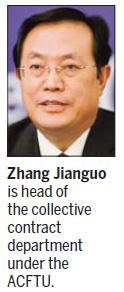
Zhang Jianguo, head of the collective contract department under the All China Federation of Trade Unions (ACFTU), said his organization will make it a priority to boost the negotiating power of grassroots trade unions.
"Nationwide experience has suggested that collective wage negotiation not only reduces labor disputes, but also helps workers' wages rise. It is also conducive to sustainable development of enterprises," he told China Daily.
China introduced collective wage negotiation in the early 1990s. About 1.25 million collective contracts had been signed by the end of 2009, covering more than 2 million enterprises and almost 162 million employees, according to ACFTU statistics.
Many local governments incorporated collective wage negotiation into their economic and social development plan, Zhang noted.
"Twenty-three provincial legislatures or governments have implemented regulations to boost collective negotiation as well as coordination among workers, employers and trade unions," he said.
Local unions have trained some 60,000 "guiders" who understand related laws and know how to protect employee rights to help in wage negotiations, he said.
China has seen an increasing number of labor disputes in recent years, with more workers resorting to strikes for higher pay.
Mediation organizations received some 406,000 labor dispute cases in 2010, a year-on-year rise of 12.1 percent, according to ACFTU figures.
ACFTU spokesman Li Shouzhen said low pay, and the slow pace of wage rises, were to blame.
Collective wage negotiation has led to the establishment of a reliable wage increase mechanism in some places, Zhang said.
"Wages of employees in enterprises that adopt collective wage negotiation are 10 percent to 15 percent higher than their counterparts without the protection of the mechanism," he said.
In some industries in Wuxi, Jiangsu province, workers' wages have grown by 5 percent to 10 percent annually in recent years after collective wage negotiation was adopted. In Tianjin's Hedong district, the yearly wage increase ranged from 10 percent to 22 percent, he said.
Besides, surveys carried out by local union federations show that most entrepreneurs think collective negotiation helps stabilize labor relations, Zhang said.
Zhang said the number of labor disputes received by Shanghai's labor mediation sector dropped 11 percent in 2009 from the previous year thanks partly to collective negotiation.
But there are many obstacles before collective negotiation can be extended to cover enterprises nationwide, he added.
"Some local governments have not realized the significance of collective negotiation to boost regional economic and social development.
"Many employers are not willing to sit down and talk about wages with their workers," he said.
Zhang said the lack of laws and regulations has also hampered the negotiating process.
Currently, there is no law in China requiring companies to sign collective contracts with employees, which explains why there is little incentive for them to do so.
To overcome this problem, Zhang said his organization will push the top legislature and the central government to amend related laws so that they spell out negotiating procedures and punishments for violators.
| ||||


About 80 percent of enterprises in China are privately run or foreign-funded, employing about 75 percent of the country's total urban workforce, according to the National Bureau of Statistics.
By the end of last year, 79 percent of overseas-funded companies and 78.5 percent of private companies had set up trade unions, ACFTU figures showed. The ACFTU plans to have trade unions widely established in the country's enterprises by 2012.
"We will also urge local labor departments to release the suggested wages for workers and regional labor costs and to detail the cost of labor in various industries (so that unions can refer to them in negotiations)," he said.
Zhao Wei, deputy director of the China Labor Studies Center at Beijing Normal University, said it will be some time before collective wage negotiation takes root.
"Many laborers, especially those in the construction and catering industries, are not aware of collective contracts. They don't have any leverage to force employers to sit down for wage negotiations," she said.
She suggested that workers should first become union members before they enter into wage negotiations with employers.