Top Biz News
China's economy grows 10.3% in 2010
(Xinhua)
Updated: 2011-01-20 10:54
 |
Large Medium Small |
BEIJING --? "In the past year, China has consolidated and boosted its recovery from the global financial crisis, and the national economy is generally operating well," Ma said.
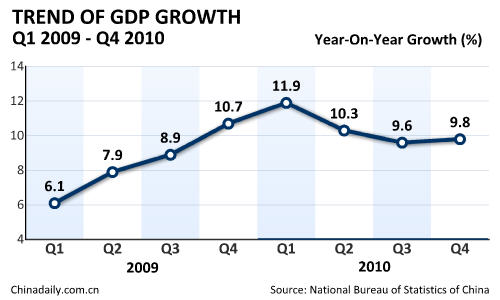
China's economy grew 10.3 percent last year, up from 9.2 percent in 2009, consolidating its recovery from the global crisis and adding expectations of further monetary tightening.
| ||||


"In the past year, China has consolidated and boosted its recovery from the global financial crisis, and the national economy is generally operating well," Ma said.
The country's economy has avoided overheating and a "double dip," he said.
The government set the full-year growth target at 8 percent in early 2010, after the economy recovered from the global economic downturn in 2009.
"The country is at a key stage of steering the economic recovery to stable growth," Ma said.
Zhang Liqun, a research fellow with the Development Research Center of the State Council, said China's economic situtation last year continued to improve and now the economy is on a stable growth track.
Zhu Baoliang, deputy director of the Economic Forecast Department of the State Information Center, described the country's economic performance in 2010 as "stable."
But the market reacted negatively to the better-than-expected figure, as the strong growth left more room for Chinese policy makers to curb inflation with further tightenings.
In Shanghai, the stock market tumbled almost 3 percent on Thursday to end at 2677.65 points.
China's consumer price index (CPI), the main gauge of inflation, rose 4.6 percent in December year on year and 3.3 percent for the whole of 2010, the NBS said.
The monthly figure was slightly lower than November's 5.1 percent, a 28-month high, but slightly higher than October's 4.4-percent growth.
Despite obvious progress in taming prices in December, China still faces challenges in curbing rising prices this year, Ma said.
One challenge is that some developed economies have introduced quantitative easing monetary policies, resulting in soaring international commodities prices, Ma said.
China's recent monetary policy, designed to fight the global economic crisis, has resulted in inflation, Ma said, adding that soaring labor costs and land prices have also pushed up prices.
The government said in December that it will shift its monetary policy stance from relatively loose to prudent in 2011.
"The stronger-than-expected growth figures will encourage Beijing to act more decisively to tame inflation. Rate hikes are just around the corner," said Qu Hongbin, Co-Head of Asian Economics Research and Chief Economist for Greater China at HSBC.
He expected at least another 150 basis points hike in the reserve requirement ratio and two 25 basis points rate hikes in the next six months.
China raised the bank reserve requirement ratio seven times in the past year, and hiked interest rates twice since the second half of last year to rein in inflation.
Lu Ting, China economist with the Bank of America-Merrill Lynch, said the fall in year-on-year CPI in December from a month earlier was mostly due to the peculiarities of the base figure, and that to a lesser extent good weather and Beijing's efforts to boost supply contributed to the lower figure.
Looking forward, Lu expects the CPI to spike again in January, due mainly to the timing of the Chinese New Year holiday and worsening weather.
The CPI might decline moderately after February if the weather normalizes, Lu added.
But Ma Jiantang sounded confident when speaking of inflation control.
"We are fully confident that we will be able to have consumer prices under control in 2011, and we have the conditions and ability to do so," he said.
China harvested a bumper crop last year and the industrial supply exceeded demand, putting downward pressure on prices, Ma added.
Ma also stressed that China will step up efforts to accelerate the transformation of the country's economic growth pattern, something the country had been working hard to achieve in the past year.
China is striving to reduce reliance on exports and investment and boost domestic consumption to provide more sustainable economic momentum in the wake of the global crisis.
The NBS data showed that consumer spending contributed 3.9 percent to the country's 10.3 percent GDP growth last year, while investment contributed 5.6 percent and exports contributed 0.8 percent.
China's retail sales rose 18.4 percent year on year to 15.4554 trillion yuan in 2010, according to the NBS.
Zhang Liqun said the market played a greater role in boosting the economy last year, as the government's economic stimulus program was coming to an end.
China launched a 4-trillion-yuan economic stimulus package two years ago in response to the international financial crisis.
"Compared with pre-crisis conditions, the quality of China's economic growth is much improved, with consumption, investment and exports playing more balanced roles in economic development," said Zhang Xiaojing, a researcher with the Chinese Academy of Social Sciences (CASS).
Yao Jingyuan, chief economist with the NBS, said China will work to keep economic growth at a stable level this year, which could leave room for the government to boost economic restructuring and control price levels.
More efforts will be put into reforms of income distribution, development of new strategic industries and the tertiary sector, as well as energy conservation and emissions reduction, he said.
"For China, 2011 will be a year of opportunities and hope, and a year of transformation and reform," said Ma.
| 分享按鈕 |