Economy
Rare earths to be more tightly controlled
By Zhang Qi and Bao Chang (China Daily)
Updated: 2011-03-08 10:57
 |
Large Medium Small |
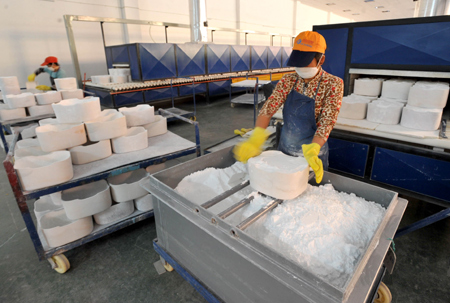
A worker at a rare-earth refinery in East China's Jiangxi province processes the raw materials on Oct 30, 2010.?[Photo / China Daily]
Industry to be refocused to ensure more sustainable development
BEIJING - China will more tightly control the exploration for rare-earth minerals and unify the distribution of precious metals in North China to regulate the previously over-exploited sector, government officials said on Monday.
The Inner Mongolia autonomous region's Bayan Obo Mine in Baotou city - the world's largest rare-earth producer and the source of 97 percent of the country's reserves - has unified the exploration of rare-earth minerals. And it will further unify the distribution of the metals, Hu Ercha, deputy head of the standing committee of the autonomous region's people's congress, said during the annual national legislative meeting on Monday.
Hu said Inner Mongolia's Baotou Steel Rare-Earth (Group) Hi-Tech Co, the country's largest light rare-earth producer, will further consolidate companies from Fujian and Jiangxi provinces, which are rich in heavy rare-earth metals.
Rare-earth metals comprise 17 elements of the periodic table that are used to manufacture such products as wind turbines, hybrid cars, missile guidance systems and mobile phones. Much larger reserves of light rare-earth metals have been discovered. These are easy to process, while heavy rare earths, which are mostly found in South China, are more expensive.
He also said the autonomous region will establish rare-earth stockpiles, to expand upon the rare-earth trading platform.
These measures will prevent over-exploitation and increase the country's influence over prices.
Jiangxi province, which has the country's largest reserves of heavy rare-earth metals, will impose controls on exploration and reduce exports this year to ensure the industry's long-term development, a local official said.
"The volume of this year's rare-earth exploration in Jiangxi will be equal to that of the previous year because we will concentrate more on the sustainability of the industry's development," Hu Xian, director of the department of land and resources of Jiangxi province, told China Daily on the sidelines of the annual session of the National People's Congress.
Yao Mugen, director of the development and reform commission of Jiangxi province, said: "Controlling the production of rare earths is our main task this year. Our strategy is to improve the recovery of industrial wastes and vegetation while exploring for rare-earth ores."
Ganzhou Mayor Wang Ping said the export of rare earth from Ganzhou will be reduced this year because processing and use are the city's top priorities.


The central government has issued a number of measures to protect rare-earth minerals and ensure the sector's sustainable development, as previous over-exploitation has damaged the environment and depleted resources.
The Ministry of Environmental Protection earlier this month issued stricter standards to emphasize pollution controls of rare earths. The standards, which will come into effect on Oct 1, might affect at least 60 percent of companies in the industry and raise the environmental costs for those companies.
The Ministry of Commerce last December announced this year's first export quotas - 14,446 tons - marking a decrease of more than 10 percent year-on-year.
China reduced export quotas by 30 percent to 40 percent last year, according to the ministry.
Minister of Commerce Chen Deming said environmental concerns have led to the reduction of export quotas, and other countries with rare-earth reserves can develop their own stockpiles. He also said China is willing to jointly develop substitutes with Japan and other countries to better conserve rare-earth minerals.
| 分享按鈕 |