Opinion
Save energy for better future
By Wang Yiqing (China Daily)
Updated: 2011-03-17 14:50
 |
Large Medium Small |
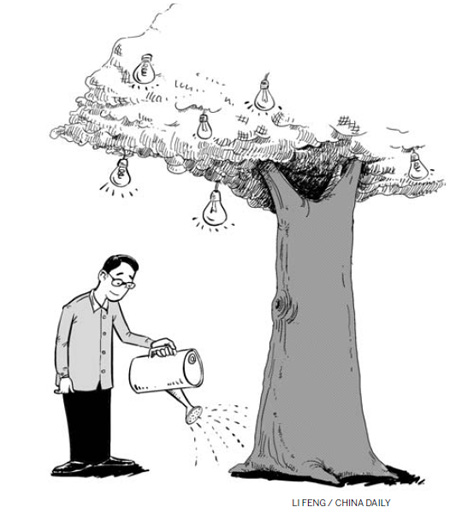
The goals of saving energy and reducing emission, set by the 11th Five-Year Plan (2006-2010), have been achieved by and large. But some of the methods used for reducing energy consumption per unit of GDP by 20 percent caused inconvenience to some people. For instance, some city governments in Shanxi, Hebei, Henan and Zhejiang provinces severed power supply and switched off the heating system late last year to meet their environmental targets.
Last week, Zhang Ping, director of the National Development and Reform Commission, even apologized for the extreme measures that the local governments had taken, because the ultimate goal of saving energy is improvement of people's livelihood.
That makes striking a balance between environmental protection measures and people's livelihood a big challenge for China.
Su Yang, an environmental researcher with the State Council's Development Research Center, says it is not an easy task. Take the 12th Five-Year Plan (2011-2015), for example. It sets three clear environmental goals: the proportion of non-fossil energy consumption in primary energy consumption should reach 11.4 percent, annual energy consumption per unit GDP should be reduced by 16 percent, and carbon dioxide emission per unit GDP should be cut by 17 percent.
These goals will make greater demands on people. It is thus clear that to protect the environment, we have to forego some of our wants.
This leads us to the 10th Five-Year Plan (2001-2005). Toward the end of 2005, Premier Wen Jiabao said that the 10th Five-Year Plan's major environmental goals had not been met. Rapid development of heavy and chemical industries across China alone was not to blame for that; the lack of mandatory restrictions had also a part to play.
Hence, the 11th Five-Year Plan incorporated the "obligatory environmental indicators", linking environmental management to local officials' overall performance. The mandatory provisions produced results. Three major environmental goals of the 11th Five-Year Plan had been met by 2009, a year before schedule. Other environmental quality indicators improved, too, to various degrees.
But public criticism against the deteriorating environment does not stop so easily. Some officials and scholars say two major conventional pollution indicators (COD or chemical oxygen demand and SO2 or sulfur dioxide) cannot reflect the precise quality of the environment. Other indictors such as ammonia nitrogen in water and oxynitrides in the atmosphere should be included in emission reduction indictors to improve the quality of the environment.
Though these indicators, in all probability, have been incorporated into the 12th Five-Year Plan for the environment, Su has reservations about the real social effects of such good intentions. Common people's criterion for good environment is different from that of experts, for it does not necessarily depend on statistics. "What the public cares most about is health risks," Su says. Many people think the environment is deteriorating because of continued environmental pollution.
This is a difficult problem to solve. On one hand, rapid development of low-end heavy and chemical industries, high population density and lack of necessary protection mechanism contribute to the frequent pollution incidents, which seem unavoidable in the short term. On the other hand, environmental health risk is hard to manage.
Although the quality of the environment affects human health, the relation between certain diseases and the environment are multi-causal, multi-resultant and hysteretic. It's hard to determine whether a certain pollutant is the direct cause of a certain disease. Moreover, the cost of routinely monitoring pollutants related to people's health (called specific pollutants) is extremely high and even developed countries can hardly afford it.


The base of China's environmental risk management is weak, but the authorities are working to strengthen it. Su and his colleagues are working on the position mark of heavy metal pollution in key regions, which can offer technical support to environmental risk management in some areas during the 12th Five-Year Plan period.
Returning to the negative effects of some environmental protection measures, it cannot be denied that they are controversial. But the central authorities promoted "energy-saving and emission-reduction" measures to protect the environment, stimulate industrial restructuring, advance technological progress and facilitate sustainable development. There is nothing wrong with the measures. The fault lies with the local officials who assume that "energy saving and emission reduction" is the ultimate aim of their governance, because it can influence their political performance.
Toward the end of the 11th Five-Year Plan, local authorities felt they had to meet their energy-saving targets to maintain their good performance records, and some of them took the drastic measure of cutting even normal electricity supply to households and enterprises.
Though Su criticizes such last-minute efforts, he insists that the advantages of using "environmental indices to assess officials' performance" outweigh the disadvantages. After all, before the obligatory indicators were introduced, environmental protection work did not progress to such an extent.
To avoid unnecessary power cuts and disruptions in the heating system, Su says, the government should readjust the indices for saving energy and reducing emissions. "The government should treat regions according to the demands of their industrial and economic development, rather than forcing them to produce equal environmental protection results."
It's difficult for some regions, whose GDP largely depends on heavy industries, to follow universal environmental rules, because that would undermine economic development and employment.
Furthermore, areas such as the Inner Mongolia autonomous region that "export" energy make great contributions to other areas' development. So it would be unfair to thrust the same set of environmental rules on them.
Nevertheless, people have to realize that the little inconvenience they suffer today to protect the environment will bear sweeter fruits in the long run - for them and the generations to come.
| 分享按鈕 |