Opinion
Proper healthcare for one and all
By Cesar Chelala (China Daily)
Updated: 2011-03-25 15:06
 |
Large Medium Small |
China's economy has developed at a fast pace over the past three decades, lifting about 400 million people out of poverty. It has improved people's health, too. One of the consequences of economic development is the increase in life expectancy at birth from 69 in 1990 to 73.5 in 2010. Also notable is the decline in infant mortality rate (expressed as per 1,000 live births) from 38 in 1990 to 13.8 in 2009, and under-5 mortality rate (per 1,000 live births) from 46 in 1990 to 17.2 in 2009.
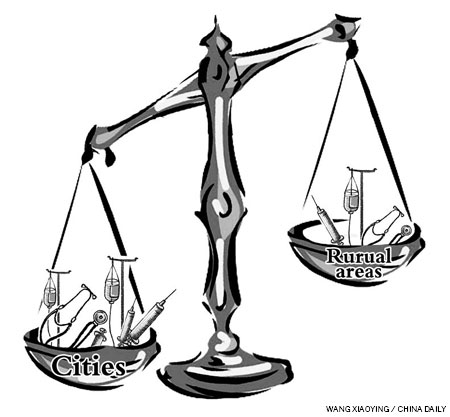
Despite this progress, however, many health issues in China remain unresolved. While wealthier Chinese people have benefited from advanced medical technologies, many poor people do not have adequate access to even the most essential medical services. About 80 percent of China's healthcare and medical services are concentrated in cities, and timely medical care is not available to more than 100 million people in rural areas.
Although some progress has been made in rural areas, many people in such areas are still malnourished, vitamin- and mineral-deficient, and victims of indoor air pollution. About 80 percent rural households do not have access to sanitized lavatories and 20 percent lack safe drinking water.
The government has to address several challenges in the field of healthcare. It has to improve the quality of medical services, make the healthcare system more equitable and reduce costs by raising the efficiency level of the system. Also, it has to regulate the healthcare system by ensuring that doctors stop prescribing unnecessary diagnostic tests and medicines, and migrant workers and senior citizens get proper and timely medical treatment.
A great part of medical costs consists of unnecessary medical tests and medicines prescribed by doctors because they are a big source of hospitals' profits. Some pharmaceutical companies offer under-the-table inducements to doctors for prescribing medicines. The resultant high cost of treatment has caused many patients to avoid going to hospitals even for vital treatment.
According to the Organization for Economic Cooperation and Development, almost half of China's doctors are under-qualified, and many doctors in rural areas have far less experience than their urban counterparts. The government has to raise the education level of healthcare workers in rural areas, too, perhaps by offering them more economic incentives.
There is still a huge disparity between urban and rural areas, and between the rich and the poor when it comes accessing healthcare services. Since the cost of getting treated for a serious illness can wipe out a family's life savings, many poor people prefer to suffer silently or be satisfied by quacks' treatment.
| ||||


China already has about 200 million migrant workers, a population that is mobile and will probably increase in the coming years. These migrant workers have special health needs that have to be addressed properly, particularly because they usually do not qualify for public medical insurance.
Some estimates suggest that by 2035, 25 percent of China's population will be above the age of 60 years, compared to 10 percent in 2001. Medical costs for such people can increase dramatically, even as their contribution to government revenue declines. The government has to be committed to provide medical help to this section of the population.
According to the healthcare reform plan, the government will improve primary healthcare facilities, introduce an essential medicine system, provide equitable access to basic public medical services and start pilot improvement programs in State-run hospitals. And public, non-profit hospitals will continue to be the main providers of medical services, with grassroots-level hospitals and clinics getting the priority.
Although the government has admitted that building a "safe, effective, convenient and affordable" medical service will not be easy, these are commendable goals. The government should prioritize the promotion of a healthy lifestyle among the people and take steps to prevent chronic non-communicable diseases.
A critical aspect stressed by the World Health Organization (WHO) and the social development department of the State Council's Development Research Center is the need to create a better system of information, accountability and for enforcement of healthcare laws and regulations.
With the help of WHO and other international agencies, the Chinese government has improved the health of its population. It's true that millions of people have benefited from this, but it's also true that millions of others are still vulnerable. All this makes China's task to strengthen its healthcare system a difficult one, but it has no choice but to improve the quality of healthcare services for all its citizens.
The author is a New York-based international public health consultant.
| 分享按鈕 |