Economy
Radiation fears clobber Japan outlets
By Ben Yue (China Daily)
Updated: 2011-03-28 11:00
 |
Large Medium Small |
BEIJING - The radiation scare in Japan caused by damage to the Fukushima nuclear power station is having repercussions in China.
 Food from Japan is being replaced with domestic produce and exports from other countries to quell safety fears.
The move is affecting restaurants, wholesalers and retailers.
The management at Edogawa Japanese Restaurant in Beijing reported a fall in customer numbers after the March 11 earthquake and reduced demand for raw fish such as salmon and tuna over fears of contamination.
They stressed that most Japanese restaurants on the Chinese mainland do not use seafood imported from Japan on a daily basis and rely on sources in Norway, Canada and the United States.
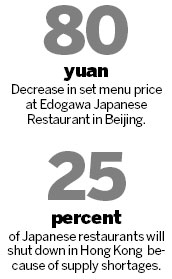
However, the restaurant has lowered its set menu price from 198 yuan ($30.18) a person to 118 yuan for a month.
Japan is now suffering a shortage of fresh food. Traditionally domestic customers enjoyed a priority in receiving locally produced food. Now, according to a China Central Television report, Chinese trading companies in Jiangsu province are working day and night supplying emergency orders of vacuum-packed fruit for Japan.
In Dalian, a major trading port in Northeast China just 1,700 kilometers from Japan, consumers are more aware of the dangers of imported food.
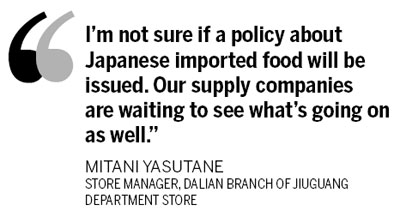
 "Our fish is from Xiamen, in Fujian province. We have full supplies of all other food that comes directly from Japan," said Mitani Yasutane, the Japanese store manager at the Dalian branch of Jiuguang department store, a Japan-China joint venture.
"I'm not sure if a policy about Japanese imported food will be issued. Our supply companies are waiting to see what's going on as well," he added.
On Friday, the General Administration of Quality Supervision, Inspection, and Quarantine (AQSIQ) announced an immediate ban on the import of some Japanese food and agricultural products.
The ban covers dairy, seafood, fruit and vegetables from five Japanese prefectures. The AQSIQ did not say how long the ban would remain in effect. It said the restrictions were needed to ensure the safety of food and agricultural products in China.
Shanghai Shishou Seafood Co Ltd, which provides vacuum-packed ready-to-eat fish and kelp to the Shanghai branch of Jiu Guang, said its regular shipping from Hokkaido to Shanghai has not been affected. The company said it believes the business will not suffer because the food is safe in Hokkaido, which is more than 800 kilometers from Fukushima.
Japan-based Ito Yokado, a general merchandise chain store with five outlets in Beijing, said it is selling instant noodles, made by Nissin Foods, and Tsubaki shampoo, manufactured by Shiseido Co Ltd, but these come from production plants in China. The only food it sells that is made in Japan are flavorings, such as wasabi and ginger sauces, of which it has large inventories stockpiled before the earthquake.
The catastrophe in Japan has created opportunities for Chinese companies who produce Japanese flavorings. Guangdong-based Jiahao Corporation, a soybean sauce and chicken soup producer, has just launched its green wasabi products. Chen Zhixiong, president of Jiahao, said his company is receiving more orders every day as many Japanese restaurants seek alternative supplies.
| ||||


The Hong Kong local newspaper Sing Tao Daily reported that people were standing in lines several meters long to buy Japanese infant formula produced by Meiji Dairies Corporation. The regional government has limited purchases to two bottles of the milk powder for each customer.
The stock is believed to have been produced before the radiation leak and is thought to be the last batch of goods without any possibility of contamination. Prices are changing on a daily basis and many complaints are being made over the Internet by mothers on the Chinese mainland who only have limited access to Meiji products.
On Taobao.com, China's largest customer-to-customer trading website, the price of Meiji infant formula has soared 40 percent. The cost of other infant-related goods has also shot up. For example, disposable diapers made by Kao Corporation incurred price rises from 145 yuan a bag to 245 yuan in just one day at some popular online shops.
| 分享按鈕 |