Economy
China: the next lap of luxury?
By Shi Jing (China Daily)
Updated: 2011-04-26 10:49
 |
Large Medium Small |
|
 |
|
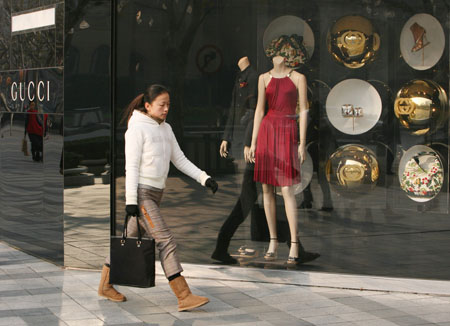
A Gucci store in Shanghai. As of December, sales of luxury goods in the Chinese market rose to $10.7 billion, or 30 percent of total global sales, up from $9.4 billion in 2009. [Photo / Agencies] |
SHANGHAI - European luxury goods companies may target China as they seek to minimize the impact of the Japanese earthquake on their businesses.
The destruction wrought by the quake is likely to have far-reaching consequences on consumer spending in Japan, which may lead to companies concentrating on the Chinese market, especially in cities such as Shanghai, Hangzhou and Beijing.
In its latest report, the World Luxury Association (WLA), an international non-profit organization that specializes in the management of luxury brands and market research, said that the market in Japan contracted significantly in the weeks following March 11.
|
||||


Ginza, the city's up-market shopping district where luxury brands such as Chanel SA, House of Gucci and LVMH Group (Louis Vuitton) are located, has seen a drop in sales of at least 50 percent in the past month. Some brands, including Louis Vuitton and Prada SpA, have seen sales decline by up to 75 percent, said Michael Ouyang, CEO of the WLA's China office.
About 90 percent of luxury brands are reducing their investment or slowing the launch of new Japanese stores, according to the WLA.
"Hermes Group, LVMH, PPR Group and the Richemont Group all held board meetings recently to adjust their plans for Japan," said Ouyang.
"More than 70 percent of the brands will try to accelerate a shift in their development focus from Japan to China this year," Ouyang said. "China will take the place of Japan and become the world's largest consumer market for luxury goods," he predicted.
As of December 2010, sales of luxury goods in the Chinese market rose to $10.7 billion, or 30 percent of total global sales, up from $9.4 billion in 2009. It was expected that China would account for roughly the same share in 2012, but that projection is now changing because of the expected sales slump in Japan.
"The earthquake has accelerated the speed with which China is overtaking Japan in terms of its importance for luxury brands. With regard to the current rate of development in China, we predict it will become the top country for the consumption of luxury goods by 2012," said Ouyang.
The earthquake has also had an impact on overseas markets, especially the cosmetics market. After the earthquake, stocks of Japanese cosmetics in many other countries sold out rapidly, especially better-known brands such as Shiseido and Kanebo. In Hong Kong, people rushed to cosmetics stores and bought Japanese cosmetics in bulk. Some of the stores were forced to close for several days as stocks dwindled as a result of the bulk purchasing.
Sales of Japanese cosmetics domestically are much higher than those of European or US brands. Japanese cosmetics are more suited to the Asian skin tone, and they hold a dominant market position as a result. However, 95 percent of people surveyed by the WLA said that they will not buy Japanese-made cosmetics because of fears of possible nuclear contamination.
"A great many people will not buy Japanese cosmetics for the next couple of years, which could severely damage the domestic industry," said Ouyang.
The earthquake has also affected the domestic market. Japanese people usually shop at night, but as the electricity supply has been disrupted a number of Tokyo's department stores are now closing at 6 pm. That's lead to a rapid decline in consumption.
Research indicates that consumer habits are changing too. More than 90 percent of those surveyed said they find luxury goods attractive, but the WLA's Ouyang said demand has fallen because people feel that displays of wealth are inappropriate after the disaster of such magnitude.
Different companies are adopting different strategies in the aftermath of the earthquake.
The designer fashion label Marc Jacobs will open two more stores in China over the next year, but Japan will remain the company's largest Asian market, according to Robert Duffy, vice-chairman and president of the New York-based luxury label.
For others, it's a case of business as usual, "Coty's perfume brands account for most of our market in Japan while makeup constitutes the majority of our market in China. We were worried that the earthquake would affect our sales, but they've been little disrupted because we have always made China our focus in Asia," said David Ennes, regional vice-president of Coty Inc.
Meanwhile, Louis Vuitton declined to comment on its plans for Asia, but, according to an employee who asked to remain anonymous, LVMH has made a donation to areas devastated by the earthquake and ensuing tsunami.
| 分享按鈕 |