Energy
Biggest energy players to continue cooperation
By Tan Yingzi and Li Xing (China Daily)
Updated: 2011-05-11 14:21
 |
Large Medium Small |
|
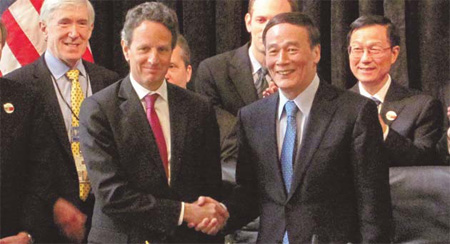 Vice-Premier Wang Qishan (center right) and US Treasury Secretary Timothy Geithner shake hands after they signed the China-US Comprehensive Framework for Promoting Strong, Sustainable and Balanced Growth and Economic Cooperation at the Treasury Department in Washington on Tuesday. [Photo / China Daily] |
WASHINGTON - As concerns over energy security grow across the globe, the world's two largest producers and consumers of power will continue to cooperate on climate change initiatives and clean energy development, senior officials from China and the United States said on Monday.
During the third round of the China-US Strategic and Economic Dialogue, State Councilor Dai Bingguo co-chaired the strategic track with US Secretary of State Hillary Clinton and exchanged views on climate change, clean energy and regional issues.
Through the dialogue, China and the US reached a consensus on a number of issues connected to energy cooperation. Both countries reiterated the understanding stated in the China-US Joint Statement on Energy Security Cooperation and reaffirmed their commitment to ensure energy security.


China and the US now have similar measures in place, including developing clean energy, enhancing energy efficiency, conserving energy and exploring alternatives, ensuring the safe development of nuclear power and other areas, said Liu, who is also head of the National Energy Administration.
Clinton said "substantial progress" had been made on the seven new US-China clean energy initiatives started during President Barack Obama's visit to Beijing in November 2009.
"I think that the policy choices that we have made on critical energy security issues, including promoting open and efficient markets, and dealing with potential oil supply emergencies and the safe expansion of nuclear energy, are especially timely for us to address," she said.
An "eco-city" project, developed by US-based Duke Energy and China's ENN Group, will help Langfang, a city in Hebei province neighboring Beijing, and the community of Charlotte in North Carolina. The two areas will use electricity produced by cleaner generation technologies and benefit from advancements in energy storage and energy efficiency. The project will also employ energy-recovery technologies, such as the use of algae to absorb carbon, and a grid designed for the efficient use of electric cars, according to Minister of Science and Technology Wan Gang.
He Weiwen, a researcher at the University of International Business and Economics, said the two countries are complementary in the development of clean technologies, which offers a good basis for deeper cooperation.
Although China's clean energy industry has been in fast-track expansion during the past few years, the US is still much more advanced in its research into some key technologies, said He.
Lin Boqiang, director of the China Center for Energy Economics Research at Xiamen University, said the US should relax its control of technology exports to China to further promote bilateral clean energy cooperation.
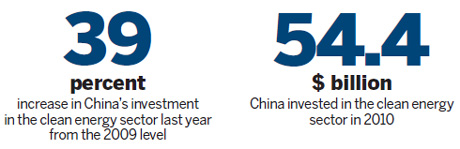
China consolidated its position as the world's largest investor in clean energy in 2010, with $54.4 billion flowing into the sector, up 39 percent from the 2009 level, according to a report by the US-based Pew Charitable Trusts, an independent non-profit organization.
Since the first China-US Strategic and Economic Dialogue, the nations have made positive progress on bilateral energy cooperation, with communication improved, key projects pragmatically promoted and science cooperation actively conducted, the National Energy Administration said at a news briefing on Tuesday.
But some experts say the two countries are also in a process of "redefining the balance of cooperation in the scope of environmental protection and climate change", because China has moved rapidly on its policies to improve energy efficiency and curb pollution while the US has not made as much progress.
For instance, China is sticking to its promise to improve energy efficiency and reduce carbon intensity in the 12th Five-Year Plan (2011-2015), said Zhang Jianyu, program manager of the US-based Environmental Defense Fund's China project.
"China has already come up with a very ambitious pilot project of carbon trading in six cities and provinces, even a timetable has been set by the government," said Zhang. "But the US is still debating how to manage its carbon emissions."
Li Jing and Liu Yiyu in Beijing contributed to this story.
| 分享按鈕 |