Cars
Geely's Volvo gaining traction
By Fang Yan and Niklas Pollard (China Daily)
Updated: 2011-05-13 11:14
 |
Large Medium Small |
|
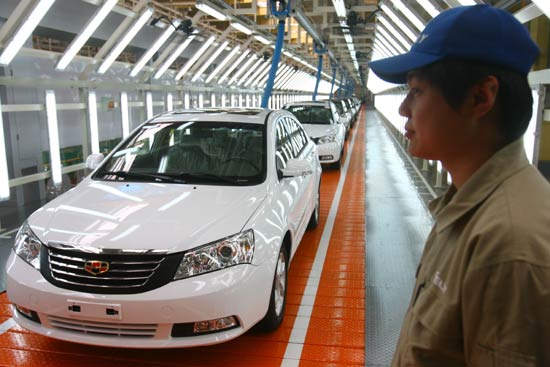 Geely Auto's new production base in Hangzhou, Zhejiang province. The strategy differences between Geely and Swedish Volvo have been smoothed over, and Volvo is beginning to make inroads in China. [Photo / China Daily] |
BEIJING/GOTEBORG - When Geely Auto snapped up the Swedish carmaker Volvo last year in what was to be China's largest auto acquisition, the uneasy marriage might have best been described by the old Chinese saying: "Same bed, different dreams".
Nine months later, the strategy differences that marked the early stage of the partnership appear to have been smoothed over and Volvo is beginning to make inroads in the world's largest auto market.
Its new S60 model has been launched to critical acclaim, while plans for a new factory in southwestern China are well under way. And Volvo's sleek new Universe concept car, unveiled at the Shanghai auto show last month, has taken a step toward shedding the company's image as a maker of safe but boring cars.
Initial signs after the $1.5 billion deal had not been promising.
There had been "huge mismatch" between the Geely leadership and the Volvo leadership regarding issues such as product strategies and plant selections, according to one source with direct knowledge of the early Volvo internal meetings.
|
||||


For Li Shufu, the architect of the Volvo-Geely deal and now chairman of both, selling big, luxurious cars was the only way the Swedish brand could make up for lost time in the Chinese market.
Li, a farmer's son who built Geely into one of China's largest private automakers in less than two decades, made his fortune building cheap cars for the masses. He wanted Volvo to tap the growing number of China's wealthy and knew what he wanted from the brand.
"When it comes to luxury cars in China, the fancier the better. Few have an eye for Volvo's Scandinavian no-frills style, to be honest," Li said ahead of announcing Volvo's five-year development plan in Beijing in late February.
But that wasn't the way Volvo's management team in Goteborg, led by Stefan Jacoby, saw things, at least initially.
"Let's ditch this talk about premium," Jacoby told Britain's Autocar magzine in November, two months after replacing Stephen Odell at the helm of Volvo. "It sounds like a pricing strategy, and it's got an expensive ring to it. We need to focus on elegant Scandinavian simplicity, our own unique identity, and not copy our competitors."
By all accounts, Geely and Volvo - a Chinese peasant boy and a European princess, as Li likes to say - are unlikely partners, and the marriage is far from one made in heaven.
"If you bring the Chinese and Europeans together, they will disagree. They have different views of the world and different views on how to move forward," said Klaus Paur, managing director of Greater China at the industry consultancy Synovate Motoresearch.
"And a high-caliber guy like Stefan Jacoby is certainly not someone just sitting there and taking notes."
But both Geely and Volvo see China as a rare opportunity for the Swedish brand, which had languished under the care of Ford Motor like a neglected child.
Even in 2010, its best year ever, Volvo delivered slightly more than 30,000 cars in China, equivalent to 13 percent of front-runner Audi and less than a fifth of sales by BMW, which raised its annual target three times but still surpassed even that higher target by the year's end. Ultimately, the sheer scope of China's premier car market might bring the two sides closer together.
Sales in the segment jumped more than sixfold over the past five year at a time when other top global markets sputtered in the wake of the financial crisis. Now, having lagged behind other top automakers in China, Volvo faces an "all or nothing" opportunity, industry observers say. It's starting to get some traction, having managed to make its first profit in five years in 2010.
"They are not getting the growth in America, they might get some growth in Europe because of Eastern Europe and Russia. But China will decide the fate of Volvo," said Michael Dunne, president of the industry consultancy Dunne & Company.
Volvo says it has already worked out the China strategy, including meticulous product schemes and an annual sales target for each year running up to 2015.
But it wants to keep the details to itself for now, except for a commitment to double the number of dealerships in China to 220. What happens inside the corporate boardroom is unclear, but at least in public, the top executives are making nice.
On Feb 25, Jacoby and Li formed a united front in Beijing to announce Volvo's up to $11 billion five-year development plan, including its first China plant.
Reuters
| 分享按鈕 |