Economy
Inflation in May hits new high
By Chen Jia and Hu Yuanyuan (China Daily)
Updated: 2011-06-15 09:28
 |
Large Medium Small |
|
 |
|
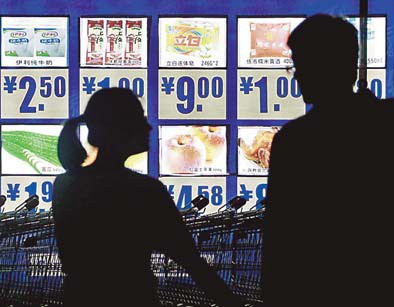
Customers are silhouetted against illuminated food prices at a supermarket in Shanghai. [Photo/Xinhua] |
Reserve ratio hiked following 5.5% rise in CPI; concerns over slowdown
BEIJING - Inflation hit a 34-month high in May, forcing the government to continue its tightening of monetary policy while raising concerns over a slowdown in the economy.
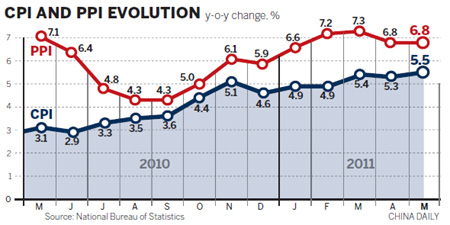
The consumer price index (CPI), a key inflation gauge, surged to 5.5 percent in May, according to figures released by the National Bureau of Statistics (NBS) on Tuesday.
The producer price index (PPI), the gauge of factory-gate prices, rose 6.8 percent in May from a year ago.
The figures forced the central bank to raise the reserve requirement ratio for commercial banks (the amount they have to set aside), for the sixth time this year, by 50 basis points.
"The timing of the move took the market by surprise," Chang Jian, an economist with Barclays Capital, said.
The 7-day repo rate, the rate for inter-bank borrowing, rose above 4 percent in the past week, pointing to tightening liquidity.
"That means inflation remains the predominant risk," Chang said, adding that slower growth may be necessary to combat inflation.
The world's second largest economy is currently struggling between inflation and a slowdown, making policy decisions more difficult, analysts said.
| ||||


"Meanwhile, the slower-than-expected recovery and high unemployment in developed countries lessened export demand.
"But China's economic growth remains stable and taming inflation is the government's priority," Sheng said.
Other figures confirmed a decline in manufacturing. According to the NBS, industrial output increased 13.3 percent from a year earlier in May. While impressive by international standards, it was 0.1 percentage points lower than in April.
The decline mirrored a nine-month low of 52 in May for the purchasing managers' index, a gauge of factory output.
"So far, the pace of the slowdown in industrial activity is in line with our expectations," Chang said.
He dismissed suggestions of a hard landing in the second half of this year. "The figures show that the economy may achieve growth of about 9 percent in 2011," he said.
Food prices, which climbed 11.7 percent in May, contributed most to inflation.
"Pork prices jumped 40.4 percent year-on-year, which was the main driving force behind the increase in food prices, although vegetable prices dropped 9.3 percent from April," Sheng said.
Meanwhile, non-food prices rose 2.9 percent and were up 0.2 percentage points from April.
Living expenses jumped 6.1 percent in May, forcing many to face rent increases.
"Rent for my apartment rose another 20 percent this month," said Yang Chao, a young salesperson in Wuhan, Hubei province.
NBS figures also indicated a slowdown in sales of consumer goods. The growth rate was 16.9 percent in May, 0.2 percentage points lower than April.
Pieter Bottelier, senior adjunct professor of China studies at Johns Hopkins University, said the rising CPI will depress growth, although he expects it to drop below 5 percent in the second half of this year.
"Consumer confidence is declining due to rising costs," said Bottelier, who pointed out that pensioners and fixed-income earners will suffer most from inflation.
The main task for the government is to curb inflation without easing monetary policy, Sheng said.
The government is expected to maintain the current policy, and inflation will decline in the second half of this year, Ding Shuang, an economist with Citibank, said in a research note.
"While we expect monetary tightening to end soon, we do not anticipate policy loosening this year as average inflation for the year will likely exceed the government's comfort zone of 4 to 5 percent," he said.
The government has set an inflation target of 4 percent for this year.
Yukon Huang, senior associate at the Carnegie Asia Program at the Carnegie Endowment for International Peace, said inflation may contribute to an improved trade balance with the US.
"As costs are increasing in China, its exports become more expensive and its imports cheaper. This will slow down exports from China and reduce its trade surplus," Huang said.
Ariel Tung, Li Jiabao and Wei Tian contributed to this story.?
| 分享按鈕 |