Opinion
Debate: High-speed trains
(China Daily)
Updated: 2011-06-20 17:36
 |
Large Medium Small |
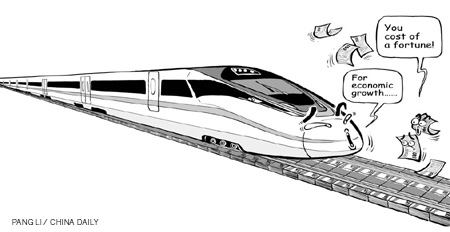
Is the plan to extend high-speed railways to the western region a wise move? One scholar says it is, but another differs totally.
Gao Bai
It sure has economic and strategic value
The high-speed Beijing-Shanghai railway, to start operations later this month, will fuel economic growth in East China by making travel among cities in the Bohai Sea economic circle and the Yangtze River Delta economic ring a lot faster.
That will be a welcome development. But for better overall national development, the government needs to integrate more cities in the western region into the high-speed railway network. Such a move will facilitate the government's strategy of developing the western region as well.


The wide regional gap, in turn, has led to many social problems in the west and east both. With a large number of people living in the east and south, cities there have developed and grown faster, a phenomenon that the declining arable land and other facilities can hardly support now. In contrast, the relatively low population density in the west has not only curbed economic growth, but has also left loopholes in national security in the region.
The introduction of high-speed railway to the western region could tackle both these problems. An upgraded transportation system would help China develop industries in the west, exploit the vast Eurasian market and lessen its reliance on exports through the sea.
Faster connectivity would shorten the distance between sources of energy and industries, too, reducing transportation losses considerably. A better developed economy will help the west attract more people and strengthen national security along China's long borders with other countries.
Local authorities have announced Xinjiang's capital of Urumqi will be built into a "core city" in west China and an "international trade center" of central and west Asia by 2020 . The goal was set in an urban development blueprint for Urumqi during the 2011-2020 period.
To achieve this goal, local authorities will build faster and more convenient transportation networks to strengthen links between Urumqi and inland Chinese regions as well as areas in central and west Asia. This year four more railways will be completed in Xinjiang.
The railway lines will help places like Xinjiang build an economy with external links, too, by developing labor- as well as technology-intensive industries and exploiting the neighboring markets.
The western region will be able to spread its influence to neighboring countries once industries develop there. If China invests as much in the west as it did in Shenzhen or Shanghai decades ago, another economic miracle could be created in the next 20 years.
Once the west develops, China will have balanced regional urbanization. Northwestern provinces have the best natural conditions to exploit solar and wind energy, which, combined with the large swathes of non-arable land, can offer the best option for low-carbon urbanization - and a new land utilization mode will be created in China.
The process will require and encourage migration to the west, which will greatly ease the pressure on land in the east and check the current trend of over-development in China's coastal belt.
Another result of extending the high-speed railway network to the west would be better harmonious relationship between different ethnic groups there. Since ethnic groups in China's northwestern region share the same tongue and religion with people in Central Asian countries, they have a natural advantage in doing business with them. If China's western parts like Xinjiang can develop labor-intensive industries and venture into foreign markets, ethnic groups will have a greater chance of getting jobs, starting their own businesses, and sharing the fruits of the country's economic development better.
Of course, such a development will not be without challenges, the biggest of which is the fragile environment of the western region. To avoid that, the economic development mode followed by China for 30 years should not be replicated in the western region. The government has to devise a new energy and environmental technology policy to better exploit the potential in the west.
In more ways than one, the extension of the high-speed railway network to the west will fulfill that requirement. Plus, the western region's development has the potential of becoming the second engine driving China's economy. Therefore, the strategy is worth considering.
The author is a professor of sociology at Duke University in North Carolina, United States.
| 分享按鈕 |