Economy
Franchise heat
By Yan Yiqi (China Daily)
Updated: 2011-06-24 16:33
 |
Large Medium Small |
Foreign companies see huge opportunities for business
|
 |
|
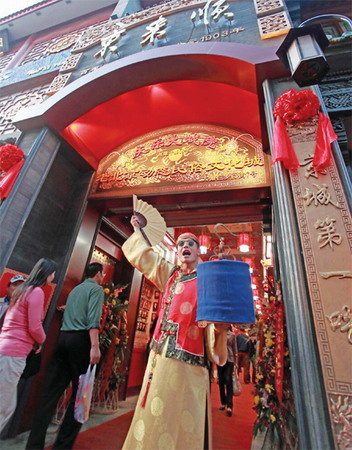
The 107-year-old Donglaishun has 200 stores, 70 percent of which are franchises. [Photo / China Daily] |
More than 22,000 people attended the three-day expo, most of them looking for franchise opportunities. Reflecting the enthusiasm of franchisees, nearly half of the stalls in the 16,000-square-meter exhibition center have already been booked for next year's expo.
As a main gauge of the franchise market in China, the China Franchise Expo reflects the growth of franchises in this country.
When the first expo took place in 1999, 40 companies from eight industries participated. This year, as the curtain opened on the 13th expo in early May, more than 270 companies from 60 industries left the exhibition center with bags full of applications.
"Ever since 1999, when franchising gained popularity in China, people have been favoring this kind of business model, either to build up their own business or to expand their business on a larger scale. Because expansion via franchising is low cost and fast," says Pei Liang, secretary-general of China Chain Store & Franchise Association.
According to statistics from the association, by the end of 2010, there were more than 4,500 franchise systems in China, covering 70 industries. The total number of franchise stores has reached 400,000.
The top 120 franchisers, according to the association, had a total sales revenue of 338.7 billion yuan (36.4 billion euros) in 2010, an 8.9 percent increase from 2009. The 120 franchisers own 131,413 stores, 12.5 percent more from 2009.
Pei calls China "the world's largest market for franchising".
"Franchising makes you feel that people around the world are all helping you to expand your business, while we have to run self-owned stores all by ourselves. That is the charm of franchising," says Zhao Zheng, deputy manager of Chain Store Development Department of Beijing Donglaishun Group, one of China's leading hot pot restaurants.
With 200 outlets, 70 percent of which are franchises, the 107-year-old Donglaishun is just one example of how Chinese companies turned to franchising to expand.
As early as 1993, China Quanjude Co, a restaurant famous for its roasted duck, had already started franchising.
"At that time, franchising seemed to be the fastest way for us to expand our business and popularize our brand name," says Cao Xiaojun, director of Quanjude's market expansion department.
"In first-tier cities like Beijing and Shanghai, we are focusing on self-owned stores so that we can have better control of our brand. But in second-and third-tier cities, local franchisees are more familiar with the markets," Cao says.


"Although foreign brands have not become the mainstream in China's franchising market, I can see that China will be the most preferred market for foreign companies who are looking for international opportunities," says Pei, adding that the economic environment in the United States and Europe has forced companies to develop elsewhere.
First Casual Food Inc, a US fast-food brand, is planning to transfer its main battlefield to China. "We are hoping that in the next 10 years, the Chinese market will account for 30 percent to 50 percent of our total sales revenue," says Marko Puschmann, chief financial officer of the company.
Although foreign fast-food stores such as KFC and McDonald's make up a large part of the foreign market in China, Puschmann says his company is confident about their China venture.
"I think it's the right time to march into the Chinese market, since it is a large piece of cake and our products are different," he says, adding that the market in China is developing so fast that more opportunities will be provided in the future.
"We have no specific criteria for our future Chinese partners. But one thing is for sure, they must have a deep understanding of the Chinese market, since this is the part that we are not so good at," Puschmann says.
| 分享按鈕 |