Opinion
Debate: Chinese film
By Chen Gang,Peng Kai (China Daily)
Updated: 2011-07-04 17:07
 |
Large Medium Small |
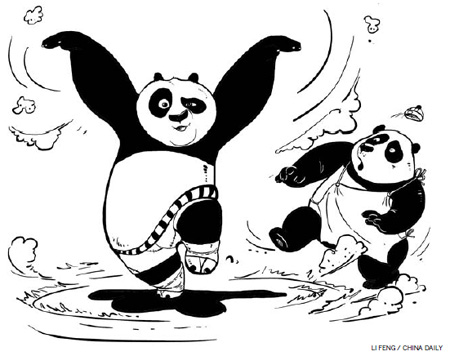
Can Chinese movies take on the challenge of Hollywood productions at home, create a niche in overseas markets, triumph at international competitions and promote China's soft power?
Chen Gang
A perfect example of profit-making
Since June 15, many people have watched Beginning of the Great Revival, a film on the 10 years between the Revolution of 1911 and the founding of the Communist Party of China (CPC) in 1921. The characters in the film, including Sun Yat-sen, Chen Duxiu, Li Dazhao, Mao Zedong, Zhou Enlai, Soong Ching Ling, are familiar names for any Chinese.
So why should people pay at least 35 yuan( $5) to watch a film that portrays characters they already know well? The reason is simple. The film belongs to a genre that originated in Hollywood under the studio system in the early 1900s. The audience has always loved this genre of films, for they emphasize star appeal, encourage business, and underline the plot and fluent space-time combination.


From The Founding of a Republic (released in 2009) to Beginning of the Great Revival, directors Han Sanping and Huang Jianxin have tried to restructure traditional mainstream movies into a certain genre that uses the operational mode of commercial blockbusters. Inherent dominant ideology, an all-star cast, and a marketized operational mode in financing, filmmaking, distribution and publicity are the three principal elements that define this genre.
Mainstream Chinese movies, especially those with important historical themes, should spread the country's dominant ideology and cultural values. By watching such films, the audience should be able not only to recall history and understand the roots and development of our culture, morals and traditions, but also meet the need to ritualize the dominant national ideology.
But earlier mainstream films expounded these aspects mechanically. A large number of figures that they portrayed lacked individuality, they simplified the appreciation of beauty and had a stereotyped narrative mode, which left the audience aesthetically fatigued. Besides, quite a number of mainstream films were failures at the box office and couldn't effectively transmit the dominant ideology and cultural values to the audience.
Beginning of the Great Revival is different from such films. It integrates the cultural heritage and social values into the plot and characters. Instead of transmitting the dominant ideology directly or forcedly to the audience, it uses a "flexible expression", which is subtly hidden in the narration, to do so. It tries to restore the inner emotions of historical figures, breaking the stereotype portrayal of the characters being "perfect" in every respect. It avoids lending ugliness artificially to the negative characters, too, and instead tries to open their complicated state of mind.
Also, the plots of Han's and Huang's two films do not simply follow history textbooks. Instead, they add more of a "human" touch to the characters. That's why in The Founding of a Republic and Beginning of the Great Revival, we see scenes like CPC leaders "celebrating" a victory, a young Mao Zedong's romantic walk in the snow with Yang Kaihui, and the self-questioning of Yuan Shikai after his dream of becoming the emperor is shattered.
In The Founding of a Republic, 172 stars formed the main cast, which was a record. A popular actor or actress reportedly appeared on the screen every 49 seconds in the film, which was a major draw for the audience. Beginning of the Great Revival continues this trend, attracting nearly 200 Chinese stars. If popular actors and actresses play the role of historical figures, the audience, especially people born in 1980s and 1990s, find it easy to associate themselves with the characters. The stars are also a guarantee of healthy box office returns.
Previous mainstream films rarely paid attention to the business aspect, and relied fully on block bookings by companies and public institutions for box office returns and passing on their message to the audience. Rarely did such filmmakers think of using innovative methods to prompt individuals to pay for a ticket to watch their films.
Beginning of the Great Revival goes beyond that; it does not rely on government investment and has charted a course of its own to earn - or lose - money. Media reports say about 40 financiers, mainly State-owned and private filmmaking companies, have invested in the film and shared the risks. The film was treated as a commercial venture right from its inception through to production, distribution and marketing.
Moreover, the use of advanced technologies such as three-dimension and multi-camera shots has made the film an exceptional gift for the audience, fulfilling their need for aesthetic appreciation.
Production and marketing executives have used the fanciest marketing tools like star promotions and event marketing for the film's distribution.
The Beginning of the Great Revival provides a reproductive paradigm for films disseminating the dominant ideology. It has proved that mainstream movies can touch the audience emotionally if they follow the principles of artistic creation and market norms.
The author is a research scholar with the Beijing Film Academy and a lecturer at the College of Humanities and Development, China Agricultural University.
| 分享按鈕 |