Exporters seek new markets for growth
Updated: 2011-07-25 09:13
By Ding Qingfen (China Daily)
|
|||||||||||


Li Jilin, president of Zhejiang Cathaya International Co Ltd, the world's largest silk goods exporter, said several factors, including weak demand abroad, raw material price hikes and labor cost rises, as well as insufficient government policies on supporting Chinese exports, will "bring bigger problems for Chinese exporters if no effective measures are taken".
Since late last year, China has shifted its focus to promoting imports to better balance its trade, and the nation has also reduced tax rebates for exports of some goods that are produced through processes that create high levels of pollution, such as steel and certain chemicals.
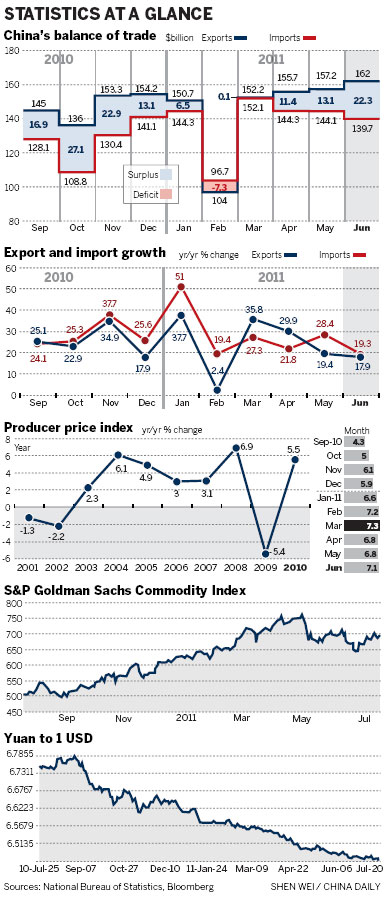
Yao Jian, a spokesperson for the Ministry of Commerce, said recently that China's export prospects are "not optimistic" and growth will "decelerate further" during the rest of the year. He cited rising costs in labor and raw materials and difficulties in financing as a result of China's tightening measures as the reason.
"We will try to stabilize exports and draw up relevant policies, in terms of tax rebates, financing, credit insurance and the processing trade," Yao said.
As wages for China's laborers keep rising, many global companies are moving manufacturing bases to other Asian nations where costs are lower. Nike, the world's leading sportswear maker, said recently that Vietnam overtook China last year to become the biggest supplier of footwear for the company.
Those who do not want to shift their production lines overseas have to consider ways of sharpening their competitiveness.
"The best time for Chinese exporters is over. They have to learn how to survive in the face of all sorts of challenges and more intensive competition, and profits will not be easy to come by," said Li Wei, economist from Standard Chartered Bank in Shanghai.
Zhu agreed. "We will see an end of the time when Chinese exporters reaped fat profits from cheap labor costs and raw materials. Also, the time when (year-on-year) export growth reached as high as 30 to 40 percent will not return," he said.
"We have to get comfortable with growth of about 10 or 20 percent. That is still high growth."
"The financial crisis and the current situation alarm us and are prompting us to change direction and make us fit for the market and enhance our competitiveness," said Zhu.
Many Chinese companies are already preparing for change by expanding their sales networks, enhancing their technology, improving their product lines and investing overseas.
Emerging markets
"We are diversifying sales channels to the European Union, Latin America and Southeast Asia," said Ge from Hangzhou Zhongce.
During the first half, Zhongce's sales to the EU grew by more than 50 percent year-on-year. The ratio of its sales to the US out of its overseas sales dropped to 20 percent from 35 percent in 2009.
The company is also producing high-end tires tailored for different markets - for example, tires that are suitable for winter weather for some European markets and heat-resistant tires for Latin American nations.
During the first half, China's exports to emerging markets such as Russia and Brazil grew by 46.1 percent and 41.3 percent respectively, year-on-year, while the figure was 16.9 percent for the US and EU, according to customs data.
Besides shifting sales to emerging markets, Zhongcheng is also diversifying and upgrading its goods and making products tailored for special customer needs, such as low-dusting formula for brake pads.
The processing trade has been a major source of China's exports during the past three decades. China is now launching measures to promote its transformation and upgrade the sector, which involves importing all or part of the raw materials, parts and components for a product from abroad and re-exporting the finished goods after processing or assembling by companies on the mainland.
In late 2010, China named Suzhou in Jiangsu province and Dongguan in Guangdong province as pilot cities for upgrading the processing trade and provided them with preferential policies such as tax breaks.
"China's processing trade needs to be transformed and upgraded, but stable and predictable policies tailored to it are much more important," Zhu said.
Zhejiang-based Jushi Group Co Ltd, the world's largest glass fabric producer and exporter, which is experiencing soaring sales, is also finding it necessary to make changes within the company.
Jushi has a large sales network across 75 nations and regions, registering annual overseas sales of $500 to $600 million. Global demand fully recovered in 2010 and is expected to surge 40 percent this year.
"There is no worry about demand," said Zhang Yuqiang, chairman of Jushi.
To reduce the risks of trade protectionism, yuan appreciation and rising costs, the company is considering investing overseas and moving production abroad.
"The sooner, the better. Markets such as Brazil, India and Egypt will be the target," he said.