PMI falls a fourth consecutive month
Updated: 2011-08-02 09:23
By Wang Xiaotian and Yu Ran (China Daily)
|
|||||||||||


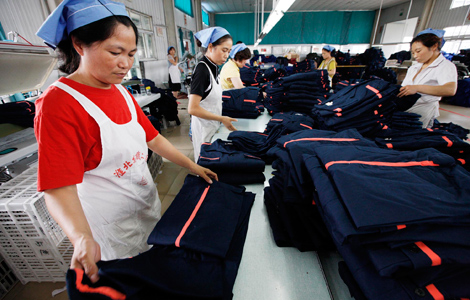
Workers at a factory in Huaibei, Anhui province, process garments for export to Southeast Asia. The newly released official PMI fell to a 29-month low.[Photo / China Daily]
Figure remains in positive terrain, indicates economy is stabilizing
BEIJING / SHANGHAI - China's official purchasing managers' index (PMI), a key gauge of manufacturing activity, fell for a fourth straight month to a 29-month low of 50.7 in July, while releasing positive signs for economic growth.
According to data released by the China Federation of Logistics and Purchasing (CFLP) on Monday, the official PMI dropped by 0.2 point from June's 50.9.
In May, it had fallen by 1.1 points from 52. A PMI of 50 or greater indicates growth and less than 50 indicates contraction.
Cai Jin, deputy director of the CFLP, said the smaller decline signals that economic growth is stabilizing and in the rest of 2011 will accelerate appropriately, after a mild slowdown.
Despite the figure's repeated declines, the better-than-expected figure and several subindices under the PMI jointly indicate a brighter picture than previous months, analysts said.
The new-orders component rose from 50.8 in June to 52.1 in July, while the finished-goods inventory dropped from 51.0 to 49.2. And prices in the industrial sector remain under pressure as the input-price component fell slightly from 56.7 to 56.3.
"Historical data show that the 'total new orders less finished goods inventory' holds some power in forecasting PMI for the month ahead," said Zhang Zhiwei, Nomura Holdings Inc's chief economist for China, in a research note. Zhang predicted that the PMI would reverse its downtrend in coming months.
"The positive signals from the PMI in July reinforce our view that China is experiencing an economic soft patch, not a hard landing," Zhang said.
Industrial production in June rebounded surprisingly despite weak PMI data in the past several months, he said, and if industrial production remains strong in July, the government is more likely to stay focused on controlling inflation rather than promoting growth.
The seasonally adjusted HSBC PMI, also released on Monday, signaled deterioration in manufacturing sector operating conditions for the first time in a year.
That figure fell to 49.3 from 50.1 in June, the lowest since March 2009, and total new order growth eased to near-stagnation amid reports of weak global demand.
"This confirms the slowing momentum of growth in the manufacturing sector against the backdrop of sustained tightening and lackluster external demand. That said, the current level of the PMI is still consistent with a 12 to 13 percent growth rate of industrial production, which leaves room for Beijing to maintain its tightening policy through the third quarter to check inflation," said Qu Hongbin, chief economist for China and co-head of Asian economic research at HSBC.
China's consumer price index, a key inflation gauge, rose 6.4 percent year-on-year in June, a three-year record high. To soak up liquidity and curb inflation, the central bank has raised interest rates three times and hiked the reserve requirement for commercial lenders six times this year.
Concerns about over-tightening economic controls have arisen as inflation remains white hot, but industrial output and the PMI showed repeated declines.
On Monday, the central bank emphasized that inflation expectation remains strong and the foundation for stabilizing prices is not yet solid enough, according to an article posted on its website.
"Once the policies loosen, the prices are likely to rebound," the central bank said. It vowed to maintain price stability as its top priority and stick to responsive, pre-emptive, and flexible macro-control policies.
It also highlighted the necessity of encouraging financial institutions to support small and medium-sized enterprises (SMEs) while controlling total credit.
Although analysts are optimistic about manufacturing messages from the new PMI figures, some SMEs in the coastal region are still having financial difficulties.