Food safety is still crucial issue in China
Updated: 2011-09-06 11:40
By Cesar Chelala (China Daily)
|
|||||||||||


The issue of food safety is very important to China, particularly in rural areas that lack control and supervision. Although the Chinese government has stepped up supervision of food and dairy products and liquor sold in rural areas at all points in the supply chain, it has to take more effective measures to ensure food safety.
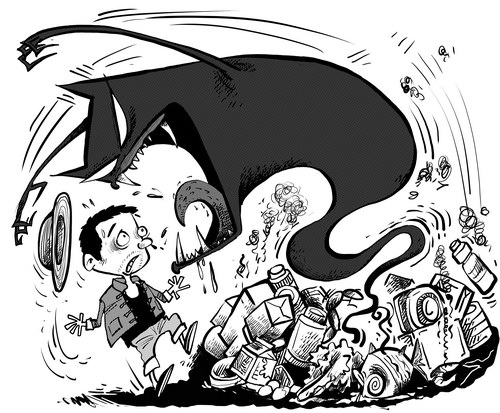 |
A large number of people fall sick because of intentional contamination of food by producers or because of careless and unsupervised practices. Some prohibited substances are added to food products to mask their poor quality, extend their shelf life or make them look more nutritious.
Almost three years after a national health scare over melamine-contaminated milk products shook China's dairy industry there has been a new wave of reports on adulterated food. Melamine is a substance used in fertilizers and plastics, and when added to food products it pretends to increase their protein content during food-quality tests. This substance, which some Chinese food producers added (and some still do) to infant milk products, chocolate and other food, could cause permanent damage to kidneys if consumed in large quantities.
Recently, there have been reports of pork adulterated with clenbuterol, a drug that can cause heart problems; rice contaminated with cadmium, a metal discharged by smelters; soy sauce laced with arsenic; noodles mixed with ink and wax; bean sprouts contaminated with an animal antibiotic; and eggs induced with chemicals, gelatin and paraffin among other adulterated food products.
Rather than diminishing, the problem of contaminated food seems to be increasing, particularly in rural areas. Why? The lure of making easy money is too tempting for many food producers. They have realized that by using additives they can increase their profit margins. The tragedy is that such food producers don't consider the serious effects that adulterated food has on consumers.
China's rapid growth in the past few decades has given rise to an estimated half a million food producers, most of whom employ 10 or fewer workers, and supervising them is difficult because they are spread throughout the country. The dearth of qualified food quality supervisors and the huge number of food producers have aggravated the situation.
Since the profits made by adulterated food can bring considerable economic benefits to local economies by increasing government income and employment opportunities, many local officials tend to turn a blind eye to such activities. To make things more complex, adulterated products are not sold in and around the places they are produced. Instead, they are transported to other areas, thus reducing the necessity and incentives of local authorities to crack down on such harmful activities.
Many adulterated food products, such as "fake" milk, are sold in rural areas making many children vulnerable to unknown health dangers. Some analysts attribute the prevalence of adulterated foods in rural areas to the low purchasing power and lower educational level of villagers, and the regulatory chasm between urban and rural areas.
For many experts, the most evident feature of China's food safety regulatory system is the fragmentation of regulatory authority among several government agencies. This is in contrast to the United States, where except for meat and poultry, which the Department of Agriculture regulates, the Food and Drug Administration is in charge of almost the entire food chain.
In 2003, in an attempt to correct this situation, the Chinese leadership created the State Food and Drug Administration (SFDA) to regulate and comprehensively supervise food products. But soon after its creation, it became evident that the new agency would face some serious criticism, particularly from other regulatory agencies. In the following years, the SFDA did not have enough authority to exercise complete supervision over food safety - and its authority remains divided among different government agencies.
The government, however, has made some progress on the issue. In 2009, China adopted a comprehensive Food Safety Law, implementing hundreds of standards of food production in line with international norms. As a result, almost half of the country's dairy food companies have been ordered to stop production after failing to meet new licensing requirements. Besides, the Ministry of Health plans to update and make public a list of legal food additives and blacklist some additives by the end of this year.
The government has to take measures to educate rural people to a level where they can distinguish between genuinely healthy food products and their contaminated varieties, and demand safe and quality products. It has to train more enforcement agents, too, because the present lot of food inspectors are not qualified enough to meet the demands.
More importantly, China's food regulating agencies have to be streamlined and their responsibilities clearly established. A clear division of duties will make Chinese citizens feel that the government is protecting their health and well-being.
The author is an international public health consultant.
Related Stories
New food safety management rules issued 2011-09-01 11:02
China arrests 2,000 suspects in food safety overhaul 2011-08-04 09:51
'Monitor food safety at the source' 2011-06-30 13:10
The dos and don’ts for food safety 2011-06-17 16:30
- Import prices of iron ore climb last week
- Firmer RMB helps curb inflation: Zoellick
- Coca-Cola to spur per capita sales in China
- Production shut down in Bohai
- China Vanke sales fall 12.6% in Aug
- Rare earth mines in E China to halt output
- August CPI likely to show slower rate of inflation
- New agency to challenge 'big three'