Agriculture faces a growing problem
Updated: 2011-10-10 09:04
By Zhou Siyu (China Daily)
|
|||||||||||


|
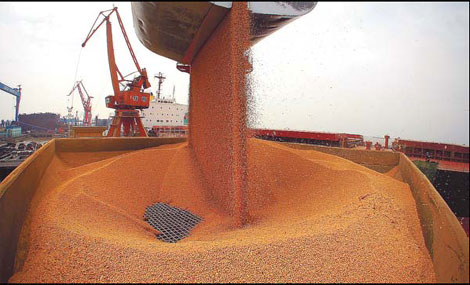
Imported soybeans being unloaded at a port in Nantong, Jiangsu province. China's accession to the WTO has brought challenges to some of its domestic sectors, such as agriculture. [Photo/China Daily] |
World Trade Organization accession is a double-edged sword for China
BEIJING - Is China's agricultural sector a threat to the nation's rapid economic growth?
That was the question posed by the late Gale Johnson, a prominent agricultural and development economist at the University of Chicago, during the closing years of 1980s.
His conclusion was that the answer was "No", which he backed up by a thorough review of China's rural development over the previous 15 years.
Twenty years later, despite the challenges arising from a closer connection with the world trade system, his answer still seems valid.
This year marks the 10th anniversary of China's entry into the World Trade Organization (WTO). During the past decade, the nation's agricultural sector has experienced stable development and has achieved increased grain production for seven consecutive years.
Accession to the WTO has brought some opportunities, said Shenggen Fan, director-general of the International Food Policy Research Institute in Washington. As China became part of the integrated global trading system, it was able to employ its connections with the international food market, so that "producers can thus specialize in the production of goods that are most suited to the country's resource endowments", Fan said.
"In China's case, the large rural labor force (relative to land area) gives the country a comparative advantage in labor-intensive agricultural production, such as fruits, vegetables, and aquatic products."
But accession to the WTO has also brought challenges. Since joining the organization, China has reduced its import tariffs on agricultural products by 72 percent. The country's current tariff is less than 25 percent of the average global level, according to data from the Ministry of Agriculture.
As the market gradually opened up, China's trade volume in agricultural products registered sharp growth. According to the ministry, the total trade volume for agricultural products shot up more than threefold to $122 billion in 2010 from $28 billion in 2001. Imports jumped to $72.6 billion in 2010 from $12 billion 10 years earlier, with a year-on-year increase of 22.3 percent over that period. In the meantime, China's exports of agricultural products jumped to $49 billion in 2010 from $16 billion in 2001, up 13.3 percent year-on-year on an annual basis.
Propelled by the booming trade volume, a trade deficit began to surface in the agricultural sector, and has been expanding rapidly over recent years. In 2010, China's trade deficit in the sector had increased to $23 billion from $4.6 billion in 2004.
Driven by growing demand, self-sufficiency rates for some products have also fallen sharply. Currently, China can only produce less than 30 percent of its annual domestic soybean consumption. Moreover, the country can only produce less than half of its annual edible oil consumption and no more than 60 percent of cotton, according to data from the Ministry of Agriculture. Many Chinese experts regard this as a result of the impact of the international market.
Analysts believed that China should further develop its agricultural processing industry to ensure food security and reinforce the nation's advantages in the international trading system. "The processing industry could cushion the impact from the global food market and secure China's food security," said Sun Licheng, a former president of North China's Jilin Agricultural University.
"Compared with the producer, processing is the part with more added-value. We can gain better control of food prices with a sophisticated processing sector, no matter who the producer is," Sun said.
To further develop the industry, the government should encourage companies to prolong the industrial chain and promote technological innovation, said Xu Xiaoqing, director of the Department for Rural Economic Development at the Development Research Center (DRC) of the State Council, a top think tank.
"Joining the WTO has formally opened up China's agricultural market. We can only rely on technologies and product quality in market competition," Xu said.
Changchun Dacheng Industrial Group Company Ltd, based in the capital city of Jilin province, is one of several companies to have undergone rapid expansion over recent years. Originally a corn processor, the company is now China's largest producer of lysine, an amino acid widely used as an additive in animal feed.
The company's success comes largely from its focus on technical innovation, through which it has transformed itself into a chemical giant with world-leading technology to turn cornfield waste into glycols. This year, the United States-based Fast Company magazine ranked Dacheng Group 46th out of the world's top 50 "most innovative" companies.
Besides the processing sector, the government should also foster some large-scale trade companies in the agricultural sector, said Xu from the DRC.
"We need some large-scale food marketers that can compete in the international market to accelerate the development of China's agricultural sector. Even some State-owned companies need more time and support for further development to become large-scale traders," said Xu.
Related Stories
China develops sustainable agriculture 2011-08-25 10:57
Promoting a 'save and grow' approach to agriculture 2011-07-01 13:16
China invests 1.84b yuan for agriculture 2011-06-06 13:33
China's agriculture sector faces rising costs in 2011 2011-04-20 09:34
- Rules tightened over banks' investment products
- China IPOs shrink 40% in Jan-Sept
- Agriculture faces a growing problem
- NAO audits China's top three steel firms
- Beijing residents think consumer prices too high
- Fuel-price drop good news
- China offers more support to economic zones in Xinjiang
- China's railway traffic sets record