| ?
|
The recent disastrous debt crisis that hit Wenzhou city, Zhejiang province, revealed a problem that is deeply rooted in China's financial market and which challenges its stability. Shadow banking, being outside State supervision, challenges the stability of China's financial market, because its inverted-pyramid financial structure could collapse at any time if there is a problem with its supporting funds.
Shadow banking has existed for a long time, but it has grown rapidly since the beginning of this year when the State tightened control of financial supply. As the tightening did not change demand, space was left for underground financing to expand. According to Japan-based Nomura Securities, the size of China's shadow financing could amount to 8.5 trillion yuan ($1.33 trillion). Liu Jigang, a researcher from ANZ bank, estimates it could even be as high as 10 trillion yuan. These estimates may not be accurate, but they nonetheless highlight the problem of shadow banking in China.
Shadow banking originated in the United States, with practitioners indefinitely expanding their credit loans by putting loans into the financial market. But it took a different form in China, where practitioners usually get loans from unofficial financial agencies like private lenders or underground banks. Both are unofficial and unsupervised.
Today shadow banking is already deeply intertwined with the US financial system, and it is now one of the main causes of risks. Credit Default Swaps (CDS) are a typical example, by changing the form of raising funds for mortgages they lowered the costs for house buyers, but introduced more bubbles into the US realty market.
In 1997, the CDS market totaled $180 billion, but it had soared to $6.2 trillion within nine years, accumulating enormous risks in the process, exemplified by the over-trading of CDS. Finally in 2008, with a fall in realty prices, the financial crisis was kindled and swept like wildfire through the US and the whole world.
Despite different practices, China's shadow banking is nonetheless also potentially dangerous and destructive. For the past 30 years, China has generally maintained a typical indirect bank-led financing system, which owes 80 to 90 percent of funds to banks in the form of loans. Within this relatively stable system, the central bank can estimate the supply of broad money (M2) and decide the size of the each year's new loans from the GDP growth rate, so as to control the amount of money loaned.
But the situation has changed with deeper financialization of the economy. Various emerging financial tools, such as agencies that raise funds through securities and insurance, have increasingly taken a larger share of the banks' role in the financial market.
None-bank loans were only 8.7 percent of the total yuan loans in 2002, but had grown to 79.7 percent in 2010. This growth in finance means the loan size is no longer an index of money supply-demand relations.
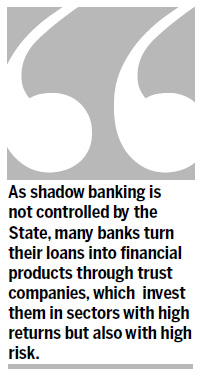
As shadow banking is not controlled by the State, many banks turn their loans into financial products through trust companies, which invest them in sectors with high returns but also with high risk.
The high returns attract more economic participants and even State-owned enterprises (SOEs) have joined the game. According to the Financial Times, several jumbo SOEs have financial platforms, while 90 percent of all loan-lending enterprises are SOEs.
The shadow banking system now has an estimated annual fund flow of 2 trillion yuan, or 5 percent of China's GDP. If it continues to grow without control and supervision, China's financing market will become increasing unstable in the near future, with possibly serious economic and social effects.
To limit the growth of shadow banking, China needs to properly deal with its relations with the official financing system. The urgent mission today is to keep a free flow of social funds within the official financing system, and to implement stricter supervision upon shadow banking, so as to solve the problem without causing grave shocks to the economy.
The author is an economic researcher with the State Information Center.


Copyright 1995 - . All rights reserved. The content (including but not limited to text, photo, multimedia information, etc) published in this site belongs to China Daily Information Co (CDIC). Without written authorization from CDIC, such content shall not be republished or used in any form. Note: Browsers with 1024*768 or higher resolution are suggested for this site.
License for publishing multimedia online 0108263 Registration Number: 130349