Gaming firms find going tough
Updated: 2011-11-21 10:01
By Chen Limin (China Daily)
|
|||||||||||


|
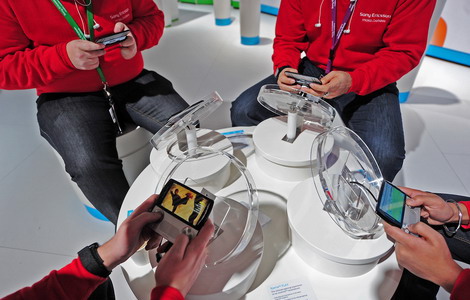 Employees demonstrate Sony Ericsson Mobile Communications' Xperia Play mobile handset at the Mobile World Congress in Barcelona, Spain. With an eye on the lucrative mobile gaming market, Chinese software companies are also developing export-oriented products for their overseas clients. [Photo / China Daily] |
Global market expected to be worth $5 billion by 2015, from $1 billion last year
BEIJING - Liu Yong is busy flying between California's Silicon Valley and Beijing these days. The chief executive officer of Rekoo Media Ltd, a major social game developer in China, hopes to try his luck on Facebook.com once again after a retreat from it two years ago.
That was a dramatic withdrawal of the company, Liu recalled. "We competed with big companies such as Zynga and Playfish head-to-head, and that was horrible," he said.
It is demanding work competing on the world's largest social networking site and, for a company that aims to go global, to do so is a tough decision.
Before Chinese social game providers step up efforts in their home market, many of them look to overseas markets because they didn't make good profits through domestic social networking platforms two or three years ago.
"We are looking to set up an office in Silicon Valley," said Liu after Rekoo, with branches in Beijing, Shenzhen, and Tokyo, gained a considerable presence in Japan. The company began to focus on the Japanese and Korean markets two years ago after it found the rising cost of getting and maintaining a presence on Facebook had erased the company's profits.
To Liu's delight, the Asian market didn't disappoint him. Two of Rekoo's games, Sunshine Farm and Sunshine Winery, had the most active daily users among all games on Mixi.jp, the largest social networking site in Japan, on Nov 15. Sometimes, the company is in the top four of the list, Liu said.
"While many of Japan's social games involve competitive plots that hardcore players like, we target more generally, and especially women players, by providing games with collaborative interaction," he said.
The company's revenues reached "tens of millions of dollars" with more than 200 percent growth last year, said Liu, declining to elaborate. About 80 percent of the revenues came from Japan, where Rekoo has 40 employees, out of a total of 500.
When the company grows bigger with more localized experience, Liu thinks it will be time to change its approach. "Social gaming is a global market. At the end of the day, you can't escape Facebook," he said.
In the same market as Liu is Wang Haining, who founded and heads another social game company, Happy Elements Ltd. Wang, however, has a different outlook in that Happy Elements has targeted Facebook since the company was established in 2009.
On Nov 15, the company climbed to seventh place among top Facebook developers, according to data tracker Appdata.com. Two years after its game Happy Fish Bowl was launched in 2009 it still has about 1.7 million daily active users. That, Wang said, is a "long life cycle for a social game", a genre that is usually developed, used, and tired of very quickly.
Going global for the past two years has left the company with important technological advantages to fend off rising competition. It has developed a global integration platform that enables a company to update different versions of a game on 15 social networking platforms across the world. With it, Happy Elements manages to reduce the cost of maintaining and updating its games. It also uses it as a worldwide channel for other developers to distribute their games globally.
"It's hard for Chinese companies to get used to international operations as they don't have the necessary DNA," Wang said when talking about the biggest challenge for companies to go global.
Happy Elements has just raised $30 million in a second round of fundraising in October. A major part of the funding will be used to hire more talent with knowledge of international operations, he added.
Following different paths, Chinese social game developers have embarked upon a long journey of going global. The worldwide social game market is expected to be worth $5 billion by 2015, from $1 billion last year, thanks to in-game advertising and virtual goods sales, according to a report by market research company Parks Associates earlier this year.
However, the cost for social games is also rising, along with fiercer competition. Liu said in 2009, to get a user on Facebook cost about 50 US cents while now it is about $3.
"Social gaming has much potential, but companies' margins are relatively low because they have to constantly spend a lot of money on marketing and research and development every time they launch a new product," said Hover Xiao, an analyst with IDC.
To fuel growth, social game providers have begun to put their home country China on the priority list. However, compared with overseas social networking platforms, Chinese ones tend to be more controlling, such as by keeping a larger part of shared revenue and developing their social games to compete with outside developers, Liu said.