Wind power on the rise
Updated: 2011-11-28 09:39
By Liu Yiyu (China Daily)
|
|||||||||||


The increasing number of variable renewable-energy systems feeding the grids poses challenges for the system's operators, who have to deal with unpredictable net-load variability and then balance the fluctuations.
LVRT was not compulsory in China until July 8, when the NEA ordered all wind farms to install the system - which costs 1 million yuan ($157,000) - by the end of this year.
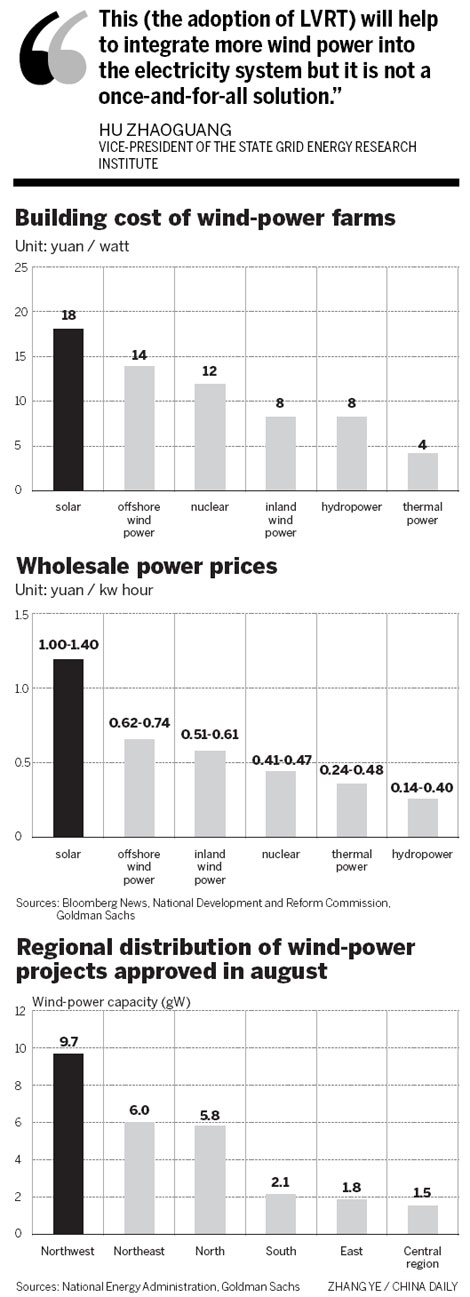
"This will help to integrate more wind power into the electricity system but it is not a once-and-for-all solution," said Hu Zhaoguang, vice-president of the State Grid Energy Research Institute.
Even with these connection-friendly characteristics, the Dongshan plant still had 20 percent of the power it generated disconnected from the grid in 2010, according to Chen Zixin, the deputy general manager of Datang (Chifeng) Renewable Power Co.
A company has to meet all the various conditions required by the State Grid in order that the energy it generates can be purchased in total, according to Chen, who added: "The construction of the grid network lags behind wind-power development."
The weak grid has been cited as the main cause of wind-power disconnections in China.
According to a report by the State Electricity Regulatory Commission (SERC), insufficient transmission capability and poor grid connections resulted in 2.8 billion kilowatt-hours remaining unused in the first six months of 2010.
The SERC report said that areas with abundant wind-power resources account for 75 percent of unconnected wind-power generation in the country because of the lag in grid construction.
China's wind-power resources are concentrated primarily in Inner Mongolia and the northwestern provinces and regions, such as the Xinjiang Uygur autonomous region and Gansu province. However, most of that energy is consumed in the heavily populated coastal areas, according to the 2010 China Wind Power Outlook published by the Global Wind Energy Council.
China's largest power distributor, State Grid, which is in charge of distribution in 26 provinces, plans to spend more than 500 billion yuan upgrading the grid during the 12th Five-Year Plan (2011-2015). That's 25 times higher than the amount the distributor spent during the period of the previous Five-Year Plan (2006-2010).
In the west of Inner Mongolia, where electricity distribution is managed separately by an independent local power distributor, the discrepancy between supply and demand is more obvious.
According to Western Inner Mongolia Grid Co (WIMG), which manages 60 percent of the power generated in the region, 42 percent of wind turbines are idle because of insufficient transmission channels.
This is partly because the power generated within the company's jurisdiction can only be exported to other provinces through transmission lines operated by State Grid.
There is little incentive for State Grid to bridge the transmission gap between its area of operations and that of WIMG, despite the fact that the latter accounts for 20 percent of national wind-power generation.
The inconsistency between the growth of the wind farms and the development of the grid network is also partly due to the lax control of approvals for wind projects.
"Local governments are authorized to approve small wind projects which could bring them direct economic benefits," said Hu of the State Grid Energy Research Institute.
On the road between Chifeng city and the remote wind farm, sit row upon row of recently constructed wind turbine factories.
The world's leading turbine companies, including Goldwind Science & Technology Co, Sinovel Wind Group Co, Gamesa Corporacion Tecnologica SA of Spain and Denmark's Vestas, have all established manufacturing bases around the large wind-farm clusters in the area.
Wind projects below 50 mW only require approval at provincial level, and it is estimated that 93 percent of China's wind farms are approved by local governments.
However, in a bid to coordinate the industry, the NEA is planning to tighten the approvals process for wind projects.
China's wind-power sector has developed too quickly, making these problems inevitable, according to Hu of the State Grid Energy Research Institute.
The country is pursuing the development of wind energy with the same determination it has exhibited in its quest for economic growth.
The national renewable and nuclear energy targets have recently been updated by the NEA. They now stand at 150 gW of installed wind capacity by 2020, along with 20 gW of solar, 380 gW of hydro and 80 gW of nuclear.
The NEA plans to increase non-fossil fuel energy to 15 percent of total primary consumption by 2020. These targets are additional to the country's goal of a reduction in energy intensity of between 40 and 45 percent by the same year.
This implies that wind-energy generation should increase by an average of 12.5 gW every year through to 2020, according to the International Energy Agency.
Apart from the issue of grid access, which has improved in the past two years, the biggest challenge for producers revolves around "softer" aspects. These include securing the human resources to support the rapid expansion of the industry and the upgrading of the existing plants in the operation, according to Hisaka Kimura, a senior investment specialist at the Asian Development Bank.