Development of China's foreign trade contributes to world economy
Updated: 2011-12-08 11:08
(China Daily)
|
|||||||||||


The development of China's foreign trade has accelerated the modernization of the national economy, enhanced the country's comprehensive strength, and improved the standard of living of more than 1.3 billion Chinese people. It has also helped integrate the Chinese economy into the world economy, and make economic globalization conducive to the common prosperity of all countries and regions.
China's reform and opening up and its active participation in economic globalization have made the country one of the world's fastest-growing economies. Over the past more than 10 years, China, along with other emerging economies, has become an increasingly important force propelling world economic growth. According to the World Bank, from 2001 to 2010, China's GDP increased by $4.6 trillion, representing 14.7 percent of the increase in the world aggregate, and the share of China's GDP in the world rose to 9.3 percent over the same period. Data from the WTO shows that from 2000 to 2009, the average annual growth rates of China's exports and imports were 17 percent and 15 percent, respectively, much higher than the 3 percent annual growth rate of world trade.
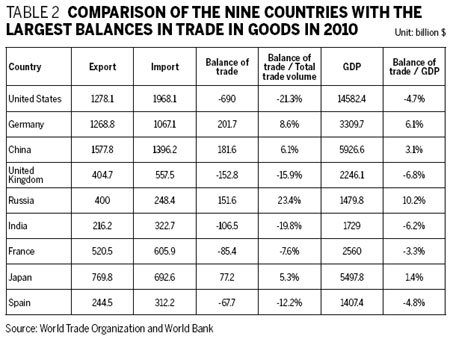
During the international financial crisis, China's foreign trade was among the first to stabilize, promoting the recovery of the world economy. After the crisis broke out in 2008, the Chinese government adopted in time a series of policies and measures to stimulate the economy, expand domestic demand and stabilize imports and exports. In 2009, global goods imports decreased by 12.8 percent, while China's goods imports increased by 2.9 percent, making it the only country to maintain growth among the world's largest economies. The China factor sustained the exports of many countries affected by the financial crisis, stimulated demand in the global commodities market, and boosted confidence, giving a new momentum to the world's economic recovery and growth. During its third review of China's trade policy, the WTO pointed out that China had played a constructive role in stimulating global demand during the international financial crisis, and had thus made significant contributions to the stability of the world economy.
The development of China's foreign trade has helped enhance the national welfare of China and its trading partners. As it accelerated its integration into the global division of labor, China has gradually developed into a major producer and exporter of industrial products relying on its labor cost advantage, relatively strong industrial supporting, processing and manufacturing capabilities, and increasing labor productivity. It provides inexpensive and quality commodities to meet the diverse demands of the international market. China's advantage due to economies of scale and low processing costs in the global manufacturing industry partially offsets the rising prices of upstream factors of production, playing an important role in curbing global inflation and raising the real purchasing power of consumers of its trading partners.
The development of China's foreign trade has provided a broad market for its trading partners. Since 2001, China's import of goods has increased by approximately five times, representing an annual growth rate of around 20 percent. China's rapidly expanding imports have become a major driving force for global economic growth, creating an enormous market for its trading partners to augment their exports. At present, China is the largest export market for Japan, Republic of Korea, Australia, ASEAN, Brazil and South Africa, the second largest for the EU, and the third largest for the US and India. As China's industrialization and urbanization are moving forward rapidly, and its domestic demand keeps growing, the country's continuously expanding and opening market will offer increasing opportunities to its trading partners.
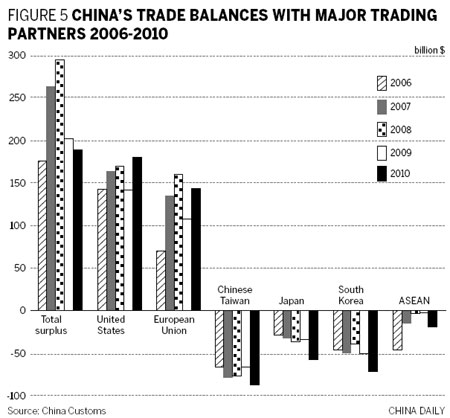
Meanwhile, China is one of the developing countries granting the biggest market access to the least-developed countries (LDCs). By July 2010, China had granted zero-tariff treatment to over 4,700 commodities from 36 LDCs which had established diplomatic ties with China. The zero-tariff commodities accounted for 60 percent of the total imports from those countries. China has promised to continue expanding its preferential treatment to the LDCs having diplomatic ties with China until the zero-tariff commodities reach 97 percent of the total imports from those countries. The zero-tariff measure has helped increase the exports of LDCs to China. Since 2008, China has been the largest export market for LDCs. In 2010, China's import of goods from LDCs accounted for approximately one quarter of those countries' total exports, an increase of 58 percent over the previous year.
China has participated in and helped push forward the reform of the global economic governance mechanism. The Chinese government actively advocates a "balanced, inclusive and mutually beneficial" multilateral trade system, and strives to establish a fair and equitable new international economic and trade order. As a large developing country with a rapidly growing economy, China plays an active role in the G20 and BRICs summits, Doha Round talks, and other international dialogue and cooperation mechanisms. China does its best to assume international responsibilities that suit its development level and strength. China continuously consolidates its cooperation with emerging countries in the fields of economy, finance, trade and investment, and works toward an equitable and rational international economic order that benefits all countries.
In addition, China strictly fulfills its international obligations regarding export controls. It consistently advocates the complete prohibition and thorough dismantling of all weapons of mass destruction, and firmly opposes the proliferation of such weapons and their carriers. China's relevant laws clearly prescribe that the state may take necessary measures to restrict the import and export of goods and technologies relating to fissionable materials or the materials from which they are derived, as well as the import and export relating to arms, ammunition or other military supplies. China earnestly abides by international conventions regarding export controls, and fulfills its non-proliferation commitments, actively contributing to world peace and regional stability. Over the past few years, the Chinese government has adopted a wide range of internationally recognized norms and practices, and formed a complete export control system covering nuclear, biological, chemical, missile and other sensitive items and technologies, providing legal grounds and institutional guarantees for the better realization of the goal of non-proliferation.